How Good Is English in Japan, Really?
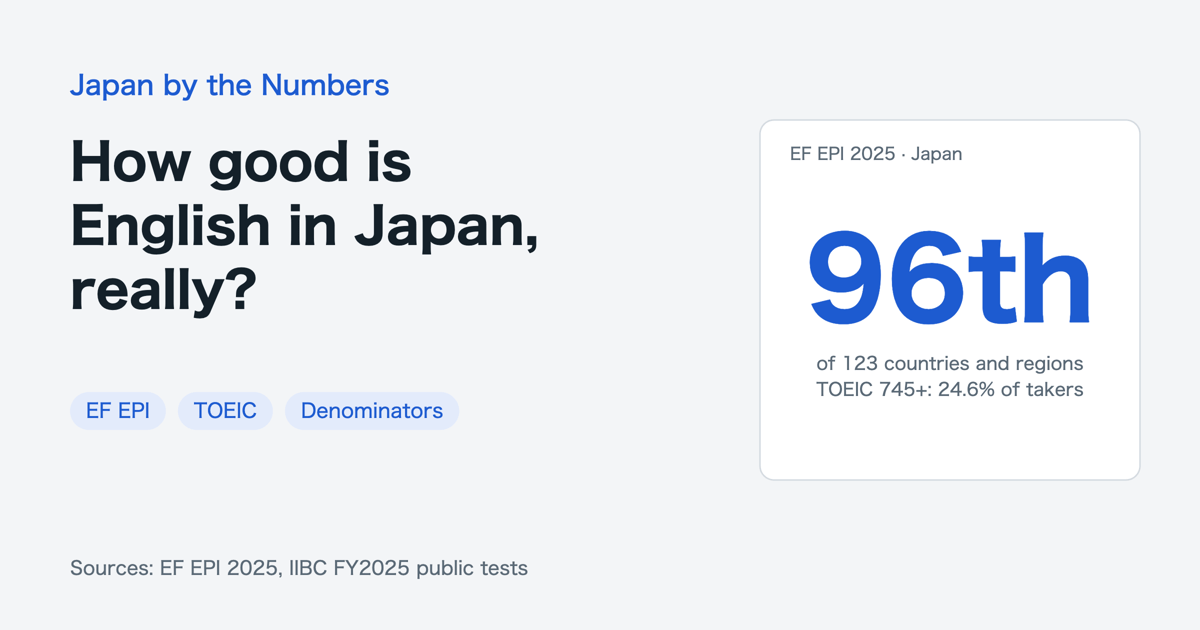
The idea that Japanese people struggle with English is widespread, and the numbers seem to back it up. In the 2025 EF English Proficiency Index, Japan ranks 96th of 123 countries and regions, in the lowest of five bands, "very low". Yet another set of numbers tells a different story. The average score on the public TOEIC test in Japan in FY2025 was 616, and one in four test takers scored 745 or higher.
One says very low. The other says a quarter of people get by. Neither number is wrong. They are measuring different people.
Who each number measures
EF EPI data comes from EF's own free online tests, taken by about 2.2 million people worldwide. There is no sampling design: the sample is whoever chose to spend time on an English test. EF is also a company that sells English courses, which is worth keeping in mind when reading the ranking.
TOEIC data comes from public test sessions run by IIBC, the organizer in Japan: 755,000 sittings in FY2025. The test costs money, and many people take it because an employer, a school or a job search asks for a score. Working adults accounted for 308,000 sittings with an average of 649; students for 434,000 with an average of 592.
Both are samples of people who chose to be tested. Japan has 68.28 million people in employment, and the working adults who sit the public TOEIC in a year are less than 0.5% of that, with some sitting it several times. Neither 96th place nor an average of 616 can be read directly as the English level of the Japanese workplace.
Fig. 1Score distribution for the TOEIC Listening and Reading public test in Japan, FY2025. 9.2% scored 845 or higher and 24.6% scored 745 or higher. This is the distribution of test takers, not of the population.
The weak skill is speaking, not reading
Fig. 2Japan in EF EPI 2025 by skill: reading 454, listening 437, writing 394, speaking 393. Reading and speaking are 60 points apart.
From the 2025 edition, EF scores speaking and writing with AI. Japan scores 454 for reading and 393 for speaking. The version of TOEIC most employers ask for tests only listening and reading. The score most often used as a hiring filter does not measure the weakest skill at all.
There is a regional gap too: 478 for the Kanto region against 436 for Chugoku, the lowest. Tokyo scores 480, at the high end within Japan.
Multiply three requirements and the pool disappears
In A talent map is not a list I wrote about multiplication: every requirement you add multiplies the pool by a fraction. Language is the requirement most easily multiplied in one time too many.
Take a hypothetical. A role has 10,000 experienced people in Tokyo. Perhaps one in ten can run a meeting and write documents in English, leaving 1,000. Require native-level Japanese and you lose more. Add industry experience, years in role and timing, and you may be down to a few dozen people you can actually reach. Every ratio here is an assumption, but the structure of the multiplication is real.
I have run into this myself. A search for a bilingual product manager went six months without a fit. When we went back to the requirements and relaxed native-level Japanese, the role was filled in a month. The job had not changed. Only the definition of what was mandatory had.
Decide which language is mandatory first
I would start with one question: in which language does this person get most of the day's work done?
- Mostly Japanese clients and a Japanese team: Japanese is mandatory. English can be written as able to handle email and join headquarters calls.
- Mostly overseas headquarters or a multinational team: English is mandatory. Japanese can be written as able to work day to day with Japanese colleagues.
- Both carry equal weight: accept that this is a scarce profile and plan budget and time for scarcity, or consider splitting it into two roles.
Also, do not screen speaking-heavy roles with a TOEIC score. It measures listening and reading. If you want to know whether someone can run a meeting in English, spend 20 to 30 minutes of the interview in English. How hard the role itself is to fill in Japan can be checked first in job openings ratios by occupation.
First, neither source publishes its sample size for Japan. EF's sample leans toward people already studying English, and its ranking changes mix in the effect of more countries joining: Japan was 14th in the first edition in 2011.
Second, the TOEIC distribution counts sittings, so people who take the test several times a year are counted more than once.
Third, the multiplication above is hypothetical. Real ratios vary a lot by occupation and need to be drawn role by role.
That line in your current job description, fluent English and native Japanese: are both really mandatory?
Sources
- EF EPI 2025, Japan fact sheet (Japanese): scores by skill and region
- EF EPI 2025 release (Japanese): 123 countries and regions, about 2.2 million test takers, Japan 96th with 446
- nippon.com (Japanese): Japan 96th, very low band, 14th in 2011
- IIBC, TOEIC Program Data and Analysis 2026: FY2025 Listening and Reading public test sittings, averages and score distribution
- Statistics Bureau of Japan, Labour Force Survey 2025 average: 68.28 million employed
Shorter notes that don't make it into a full article go on LinkedIn. Follow me there.