Does Monitoring Raise Performance? Data on 23,461 People
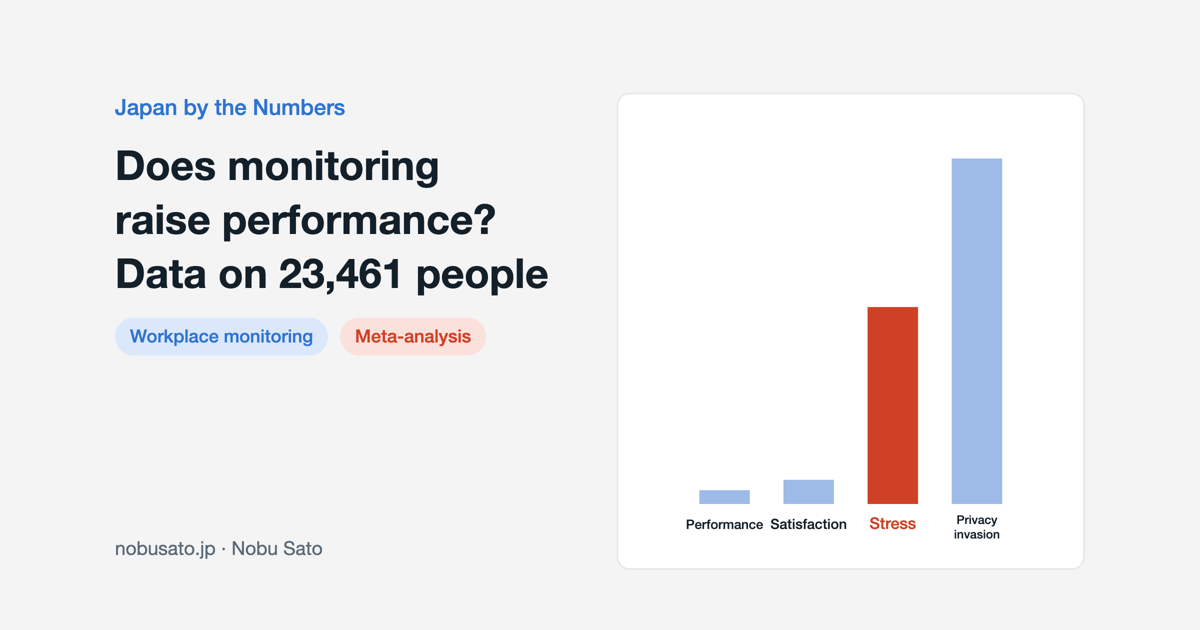
If your head office wants screen and keystroke tracking on the Japan team, show them one number first. Across 23,461 people, the correlation between being electronically monitored and performance was −0.01. Stress went up instead.
The request usually sounds reasonable. HQ is in another time zone, the Japan entity is small, and nobody abroad can see what happens in the Tokyo office. Screenshots every ten minutes, active-window logs, keystroke counts. If we can see it, we can manage it. I understand the instinct. The research just doesn't back it.
Inside the meta-analysis
The study is Ravid, White, Tomczak, Miles and Behrend, "A meta-analysis of the effects of electronic performance monitoring on work outcomes," published in Personnel Psychology, volume 76 (2023; online in 2022). It pools earlier studies on electronic performance monitoring (EPM), which the authors define as using technology to observe, record and analyze information related to someone's job performance.
The pool is large for this field: 94 independent samples from 79 sources, 23,461 people in total. Knowable Magazine brought it back into the conversation in August 2026, in a piece on how AI and tracking software are giving employers more ways to watch staff. I read the paper itself to check the figures below.
Performance barely moved
Compare monitored with unmonitored conditions and the correlation with broad performance is −0.01 (41 samples, 5,804 people). For task performance it was 0.00 (28 samples). Both confidence intervals straddle zero. Speed and quantity alone: −0.01. Accuracy came out at +0.07, with the lower bound sitting right at zero.
The authors put it plainly in the abstract: their results provide no evidence that EPM improves worker performance. There's no evidence it hurts performance either. On output, monitoring mostly does nothing.
What moved instead
Stress. Being monitored correlated with stress and strain at 0.16 (23 samples, 5,022 people), with an interval of 0.13 to 0.20, clearly away from zero. The sense of privacy being invaded came in at 0.28. A broad measure of attitudes toward the job dipped to −0.11.
A correlation of 0.16 is small. Monitored people were a bit more stressed. Nothing dramatic. But if the benefit side reads zero and the cost side reads slightly positive, you have already lost the business case.
One number people tend to overstate: job satisfaction on its own was −0.02 (14 samples), essentially flat. "Monitoring kills satisfaction" is more than this paper shows.
Fig.1Under monitoring, broad performance (ρ = −0.01) and task performance (0.00) barely moved, while stress and strain rose (0.16) and felt privacy invasion was higher (0.28). Job satisfaction was flat (−0.02). Source: Ravid et al. (2023), Personnel Psychology meta-analysis, presence analysis (Table 2).
Transparent or invasive
The way you monitor seems to matter more than whether you do. Among monitored workers, the more transparent the system (people know what is tracked, why, and how the data will be used), the better the attitudes: +0.26 with job satisfaction and +0.37 with feeling supported by the organization. The more invasive the system, the worse things looked: attitudes −0.17, stress +0.20, and even performance −0.13.
The paper also splits monitoring by purpose: development, administration and safety, performance evaluation, and plain surveillance. Here the authors found no statistically significant differences between purposes. Monitoring used for evaluation showed worse attitudes (−0.23), which is worth noticing, but "it's fine if it's for development" isn't a conclusion the data supports yet.
What the numbers don't tell you
Of the 59 samples in the monitored-versus-unmonitored analysis, 36 were lab studies and 23 were field studies. The authors themselves say it's unclear how well simulation results match the reactions of people monitored in real jobs. Their literature search ended in February 2021, so I'd assume the newest AI tools that score call tone or flag idle time are barely represented. That's my inference from the search dates, not something the paper says.
Nor is this a study of Japanese workplaces. How a Tokyo team reacts to remote tracking from an overseas HQ is a question the paper can't answer. What follows is my reading.
What I'd put on the table instead
When HQ says it can't see the Japan team, I find the worry usually splits into two questions. Is this person right for this role? Is the work we asked for actually moving?
The first is a hiring and placement question. It gets easier once the role has been defined and scored before anyone looks at a person, which I wrote about in score the role before the person. No tracking tool fixes a mismatch between a person and a seat.
The second is answered by outputs and dates. What shipped this week, what slipped, and why. A weekly list like that tells you more than any keystroke count, and it's something a Japanese manager can produce without feeling watched.
Then there's bad news. A team that gets punished for reporting delays will report them later, and heavier logging tends to make that worse. What fixes it is the relationship around the report, as in making it safe to bring bad news. Many of the habits HQs bring to a young Japan entity come from running a large, mature organization at home. I have argued that a startup entity shouldn't be run like head office, and monitoring is one more example.
If you still want to measure something, say up front what you track, why, and who reads it. In this paper, transparency was the one condition where attitudes clearly moved in the right direction.
Before asking for a quote from a monitoring vendor, sit down with your Japan country manager and write one page: what has to be delivered this quarter for the entity to count as on track. If that page is hard to write, the logs won't help, because there's nothing to read them against.
Sources
- Ravid, White, Tomczak, Miles & Behrend, A meta-analysis of the effects of electronic performance monitoring on work outcomes, Personnel Psychology 76(1), 5–40 (2023): K=94, N=23,461; performance ρ=−0.01; stress ρ=0.16
- Knowable Magazine, Your boss is watching you (August 31, 2026): interviews with Ravid and other researchers
Shorter notes that don't make it into a full article go on LinkedIn. Follow me there.