Glossary: The Terms I Use for Hiring and Org Design in Japan
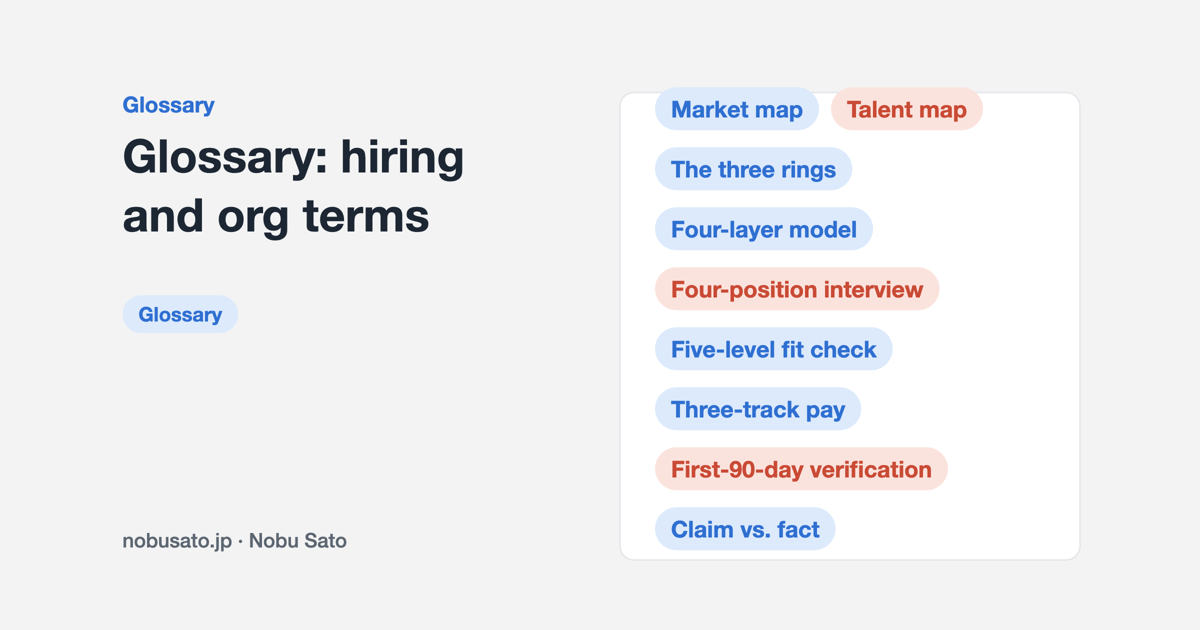
When I write "talent map" or "four layers" in an article, I mean something specific, and I use each term the same way every time. These are the working terms I rely on when I talk about hiring and building organizations in Japan. Each entry gives a plain definition, a few lines on how the term is used and where people go wrong, and links to the articles that work it through.
Market map
A market map is a list of the companies that matter to your decision in one market, with a written reason next to each name explaining why it is there. It answers who is in this market, who is competing with you, and how they actually operate. A company earns a place for one of three reasons: it competes with you for the same people (talent overlap), for the same customers (business threat), or it holds a channel or a license you need (access control). A competitor list ranked by fame is an encyclopedia. It looks thorough and decides nothing.
Read more: Picking the wrong competitors is worse than having none, Pick your next company with a market map, SMEs are 99% of Japanese companies. Decide who you're selling to first.
Talent map
A talent map takes the companies on the market map and shows which of their functions overlap with the person you need, where the key people sit, and what the market pays them. The question it really answers is which requirement to relax first when you can't fill the role. Requirements multiply rather than add up: each extra one shrinks the candidate pool by a proportion, so a reasonable-looking job description can describe almost nobody. The market map and the talent map belong to no single strategy. They are the shared base of facts for every judgment that follows. The market map settles who is in the game, the talent map settles who could come, and the composition of the team settles where those people go.
Read more: A talent map is not a list. Here's the question it answers, Audi's First Year in F1, Read Through Org Design and Talent Mapping.
The three rings
The three rings sort the companies on a talent map by their distance from the target domain: the same field (first ring), an adjacent field (second ring) and a distant field (third ring). For behavior-driven roles, I define the second ring by what people do all day. The industry they happen to work in matters less. Most recruiters' calls stop at the first ring. A common mistake is to draw the second ring by industry, which leaves out the people who already do the work every day.
Read more: Which circle of the talent map are you in?, A talent map is not a list. Here's the question it answers.
Four-layer model: core, patterns, equipment, context
The four-layer model reads a person, and an organization, through the same four layers: core, patterns, equipment and context. Core is drive, deep traits and the values a person won't cross; it is used to veto. You learn it from why someone actually left and joined their last few jobs, never from asking what they value. Patterns are how they behave under pressure, how they learn in unfamiliar territory and how they think; they set the ceiling, and you test it by walking through one real failure and asking what they did at the time. Equipment is ability, experience and skills, which can be trained or replaced, and which traditional interviews weight too heavily. Context belongs to the person-plus-environment, so the same person can perform very differently under another boss or team, and what an organization diagnosis finds about how a company really decides becomes the context input when you assess a person.
Read more: Before you change jobs, do a four-layer self-portrait, Why exit surveys never tell you why people left, After AI, which layer of you loses value first?
Four-position interview
A four-position interview is a way of collecting evidence, instead of adjectives, by moving the candidate through four positions on every question: the conditions at the time, the trade-offs they made, the action they took, and the result along with what it cost. Skip the first and last positions and what you get is a rehearsed success story. When you ask about a failure, you want what they did then. The lesson they drew later is mostly polish.
Read more: After the resume screen: what I look for in an interview, Telling failure as evidence.
Five-level fit check
The five-level fit check is how I judge a person against a role without a weighted average: check for veto items first, then look at the weakest layer, then give one of five verdicts: strong fit, fit, average, poor fit, or strong mismatch. A candidate who is strong on three layers and broken on one can still post a decent average score. After they join, the trouble usually comes from the broken layer. Candidates can run the same check in reverse on an offer they are holding.
Read more: Run a Five-Level Check on Your Job Offer, After a rejection, read which layer you got stuck on.
Three-track pay
Three-track pay designs compensation as separate tracks: grade sets base pay, responsibility modules set the role-based allowance, and results set the bonus. Every rule should state when it stops applying. An allowance with no expiry condition, once paid, is very hard to take back. On the candidate side, split an offer's total into the three tracks and compare the floors; two offers at ¥8 million can differ twofold in risk.
Read more: Read your offer in three tracks, Four kinds of relationships, and why pay design goes wrong.
First-90-day verification
First-90-day verification means handing the hiring manager, before the hire is made, a short list of what must be verified in the new person's first 90 days, then looking back at day 90 to see whether the hiring judgment was right. Its real purpose is calibration: without the look-back, nobody learns whether the interview read people well. Candidates can run their own version. Write down the promises you heard before joining (scope, budget, headcount, pay review) and check them at 30, 60 and 90 days.
Read more: Your First 90 Days in Japan: Check What You Were Promised, When your boss changes: the first 90 days are an interview.
Claim vs. fact
Claim vs. fact is my evidence rule: use only information that can be checked, mark every item with its source and date, and write "not disclosed" where nothing can be found, without filling the gap by inference. A number a company reports about itself, such as user count or team size, is recorded as a claim even when it sits on the official website. It becomes a fact when an actual event or an independent source backs it up. When the same company says two different things in two places, flag the conflict.
Read more: Why you can't find most Japanese companies' financials, One Company, Four Female Manager Ratios.
Shorter thoughts go on LinkedIn.