Run a Five-Level Check on Your Job Offer
The company spent weeks scoring you before it made the offer. You can score the offer back with the same method, and in Japan you should, because the paperwork tells you more than most candidates read.
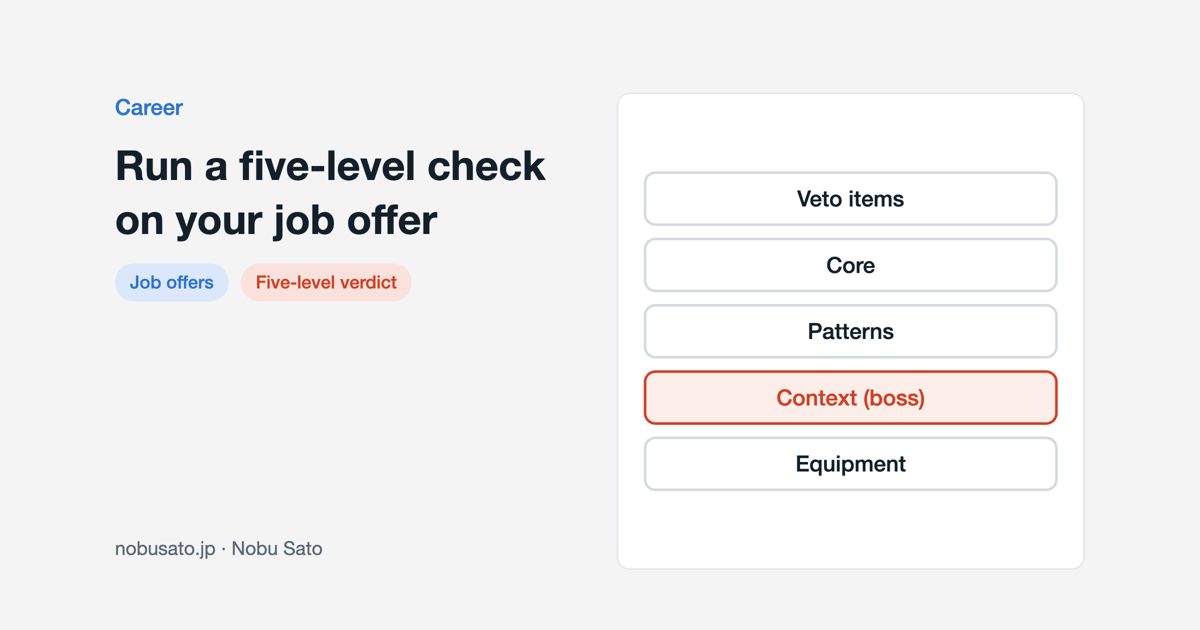
When I assess a person against a role, I use a five-level verdict: strong fit, fit, neutral, poor fit, no fit. First I check veto items. If one is hit, the answer is no fit, whatever else is good. If none is hit, the weakest layer sets the verdict. I never average. Turn that around and it works on an offer letter just as well.
Why use a hiring model on your own offer?
Because the logic runs both ways. The company asks whether your core, patterns, equipment and context fit the role. You can ask whether the role's boss, content, pay structure and company stage fit you.
That needs a picture of yourself first. I wrote about drawing one in a four-layer self-portrait before changing jobs. Without it, an offer shrinks to two numbers: salary and company name.
When I moved from engineering into HR, the whole interview tested one thing. With no HR experience, could my existing capabilities carry the role? Looking back, I didn't walk in with a question that sharp of my own.
Step one: check your veto items
A veto item is a condition that makes the offer a no fit on its own. For a candidate it usually looks like one of these.
Something in your core the role can never give. Say you need to make real decisions, and the Japan role you've been offered has every decision sitting at a regional HQ. A big title won't change that after you join.
A boss red flag. The hiring manager blames the previous person in the seat. Or ignores your questions and keeps talking about himself. I often see these signs get stronger after someone joins. Your day-to-day is mostly your boss, which is why I argue you should choose the boss, not the company.
A relocation (転勤, tenkin) clause you can't live with. If your partner's job or your kids' school ties you to Tokyo, "transfers to any branch nationwide" is not something a higher salary cancels out.
Keep the list short. If you have five veto items, you have a wish list.
Step two: build the job side in four layers
If nothing is vetoed, score the job in four layers, each on the five levels. Use what you actually heard in interviews. The job ad is the weakest evidence you have.
Boss and team. This faces your patterns: how you behave under pressure, against what this person rewards. Are you even sure which interviewer will be your direct manager? It's often unclear, more often than you'd expect.
Role content. This faces your equipment. The best evidence is the answer to "what do you need from me in the first three months?" A specific answer means the role exists. A vague one means you'll be defining it.
Pay structure. The total matters less than the shape. How much is grade-based base pay, how much is tied to responsibilities, how much is bonus on results, and who decides each part. In Japan, check whether fixed overtime pay (固定残業代) is folded into the monthly number.
Company stage. This faces your context layer. Building from zero, scaling, or defending? The same title means a very different first year in each.
Fig.1With no veto item hit, the weakest of the four layers (here, pay structure) sets the verdict. Three strong layers do not average it up to a fit.
Why does the weakest layer decide?
Because that's where the dissatisfaction leaks out later. Great work, good boss, growing company. If pay is decided in a way nobody can explain, you'll be back to that issue at every review.
Strong layers rarely cancel a weak one. They just make it easier to ignore on the night you get the call.
This is the mirror of how I read a rejection. When a company turns someone down, it's usually a veto item or a weakest layer. Same logic, other direction.
If your weakest layer is neutral, the offer is neutral. You can still take it. Plenty of good moves are neutral on paper. Just take it knowing that.
What to ask for before you sign
Any layer you can't score is a question to ask now. The window between offer and signature is one of the few times a candidate has leverage to ask.
Ask for the written terms first: the 労働条件通知書 (notice of working conditions) or the employment contract. Japan's Ministry of Health, Labour and Welfare (MHLW) amended the Enforcement Regulations of the Labor Standards Act from April 1, 2024. Employers must now state, for every worker at hiring, not only the initial workplace and duties but also their "scope of change". The MHLW's guidance defines that scope as how far they may change during the contract, including expected future reassignments. Job ads are expected to show it too. That's as of October 2026; the MHLW page on the 2024 rule change (Japanese) has the details.
So read those two fields. "On hire: Tokyo head office. Scope of change: head office and all branches in Japan" means relocation is allowed on paper. If that touches a veto item, ask how often transfers actually happen and how they handle your consent. I wrote about whether you can refuse a transfer in Japan separately. This is general information, not legal advice. For your own case, a Labour Standards Inspection Office consultation corner or a lawyer is the right place.
Then the pay breakdown. Base, allowances, how the bonus is set, whether fixed overtime is included. Two offers with the same total can grow very differently over three years.
Then one more conversation with your future boss. The interviews were the company looking at you. Now you look at them. What happened to the last person in this role? What do they expect in the first six months? How they answer tells you as much as what they say.
The check has a weak spot. A candidate scores with far less data than a company does. The company has your CV, several interviews, often references. You have a few hours of conversation, a job ad and a notice of terms. You can get the weakest layer wrong.
And if you have to leave your current job, the weakest-layer rule may feel too strict. I'd still run it. It tells you what to fix first once you're in.
Write your veto items down before you open the offer letter. Once a number is in front of you, the list tends to get shorter.
Shorter notes that don't make it into a full article go on LinkedIn. Follow me there.