Why recruiters in Japan don't reply to you
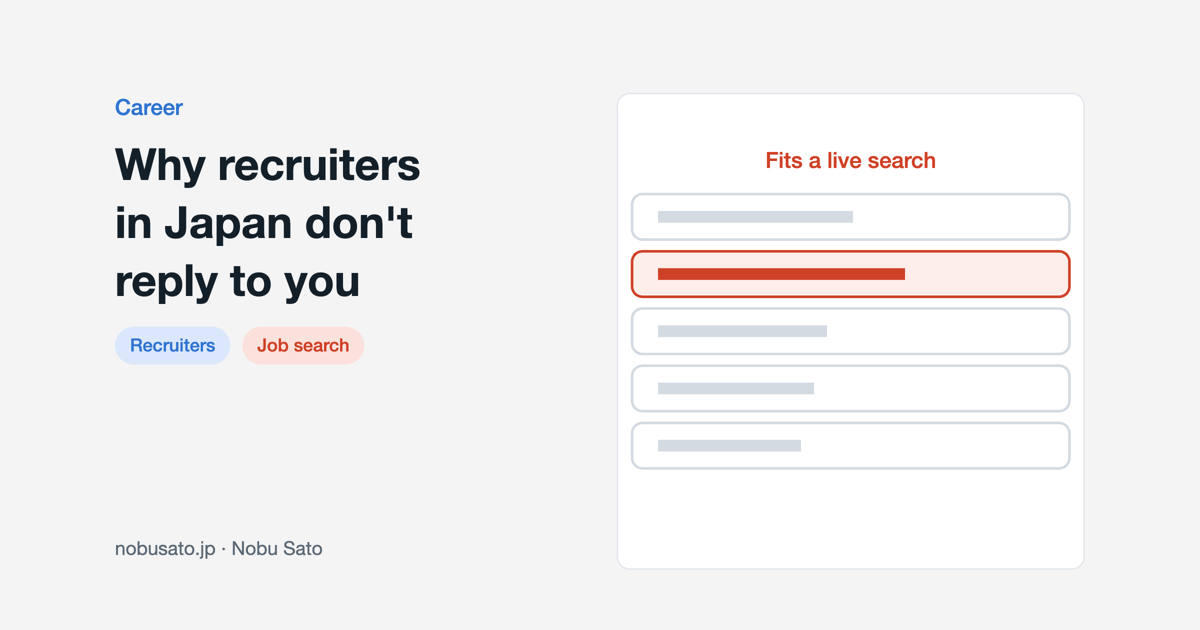
A recruiter in Japan who doesn't reply is usually telling you more about their open roles this week than about you. They are paid by the hiring company, only when someone is placed, so their time goes to the people who fit a live search right now.
I spent years hiring through agencies as an in-house recruiter and later as HR head at several companies in Japan. I also worked as an RPO recruiter, running hiring on behalf of client companies, so I've seen it from the hiring side and from the service side. Foreign professionals here often take the silence personally. Knowing how the business works makes it easier to stop guessing.
Who pays the recruiter?
The employer pays. You don't.
This is written into law. Under Japan's Employment Security Act, a fee-charging placement agency generally cannot charge job seekers. The exceptions are narrow: entertainers, models, and managers, scientists or skilled specialists whose new job pays over 7 million yen a year (Ishikawa Labour Bureau, MHLW, as of October 2026). On the employer side, most agencies charge under a fee schedule they file with the Minister of Health, Labour and Welfare.
In practice, the fee is a percentage of the hire's expected first-year pay, which Japanese contracts call theoretical annual income. The industry norm is around 30 to 35%. Recruit Agent, one of the largest agencies, describes 35% as the common setting in its 2026 guide for employers (Recruit Agent).
The national totals show how big this is. In the Ministry of Health, Labour and Welfare's preliminary report for fiscal 2024, fee-charging agencies made 888,993 permanent placements and earned about 913.6 billion yen in fees on them (MHLW, published March 2026). Dividing one by the other (my own calculation) gives an average of roughly 1.03 million yen per placement, across every level and job type.
So a recruiter's day is a sorting exercise. Who could close this quarter? Everyone else waits.
Why do recruiters go quiet?
Most often, because they have nothing that fits you today.
I think about hiring as a talent map, not a list. A company looks first at people doing the same job in the same field, then at adjacent fields, and only then further out. Recruiters work from the same map, one search at a time. If you sit in the inner circle of a live search, you get a call the same day. If you're in the outer circle, you get a polite delay, or nothing.
The map moves. I once spent six months searching for a bilingual English and Japanese IT project manager on a limited budget. When we dropped the native-level Japanese requirement, we hired within a month. One changed requirement, and a different set of people became the inner circle. Silence today can mean something quite different in six months.
There's also a capacity point. The same MHLW report counts 30,561 fee-charging agency offices that filed reports for fiscal 2024. Only 13,946 of them placed anyone that year. Japan has a very long tail of small agencies, and some of the silence is simply a small shop with too many inboxes.
Contingency agencies and search firms are different jobs
If you've worked in London or New York, you know this split already. It matters in Tokyo too.
A contingency agency (jinzai shokai) matches registered candidates to open roles and gets paid on placement. Several agencies often work the same role at once, so speed matters to them. A retained or executive search firm is hired for one specific position, usually with money paid upfront, and maps the market to approach people directly.
That changes what contact means. A search consultant calling you means you're on a target list for a real mandate. Sending your CV to a search firm unprompted rarely starts anything, because they start from the client's brief and go looking. A contingency recruiter, on the other hand, will happily take your CV and may still never call, if nothing fits.
Who gets placed first
Recruiters prioritize people who won't cause surprises after they've been put forward.
The candidates who tend to move smoothly have a few things in common. Their current pay was clear and broken down: base, bonus, overtime, allowances, and for foreign-company staff, any equity or relocation support. Their constraints were stated early: location, remote days, minimum salary, notice period, and visa status if it affects the start date. They were honest about other processes. And they answered within a day or two.
You'll notice talent barely comes into it. Each of these makes you easier to predict. A recruiter who knows your numbers can check fit in five minutes, instead of finding out at the offer stage that the gap is 3 million yen.
What gets you dropped
Unclear motives come first. If your reason for moving changes each time you talk, the recruiter can't pitch you to a hiring manager, who will ask exactly that question.
Ghosting is next. Going silent after a first interview costs the recruiter credibility with the client. They remember.
The one that surprises foreigners most is double submission: applying to the same company through two agencies, or through an agency and directly. In Japan this is handled strictly. The company gets your name twice, has to work out which agency introduced you, and may set your application aside to avoid a fee dispute. To an HR team, it can look like the candidate isn't tracking their own search. Keep a simple sheet of where you've been submitted, by whom, and when.
A five-line message that gets answered
Busy recruiters skim. A shape like this is easy to act on.
Line one: current role and years. ("Engineering manager at a payments company, 3 years, team of 8.")
Line two: current total pay, broken down.
Line three: two non-negotiables, at most.
Line four: when you could move, and what other processes you're in.
Line five: which of their roles or sectors you're interested in.
Line five does the work. "Open to opportunities" gives them nothing to match. "Interested in the fintech product roles you posted" lets them place you on their map in seconds. Send the CV after they reply.
One limit on all of this: how recruiters rank candidates internally varies a lot by firm. A firm that rewards volume behaves differently from one that rewards fee size, and I've only seen a slice of the market. I also haven't found a reliable figure for how much of Japan's market is retained search versus contingency, so I won't guess.
If you want to read silence more precisely, work out which circle of the talent map you're in before you write to anyone. Then judge each recruiter on two points only: whether they have a search where you're near the center, and whether your message made that obvious.
Shorter notes that don't make it into a full article go on LinkedIn. Follow me there.