After a rejection, read which layer you got stuck on
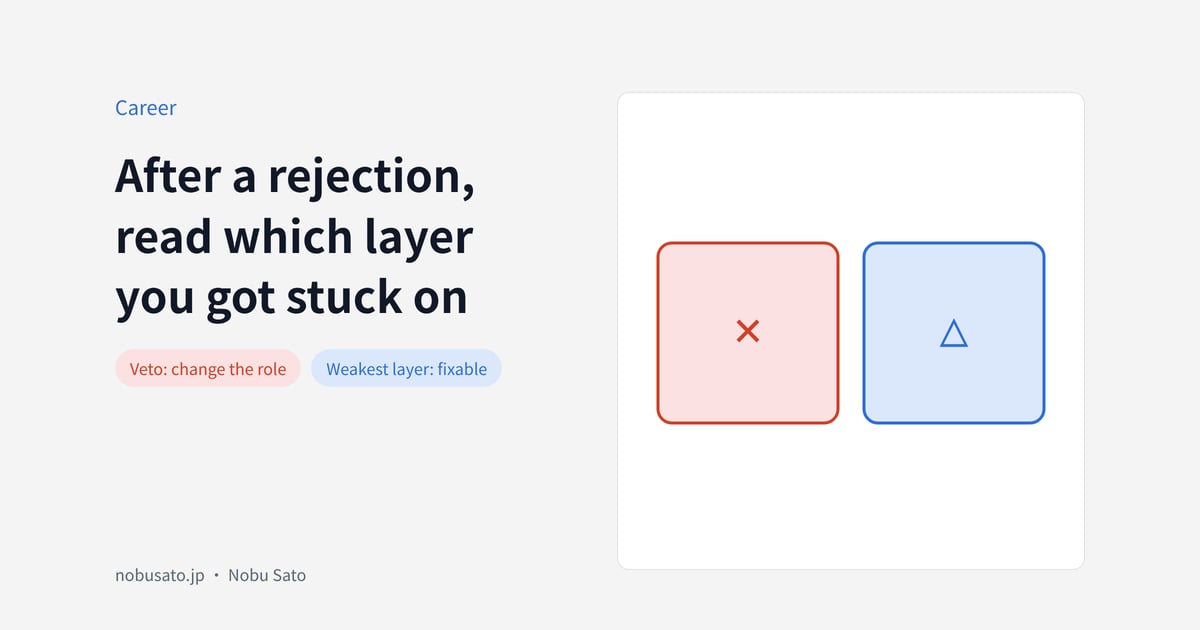
The interview ends, and a few days later the polite rejection arrives. Most people react one of two ways: blame themselves or blame the company. Neither helps, because neither tells you where you got stuck.
Two kinds of rejection, two completely different fixes
When I judge fit between a person and a role, I don't take a weighted average. First I check the veto items. Then I look at the weakest layer. Rejections split the same way.
Kind one: you hit a veto item. Your drivers don't match the role, your values clash with the company's, or one of your under-pressure patterns resonates with a risk the team already has. Interviewers usually decide this in the first twenty minutes; the rest is procedure.
Kind two: no veto, but your weakest layer fell short. Usually the equipment layer: a capability one notch below what the role needs, or a key experience you were present for rather than responsible for.
Fig.1Two kinds of rejection. Decide which first, then whether and where to fix.
Kind one can't be fixed, and shouldn't be. Bending your drivers to suit a role gets you in and then out again. The fix is a different role, which is what the four-layer self-portrait is for. Kind two can be fixed, and the direction is specific.
How to tell
Read the interview itself.
The interview ends early, questions suddenly get shallow, the interviewer starts chatting instead of probing: that's kind one. They've decided you don't fit and are closing politely.
The interviewer keeps pressing on one topic, asks for a second example, a third, and then the topic disappears: that's kind two. They were looking for evidence and didn't find it. That topic is your weakest layer.
The other way is to ask. Japanese companies won't tell you the reason. Recruiters will. If you went through a recruiter, after a rejection always ask where the client got stuck. The recruiter knows, and most will tell you, because they want to put you forward again.
Fixing kind two
If it's a capability notch: I score 0 to 3, where 1 is needs pushing, 2 delivers independently, 3 leads others. If the role needs 2 and you're at 1, find one chance to deliver something end to end on your own. Three to six months.
If it's experience you were present for rather than responsible for: next time, tell the part you did, however small. "I owned X on that project" is worth ten times "I was on that project." Telling failure as evidence is the same principle.
Where I'm not sure
Some rejections have nothing to do with you: the role was frozen, someone internal got it, the budget was cut. You can't read those from the interview. Only the recruiter can tell you.
Your last rejection: which kind was it?
Shorter notes that don't make it into a full article go on LinkedIn. Follow me there.