After AI, which layer of you loses value first?
The part of you that loses value first after AI is the part you can write on a resume. The parts that only show up under pressure are gaining.
I once interviewed a candidate with a packed resume. Owned this, led that. I asked for one specific event: the situation, what he chose, how it turned out. He stalled. Looking back, that interview was a preview.
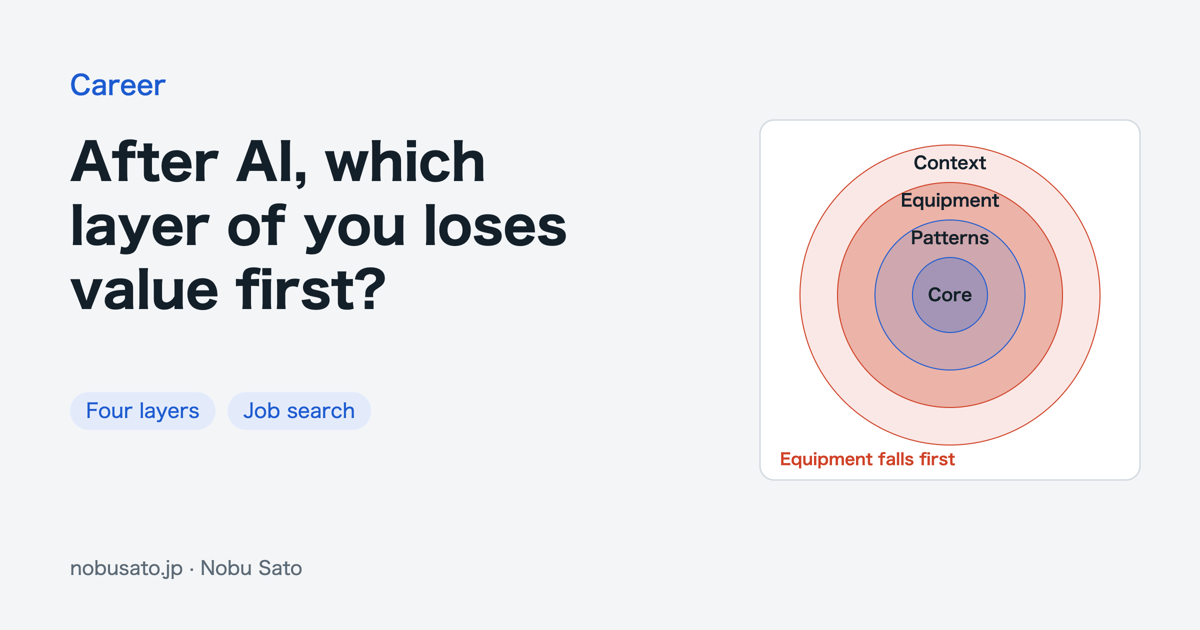
I look at people in four layers. The core: what you want and what you will never do. Patterns: who you become under stress. Equipment: skills, experience, track record. Context: whether you add or drain when placed with this company, this manager, this team. I used the same model in the exit survey post.
These four layers don't lose value at the same speed. Here is how I see it.
Fig.1The order in which four layers lose value after AI. This is my judgment, not a measurement. The writable part of your equipment falls first; patterns and core become more visible.
Equipment falls first, especially what can be written down
Inside the equipment layer, whatever can be written down loses value first: knowledge, playbooks, a language's syntax, speed at writing code. If it can be written down, a model can learn it, and a junior with good tools can get to 70 or 80 percent of it.
A Stanford paper from August 2025 used data from the largest US payroll software provider to see whose jobs moved first after generative AI spread. In the most AI-exposed occupations, employment for 22 to 25 year olds fell 13% in relative terms. More experienced workers in the same occupations held steady or grew. The drop was concentrated where AI tends to replace people rather than help them.
My reading of why the young get hit first: a new graduate's equipment is almost all writable. Coursework, tutorials, practice. A senior person's equipment has other things mixed in, a feel for situations and lessons from things that went wrong. Those are hard to write down, so they don't move as easily. I wrote about experience being unbundled in When experienced stopped being a selling point.
Equipment doesn't go to zero. It's still the entry ticket. It just stops setting you apart.
Context: half of it falls
Part of your context advantage is information. You know the internal processes, how a system is configured, who can approve things. That edge is thinning. With documents, search and AI on top of internal knowledge, a new hire can learn in a week what used to take six months.
The other half holds: whether you work well with this manager and this team. It matters more as teams shrink. One person out of step in a team of five does far more damage than in a team of fifty.
Patterns hold, and get more visible
Patterns are you under stress. When a project is about to fail, do you tighten control or go quiet? When you're challenged, do you explain or push back?
AI can't stand in for this layer, and it's being weighted more. The economist David Deming found that from 1980 to 2012, the share of US jobs requiring heavy social interaction rose by nearly 12 percentage points, while math-heavy jobs with little social interaction fell by 3.3 points. That predates generative AI, but it points the same way: the more machines can do, the more how people work together is worth.
In an interview, the only way to see this layer is through events. As I wrote in what I look for in an interview, interviewers write down events, not adjectives. That candidate stalled on exactly this layer. The equipment words were all there. There was no event that showed his patterns.
Core holds most, and is hardest to prove
Core is what you want and what you won't do. Once tools let you do far more, choosing what to do becomes the constraint, and that choice comes from your core.
The trouble is that it's the hardest layer to show on a resume or in an interview. It only shows in past choices: why you left, why you stayed, what you gave up. Write out the real reasons for your last three job changes side by side. I described how in the four-layer self-portrait.
What to do now
Keep building equipment, but don't hoard it. Write down what can be written down yourself, and turn it into your own method.
Shift your interview prep. Stop listing what you owned. Prepare three to five specific events: the situation, how you judged it, the result and the cost. In each one, be ready to say how you behaved under pressure.
When choosing your next job, look hard at the half of context that holds: team size, who the manager is, whether the two of you are likely to work under stress. That will matter more than the company's name.
If you're just starting out, the entry door really is narrower. Find a role, even a small one, where you make calls and own the outcome. Patterns and core only grow in real events.
Where I'm not sure
The Stanford data is from the US. Japan still hires graduates in one annual intake, so the effect may come later here, or in another form, like fewer graduate slots. There's no Japanese data of the same precision yet. I'm waiting for it.
The order of the four layers is my judgment, not a measurement. If you're seeing something different, tell me.
Which layer of yours do you most want to protect?
Shorter notes that don't make it into a full article go on LinkedIn. Follow me there.