When your boss changes: the first 90 days are an interview
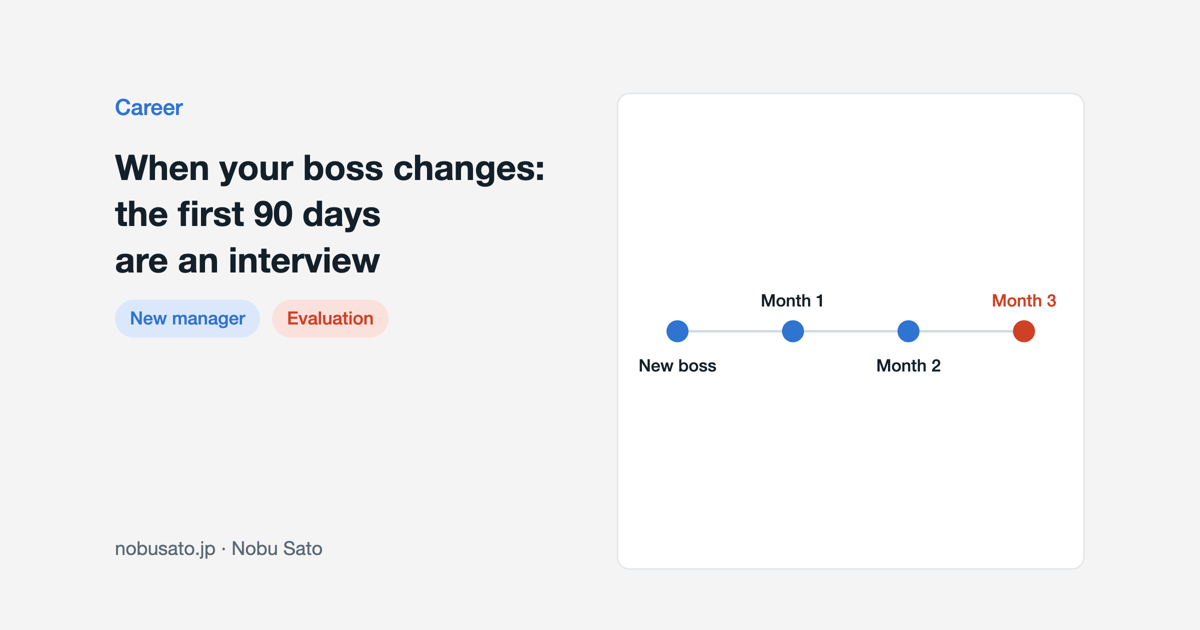
When your boss changes, your job description stays the same but your situation doesn't. Treat the first three months with a new boss as a new interview, because that is roughly what it is.
I've watched a lot of manager changes from the HR side. The same person, with the same skills, can go from top performer to "not sure about them" in one review cycle. Usually nothing about the person changed. The boss did.
Your boss is most of your context
Performance depends on context, and your boss is the biggest piece of it.
I look at people in four layers: core, patterns, equipment and context. Core is what drives you. Patterns are how you behave under pressure. Equipment is your skills and knowledge. Context is the boss, the team and the stage of the business. A new boss swaps out a large part of that fourth layer overnight, while the other three stay where they were.
There is data behind the intuition. Gallup estimated in 2015 that managers account for at least 70% of the variance in employee engagement across business units (Gallup, 2015). That research is mostly American, and engagement is not the same thing as performance. Still, it matches what I see: people who fade after a manager change, and people who suddenly take off.
If you haven't mapped your own context layer yet, the four-layer self-portrait is a good place to start. A boss change is a job change that happens to only one layer.
A new boss decides fast, on thin evidence
In the first 90 days, the new boss is forming a view of the team. Quickly, and from very little.
Michael Watkins made the 90-day window famous with The First 90 Days (2003). New managers are under pressure to show results, and to do that they first need to decide who can do what. They don't have time to find out slowly.
So they use what's in front of them. The handover from the previous boss. Who speaks up in meetings. Whatever output is visible.
Fig.1A new boss's first view of you is built mostly from the handover, who talks in meetings and visible output. Coordination work, prevented problems and verbal promises from the old boss rarely make it in unless you say them out loud.
A handover is one person's summary, filtered through their own opinions. Talkers look bigger than they are. The quiet person holding three departments together looks smaller. None of this means the new boss is careless. Anyone judging a team in 90 days ends up here.
What to do in those months
Re-run the three questions, by watching. In choose your boss, not the company, I suggested three questions to ask a future boss in an interview: why the last person left the team, how the last disagreement with a direct report was settled, and what they most want done in the first three months. You can't interview your new boss. You can watch for the same answers. How do they talk about people who left their old team? When someone pushes back in a meeting, do they take it away and think, or shut it down? What do they keep repeating in the first month? Four weeks is usually enough to see a pattern.
Make your work legible. Your old boss knew your work from years of watching. The new one has nothing. Ask for 30 minutes early on and give them one page: what you own, what's in flight, and the invisible coordination work. If that feels like self-promotion, call it a supplement to the handover. Nobody will object.
Re-agree priorities out loud. Whatever you and the old boss understood without saying it does not exist for the new one. Ask directly: "This half, I'm putting A first and parking B. Is that still right?" Skipping this question is how people end up hearing "B didn't move" at review time.
The old deal does not carry over
"I'll push for your promotion next year." "Finish this project and it'll show in your rating." Promises like these often never reach the new boss. When they do, the new boss may not feel bound by them.
In Japan this hits at predictable times. Many companies run their regular transfers in April and October. An older survey by Romu Gyosei Kenkyujo (2007, reported by Jinjibu, in Japanese) found that among companies with two fixed transfer rounds a year, April and October was the most common pair at 45.2%. More than 60% transfer people as needed, so it's not universal. But if your boss changes in April and the first-half review closes around September, your evaluator will have watched you for less than six months and will rely on the predecessor for the rest.
So while the old boss is still in the building, ask them to put your goals and progress in writing, even an email. Then raise the old promise with the new boss as a question, not a claim: "This is what I discussed with your predecessor. I'd like to know how you see it." If the answer has changed, you want to know in May, not in October.
It really is a new interview
When I moved from engineering into HR, the whole interview tested one thing. I had no HR experience, so could my existing capabilities carry the role? The first months under a new boss feel similar. Your track record matters less to them than whether what you can do today works on their team.
How far to adapt is the part I can't settle. If three months of watching shows a mismatch at the core layer, adapting harder may just burn a year, and a transfer or a move may be the better call. But I also often hear of people whose worst first impression of a boss became their best working relationship a year later. Three months might be too early to decide.
When your boss changes, you are evaluating them too. From what I've seen on the HR side, the people who come through a manager change well are the ones who finished that assessment before the boss finished theirs.
Shorter notes that don't make it into a full article go on LinkedIn. Follow me there.