Your First 90 Days in Japan: Check What You Were Promised
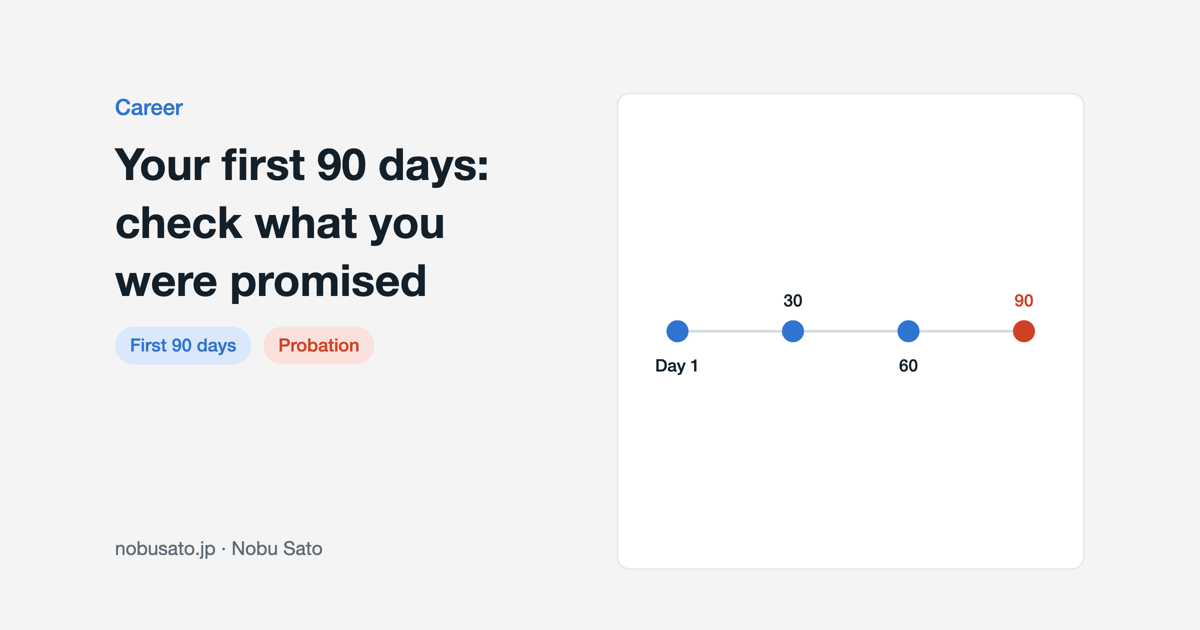
Everything you were promised before you joined is a hypothesis. Write it down before day one, and check it at day 30, 60 and 90.
I suggest this because of a pattern I see often, especially in foreign companies in Japan. Someone joins on the strength of a budget, two open headcount and a boss who says the role is "the priority this year." Six weeks in, none of it is visible. They stay quiet, because they're new. By month five they're quietly interviewing elsewhere, and nobody at the company knows why.
Why treat interview promises as hypotheses?
Because the people making them usually mean it, and plans still change. A hiring manager describes the plan as it stands that week. Budgets get cut mid-year. A headcount request can sit in an approval queue at headquarters for months. The boss who hired you may move on before your first review.
None of this requires anyone to be lying. That's why it's worth checking. Assume bad faith and you'll read every delay as a betrayal. Assume everything is fine and you'll notice the gap too late.
So the night before you start, write one line per promise. Most lists come down to the same six:
- the one thing you're expected to get done in the first three months
- your role scope: what you can decide and sign off on
- budget
- headcount you were told you could hire
- the boss's stated priorities
- when your pay and performance review happens
Phrase each one so it can be proven wrong. For budget: "If there's budget, I should see a cost line with my name on it by day 30."
Item one comes from the interview
In choose your boss, not the company, I suggested asking in the interview: "If I join, what's the one thing you most want me to get done in the first three months?" Whatever the answer was, it becomes the first line of your list.
At day 30, agree on it again in writing, even if it's a two-line email after a 1on1. At day 60, show progress. At day 90, check whether you delivered or whether the goal itself moved. Goals move all the time. The damage comes when the goal moves and your review still uses the old one.
If the interview answer was vague, ask again in your first 1on1. A second vague answer is a result too.
What to check at 30, 60 and 90 days
Day 30 asks: does it exist? Day 60: is it moving? Day 90: did it deliver?
Fig.1Six hypotheses, checked three times: at day 30 for whether they exist, at day 60 for whether they are moving, at day 90 for whether they delivered. Where an item stalls tells you what to talk about next.
Take headcount. At day 30, is the requisition approved, or still waiting on regional sign-off? At day 60, is the job posted? At day 90, have you interviewed anyone? Each stage tells you something different. A requisition stuck in approval is a budget conversation. A posting with no candidates is a market problem, and that one may not be anyone's fault.
Pay review timing is the item most people only heard verbally. Get it in writing by day 30: when the first review is and who does it.
When should you say something?
Sooner than feels comfortable. If something doesn't exist at day 30, raise it that week, as a fact and a question: "I can't find the budget line for this project. Where should I be looking?" Asked that way, it gives your boss room to explain, or to fix it.
At day 60, ask why something isn't moving. At day 90, talk about what would need to change in the next three months for you to stay committed. Skipping these steps and resigning at month five leaves your boss with nothing to act on.
I've been on the other side of this. I once tried to keep a team member who had decided to leave. They wouldn't discuss it, and I never found out why. For a manager, that is the hardest version. It's also why exit surveys rarely tell you the real reason.
Quitting during probation is still resigning
Many people from overseas assume probation in Japan works both ways as a free exit. It doesn't, legally. Probation is part of an employment contract that already exists. From the employer's side, refusing to confirm someone after probation is treated as a dismissal, as I covered in probation in Japan.
From your side, leaving during probation is an ordinary resignation. For a contract with no fixed term, Article 627 of the Civil Code says it ends two weeks after you give notice, and the employer's agreement isn't required (Kagoshima Labour Bureau FAQ, as of October 2026). Work rules often ask for a month, and in practice most people agree a date with the company. Fixed-term contracts follow different rules.
One more provision is worth knowing. Article 15(2) of the Labor Standards Act says a worker may end the contract immediately if the working conditions stated to them turn out to differ from reality (as of October 2026). Be careful with it, though. It is generally read as covering your own terms of employment that the employer must state at hiring, such as pay and hours. What a manager said about budget over coffee is probably outside it, so the cases where it actually helps are narrow. Since April 2024, employers must also state the possible scope of changes to your work location and duties when you're hired (Shizuoka Labour Bureau). So when you check role scope, reread your written terms first.
This is general information, not legal advice. For your own case, the Labour Standards Inspection Office's general labor consultation corners are free, or talk to a lawyer.
The 90 days also line up with probation at most firms. In a 2012 survey by the Japan Institute for Labour Policy and Training (JILPT), 86.9% of companies had a probation period, and for mid-career regular hires the most common length was about three months, at 65.7% (JILPT survey report).
When is it time to leave?
I use the same logic I use for hiring. First, check for veto items. If the role turns out to be a different job, or your boss says they don't remember what was discussed before you joined, that can settle it on its own, however good the rest looks. Otherwise, look at your weakest line, not the average. If the weakest item is one you can't live with, that's your answer.
Leaving early is common in Japan, more than many foreigners expect. The Ministry of Health, Labour and Welfare reported in October 2026 that 31.2% of university graduates who started work in March 2023 left within three years, 11.0% in the first year alone (MHLW data). In the ministry's 2025 survey of job changers, published in September 2026, 24.7% of people who quit for their own reasons said the work itself wasn't satisfying (MHLW summary).
Ninety days is too short for some jobs. A large enterprise deal or an org turnaround may show nothing measurable in three months. In those cases I replace "did it deliver" with "is the pace right," and I'll admit that's a softer test than I'd like.
What I want from the list is that on day 90, you and your boss are looking at the same page. If it also tells you to leave, fine. That's a side effect. Start tonight with the promise you remember most clearly, in the words they used.
Shorter notes that don't make it into a full article go on LinkedIn. Follow me there.