What foreign companies struggle with most in Japan
Companies planning to enter Japan ask me about paperwork first. How to register the entity, which licenses are needed, how long a bank account takes.
All of that is tedious. None of it is the hard part. The hard part shows up in the data, and it has been showing up for years.
What ranks at the top of the surveys?
JETRO asks foreign-affiliated companies in Japan every year what their biggest business challenges are. In the FY2025 round, 1,423 companies answered, with multiple answers allowed.
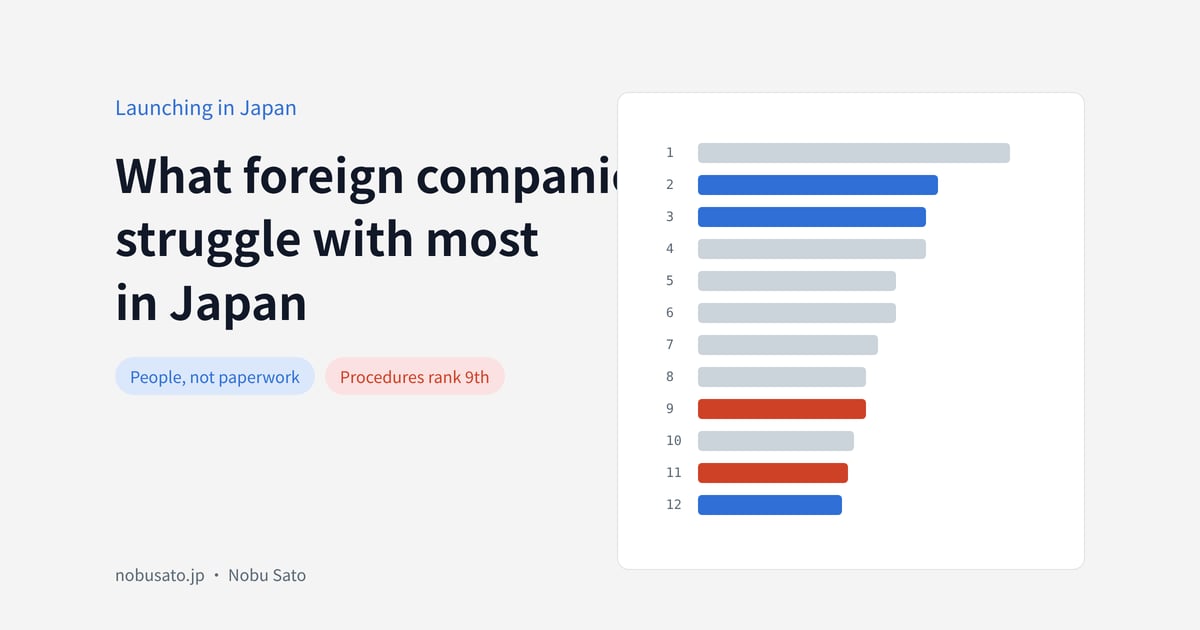
First was currency risk, 52.1%, no surprise given the yen's last few years. Second, language and communication barriers, 40.3%. Third, inability to hire specialists, executives and managers, 38.4%. Fourth, a shrinking market from the aging population, 38.2%. Difficulty hiring general staff, sales staff and administrators came in at 24.5%.
Complex administrative procedures? 28.1%, ninth place. Tax procedures, 25.0%, eleventh.
Fig.1JETRO FY2025 survey (n=1,423, multiple answers). Three of the top twelve items are about people; both procedure items sit in the bottom half.
Put communication, specialist talent and general talent together and three of the top twelve items are about people. The two procedure items both sit in the bottom half.
This isn't a one-year fluke. METI used to run its own annual survey of foreign companies. In the 2020 round, with 2,476 respondents, the top obstacle to doing business in Japan was high business costs at 75.1%, and second was difficulty securing talent at 53.6%. Administrative procedures were fifth at 40.5%. That survey ended after FY2020 and JETRO's picked up the question. The answer hasn't changed.
What has changed in five years is the paperwork. In JETRO's FY2023 survey, about one company in four said administrative procedures were improving, for the second year running. Talent was the item most often reported as getting worse.
Which people can't they hire?
The FY2025 survey has one more set of numbers. Among companies currently hiring, about eight in ten said they can't fill the roles they need, or expect not to. The hardest role to fill is sales, picked by more than sixty percent. Outside the major cities, non-IT engineers are the scarcest.
Sales being the hardest matches what I've seen. A foreign company entering Japan brings a finished product and HQ's technology. The one thing it has to grow locally from zero is the sales team. And Japanese salespeople have far more reservations about joining a foreign company nobody has heard of than most executives expect.
If you can't hire sales, nothing else gets its turn. The entity is registered, the office is leased, and the first revenue still doesn't arrive.
So why does everyone spend their energy on paperwork?
Because paperwork is certain.
Company registration has a checklist. What documents, how many weeks, and a consulting firm or administrative scrivener will quote you a price. It looks hard. It's a road with a known answer.
People have no checklist. I helped one foreign company set up in Japan, and every early question was about procedures. Halfway through, the real problem surfaced. They wanted to hire their first employee and couldn't say what that person should look like, what to pay, how to interview, how to persuade someone to join a company nobody in Japan had heard of, or what to say in the conversation. None of those questions had a standard answer, so none of them had been asked.
Most executives handle it the same way: finish what can be finished, and worry about hiring when hiring fails. By then the entity exists, the office is leased, and HQ is asking about the first quarter's numbers.
Maps first, paperwork second
My own approach fits in two words: don't guess.
Entering a new market, build the market map first, then the talent map, then work down through product, sales and organization in that order. Paperwork comes after those three steps, not before.
Fig.2The order for entering Japan: answer who's there and who can come, decide product, sales and organization, then do the paperwork.
The market map answers who's there. Which players, which ones fight for the same customers, which ones can supply people, which ones decide whether you get to play at all. Get this wrong and everything after it is wrong. I wrote about that in Picking the wrong competitors is worse than having none.
The talent map answers who can come. How many people are left once the role's requirements multiply, how thick each ring of companies is at each distance from your business, and which requirement you'll drop when you can't fill the role. This decides more than hiring. It decides what the organization looks like, who the first person is, and whether to open a regional office. Details in A talent map is not a list.
With both maps drawn, who the first hire is, what to pay, how to interview and how to persuade are mostly already on paper. Then you do the paperwork, as a company that knows who it needs and who it can get.
Reverse the order and you get the eighty percent in the survey.
What I haven't worked out
The second-ranked item, language and communication barriers, looks less and less like a language problem to me. When HQ and the Japan entity can't communicate, it's usually a difference in background and culture, and in the granularity each side looks at. HQ sees quarters and market share. The entity sees this customer, this person, this week. Same language, no overlap. A map doesn't solve that. I ran into it once in Two people at the top and I still don't have a good answer.
When your company entered Japan, what actually stopped you first: the paperwork, or the people?
Shorter notes that don't make it into a full article go on LinkedIn. Follow me there.