Changing Jobs After 40 in Japan: You Sell Judgment
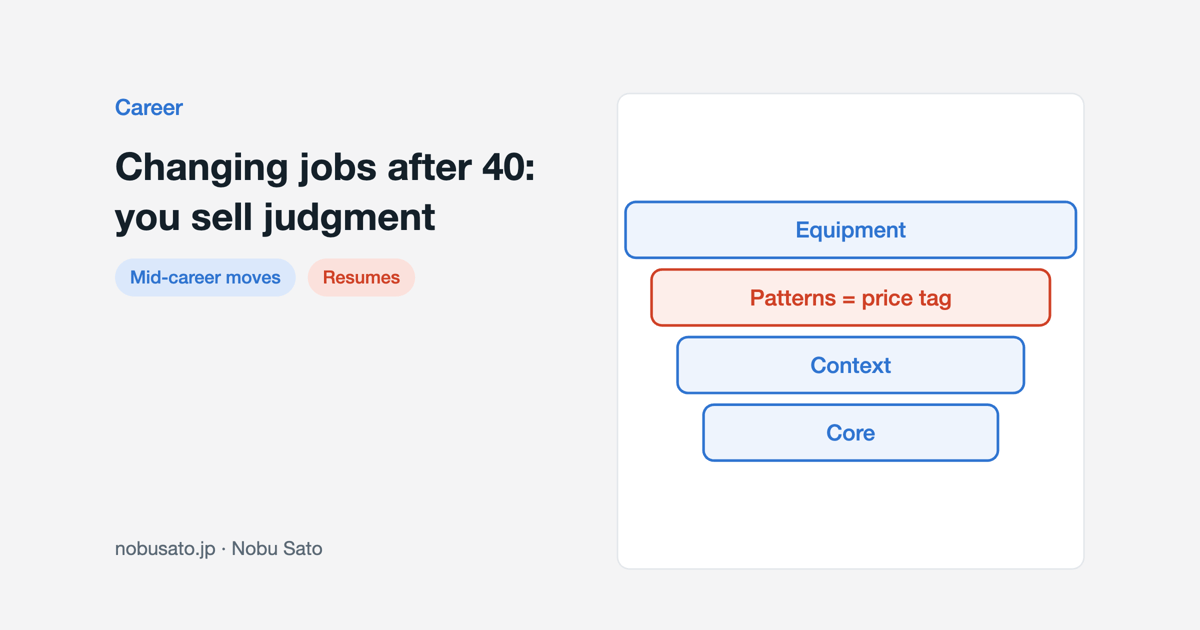
After 40, what you sell in a job change is how you decide when the information is thin and the stakes are real. Most resumes I read from candidates in their forties still sell a list of skills.
I once interviewed a candidate for head of sales strategy. He had done a lot, and he could name all of it. Every time I asked for one specific case, he stalled.
The age-35 cut-off is out of date
People still say 35 is the limit for changing jobs in Japan. The numbers stopped supporting that some time ago.
Japan's Ministry of Health, Labour and Welfare (MHLW) published its 2025 Survey on Job Changers in September 2026. In the individual survey, people aged 40 and over made up about 52% of all job changers. The 40 to 44 band alone was 12.0%, close to the 13.7% for ages 30 to 34.
Fig.1In 2025, people aged 40 and over were about half of Japan's job changers. The largest single band was 25 to 29 (16.8%), but 40 to 44 (12.0%) was close behind 30 to 34 (13.7%). The 52% is the sum of the bands, rounded.
A caveat on scope. The survey counts people hired as regular full-time-type employees who had worked at another company within the past year. Part-timers are excluded. So read it as a sense of scale. What matters is that it's roughly half.
Private data points the same way. Recruit's September 2024 report on mid-career job changes, based on its Recruit Agent placements, says the number of job changers in their forties and fifties grew faster than the total. The share of those changers who got a pay rise of 10% or more went from 15.6% in fiscal 2014 to 27.4% in fiscal 2023.
If you came to Japan believing the old "35 is the limit" line, you can drop it. I looked at the wider picture in a post on Japan's job-change rate. Movement is still low overall, but age is no longer the wall it was.
What Japanese employers say they're buying
The same MHLW survey asked employers why they hired. For managerial roles, 60.7% of workplaces that hired a job changer said the reason was that the person could use their experience and contribute right away. 50.2% cited specialist knowledge. When setting pay, 59.2% considered past experience, ability and knowledge. Only 35.3% considered age.
I split "experience" into two things.
The first is what you can write down. Tools, certifications, industry knowledge, the duties you held. In my four-layer model that's equipment.
The second is how you behave under pressure. What you prioritize when the data is incomplete. When you pull the plug. Which failure patterns you've already watched play out. That's the patterns layer.
At 28, equipment can win you the job. At 45, someone younger, or someone younger with good AI tools, catches up on equipment fast. When I wrote about which layer loses value first, the written-down part came out as the first to lose value. Patterns hold up. That's what a mid-career hire is really paid for, even when the job ad lists skills.
I have a personal reason to believe this. When I moved from software engineering into HR, the whole interview tested one question. With no HR experience, could my existing capabilities carry the role? My equipment for HR was close to zero. They were looking at how I decided.
How to make judgment visible on a resume
Most mid-career resumes are lists of responsibilities. Built the sales strategy. Designed KPIs. Managed a team of twelve. All true, and all identical to the next candidate with the same title.
As someone who reads a lot of these, here's what I find more useful. Pick two or three cases. For each one, write the situation and its constraints, the options you had, why you chose the one you did, and what happened. Numbers go in the outcome line, not the headline.
One case can be a failure. A decision that was sound but still lost tells an interviewer more than a clean win, because they can see your reasoning without the result covering for it.
This works in English and Japanese resumes alike. A Japanese 職務経歴書 has a looser format than people assume, so there is room for it.
When the interviewer says "be specific"
I don't think my sales strategy candidate was unprepared. His unit of story was too big. "I rebuilt the sales organization" is a summary of a result, and there is no decision anywhere in it.
"Specific" means one meeting, one week, one call you had to make. What did you know? What didn't you know? Who disagreed, and how did it end?
Before an interview, take each case on your resume and mark the moment you hesitated most. Rehearse that moment and leave the summary for the end. If the case is a failure, the advice from telling failure as evidence applies: say what you did at the time, in order, before any lesson.
What changes after 50
I don't know how far past 50 this holds.
MHLW's 2025 Survey on Employment Trends, published in August 2026, shows the split. Among job changers aged 40 to 44, 44.9% earned more than in their previous job and 27.4% earned less. At 50 to 54 it flips: 29.4% earned more and 42.0% earned less.
I can't yet say why. Maybe judgment isn't valued at that age. Maybe it is valued but the pay structure doesn't reflect it. Some of those moves may also follow early retirement programs or the end of a managerial post at a fixed age, which pull pay down for reasons unrelated to the person. Treating 41 and 53 as the same "mid-career" group is probably too rough.
So here is a test I would run before rewriting anything. Think of the heaviest call you made in the last five years. Could you tell it to a stranger in five minutes, with the moment of doubt left in?
Shorter notes that don't make it into a full article go on LinkedIn. Follow me there.