Foreign workers in Japan: who the 2.57 million are, and where
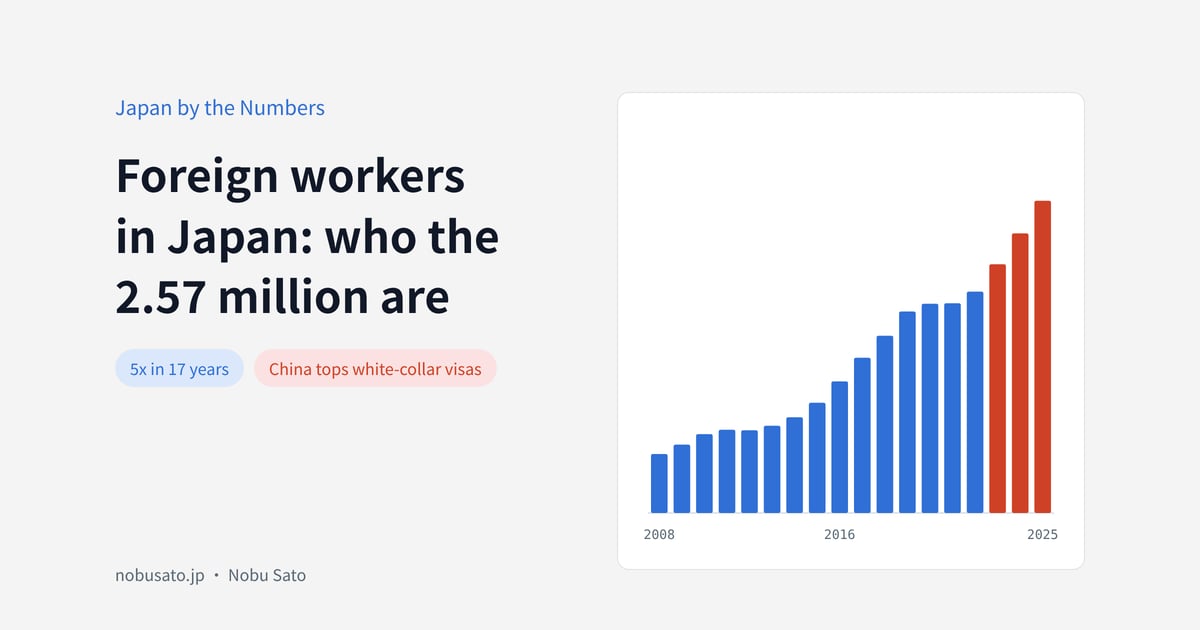
Every January, Japan's labor ministry publishes the foreign-worker count as of the previous October. As of October 2025: 2,571,037 foreign workers, up 268,000 from a year earlier, the third straight year of roughly 12% growth.
I read this release every year. Not for the total, but for the lines underneath it. They're far more useful.
Five times in seventeen years
In 2008 the figure was 486,000. It passed one million in 2016, reached 1.72 million in 2020, 2.05 million in 2023, 2.57 million in 2025.
Fivefold in seventeen years, while Japan's total labor force barely moved. A large share of the workers Japan added over that period were foreign. When executives say Japan is short of people, the reality underneath is that Japan is already filling the gap with foreign workers, and filling it faster each year.
Fig.1Foreign workers in Japan as of each October, 2008 to 2025. Past one million in 2016, 2.57 million in 2025. Unit: 10,000 persons.
China fell to second, then the gap widened
Until 2020, Chinese nationals were the largest group. In October 2020, Vietnam passed China, 444,000 to 419,000. By 2025 it was Vietnam 606,000, China 432,000, a gap of 174,000.
The Chinese count has been nearly flat for five years. The growth is Vietnam, Indonesia (up 35% in one year), Myanmar (up 43%), Nepal, Sri Lanka.
What changed is the kind of foreign worker Japan brings in: from Chinese people coming to study and work, to Southeast Asians filling gaps in manufacturing, construction and care. They go into entirely different jobs.
Fig.2Main nationalities, 2024 versus 2025. China was already at 419,000 in 2020 and has barely moved since; Vietnam, Indonesia and Myanmar are rising. Unit: 10,000 persons.
White-collar visas: China still first
Split by residence status and you get a different picture.
The Engineer/Specialist in Humanities/International Services visa, the standard white-collar work permit, covered 468,000 people in 2025, up 14%. By nationality: China 136,000, Vietnam 112,000, Nepal 43,000, Korea 31,000, India 14,000.
In the white-collar pool, Chinese nationals remain first by a clear margin. In the information and communications industry there are 98,000 foreign workers, two-thirds on this visa.
How big is the pool of Chinese-speaking engineers in Japan? I've been asked that many times in search work. A rough estimate: 136,000 on this visa, times the share that goes into IT. It matches what I've felt in the market: tens of thousands, not more, and hardly growing in recent years.
Fig.3Engineer/Humanities/International Services visa holders by nationality, 2025. China first at 136,000. Unit: 10,000 persons.
The other two lines
Specified Skilled Worker: 286,000, up 38% in a year, the fastest-growing category. Technical Intern Training: 499,000, still growing but slowing. Together 785,000, almost all in manufacturing, construction, agriculture and care, which lines up exactly with the 5x and 8x occupations in the previous post.
Japan is replacing the intern program with a new training-employment scheme, so this line will be redrawn over the next few years.
Tokyo holds a quarter
Tokyo 652,000, or 25.4%. Aichi 249,000, Osaka 208,000. Tokyo's share of foreign workers is well above its share of total employment, which is the same story as white-collar jobs concentrating in Tokyo.
371,000 workplaces employ foreign workers, and 63% of them have fewer than 30 employees. Large companies are a smaller part of this than people assume. Anyone recruiting foreign talent in Japan knows it: the clients are small and mid-sized firms and foreign entities, not the big names.
Two implications for foreign companies
One. If you need site workers in Japan, the pool is Southeast Asian, not Chinese. The intermediaries and visa routes are completely different. Don't apply your engineer-hiring playbook.
Two. If you need Chinese-speaking white-collar staff, the pool is those 136,000, and it hasn't grown much in five years. It isn't inexhaustible, and you're competing with every Chinese company in Japan. Map the pool before you move. That's A talent map is not a list.
Where I'm not sure
The data comes from employer filings, and under-reporting is common among small firms, so the real figure is above 2.57 million. It also counts only employees, not business owners or freelancers.
Your foreign employees in Japan: which visa are they on?
Shorter notes that don't make it into a full article go on LinkedIn. Follow me there.