Japan sees 3,400 labor tribunal cases a year. That's not small
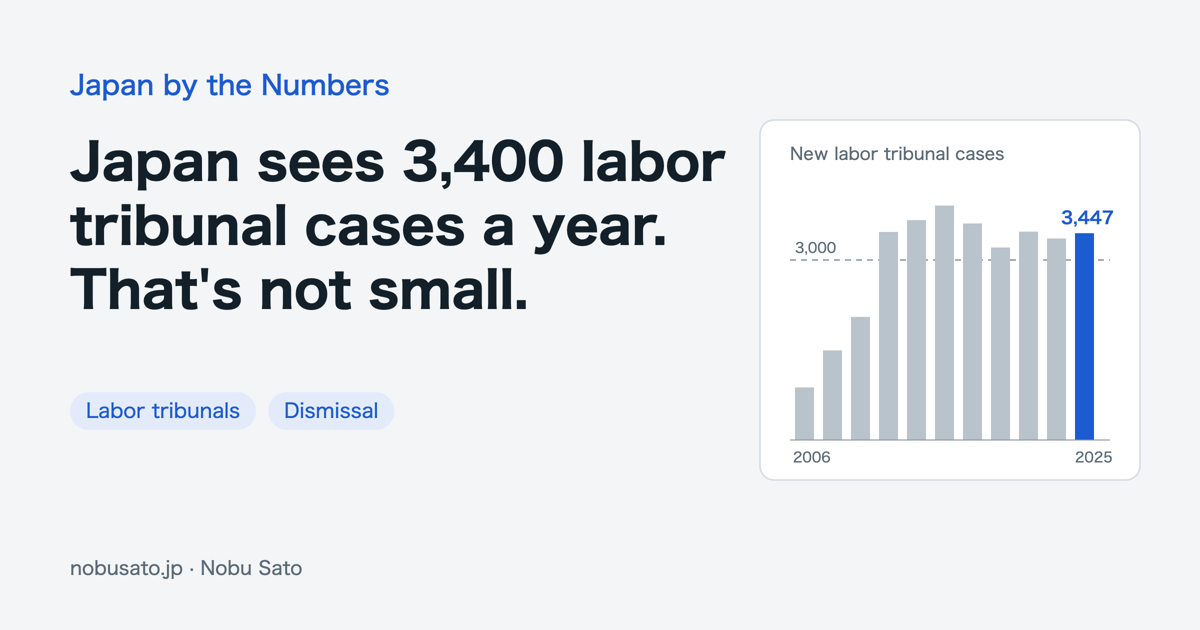
Japan's district courts take in about 3,400 new labor tribunal cases a year. In 2025 it was 3,447 (preliminary).
Foreign executives usually hear that number and relax. A country of 120 million, a few thousand cases. I don't think they should.
What is a labor tribunal in Japan?
A labor tribunal (rodo shinpan) is Japan's fast track for individual employment disputes. A panel of one judge and two lay members with labor experience hears the case, in principle within three sessions. Most cases end in a negotiated settlement. The system started in April 2006.
The IBM Japan lockout dismissals
The case I bring up first is IBM Japan.
In 2012 and 2013, IBM Japan dismissed a group of employees for poor performance. They were told on the day, asked to hand in their PCs and walked out of the building. The Japanese press called it lockout dismissal. The basis was IBM's relative rating system. A few years near the bottom put you on the list.
The employees sued at the Tokyo District Court in five waves. On March 28, 2016, the court ruled the first dismissals invalid and ordered back pay from the dismissal date. One plaintiff had worked there for about 25 years.
The reasoning is what matters for employers. Ranking low on a relative scale, even for years, is not enough to fire someone. He had been transferred before, and his contract didn't fix his role or location. So the company should have tried a transfer or a demotion first, or told him plainly that dismissal was possible and given him a real chance to improve. It did neither. Later waves also ended in wins or settlements for the employees.
That case went to full litigation, not a tribunal. But it shows how hard Japan's dismissal rules are, and why close to half of all tribunal cases are about dismissals. A performance system designed at headquarters and applied as is in Japan tends to hit this wall.
Twenty years, one flat line
Since 2009, Japan has had more than 3,000 new labor tribunal cases every year.
Fig.1New labor tribunal cases at Japan's district courts. Above 3,000 every year since 2009, peaking at 3,907 in 2020, the first COVID year. 3,447 in 2025 (preliminary). 2006 covers April to December only.
Cases climbed fast in the first three years, crossed 3,000 after the 2008 financial crisis and never came back down. The peak came in 2020. Then it settled back onto the same plateau.
Good years don't pull the number down much. Bad years push it up. That flatness is the point.
Why 3,400 cases is not a small number
Courts only see the end of the pipeline.
In fiscal 2021, according to Japan's labor ministry, prefectural labor bureaus handled about 1.24 million consultations. Around 280,000 involved individual employment disputes, and 3,760 went to bureau mediation. Labor tribunals took 3,609 new cases that year. Most disputes end earlier, in internal talks, a lawyer's letter or mediation. The ones that reach a tribunal usually involve an employee who has hired a lawyer and wants a result.
Of those 3,609 cases, 1,751 sought reinstatement, mostly after a dismissal. Close to half.
So the national average tells a single company very little. The useful question is how many people you plan to let go this year, and how.
Small foreign subsidiaries are the most exposed. One or two people in HR, work rules translated from headquarters, no performance records. One case can tie up management for half a year.
Fast, and mostly settled
Tribunals are quicker than courts, but not as quick as three sessions sounds. In 2024 about 80% took more than two months, and about 2% finished within one. Full labor lawsuits averaged 16.1 months.
In 2019, 71.2% of tribunal cases ended in a settlement. In 2023 it was 68.8%, the fourth year in a row under 70%. Still, roughly seven in ten settle.
From the employer side, I think of a tribunal as a timed price negotiation. If your evidence isn't ready by the first session, you spend the rest of it conceding.
How much does one employment dispute cost in Japan?
In the cases I've seen, the cost has three parts: about ¥3 million in legal fees, a settlement of around six months' pay, and wages for the period of the dispute. The last one is easy to miss. If a dismissal is ruled invalid, you owe pay from the dismissal date until the case is resolved.
A rough example with assumed numbers: an employee on ¥600,000 a month. Settle at the tribunal in about three months and you pay ¥3 million in fees, ¥3.6 million in settlement and ¥1.8 million in back pay. That's about ¥8.4 million. If it goes to a full lawsuit and takes eighteen months, back pay alone is ¥10.8 million and the total passes ¥17 million.
That doesn't count management time.
Tribunals are flat. Lawsuits are rising
In 2024 Japan's district courts took 4,214 new labor lawsuits, the most since 1992 and more than the 3,964 of the 2020 COVID year. In 2025 it was 4,112, the second highest.
Inside the 2025 number, claims for money (wages, severance) fell by 300 to 2,844. Claims not about money, like reinstatement or damages, rose by 198 to 1,268.
My read: the fast track handles the same volume, but more people go past it to full litigation, and more of them want their job back or an admission, not just a payment. The room to close out a dismissal with money is getting smaller. Two years of data isn't a trend yet, so I'm watching it.
If you're setting up in Japan
Get your work rules, employment contracts and performance records to Japanese standards before your first employee starts. Once a tribunal petition arrives, most of your negotiating room is gone. The up-front cost is small next to the numbers above.
I've written about who that first employee should be in Your first hire in Japan should not be a salesperson, and about where foreign companies actually get stuck in What foreign companies struggle with most in Japan.
One question I can't answer yet. Employees can now use AI to look up the law and draft a petition. Will that push the 3,400 baseline up another step? I think it will. I haven't seen the data.
Sources
- Rodo Shimbun: 2025 judicial statistics, 4,112 lawsuits and 3,447 tribunal cases (Japanese)
- Rodo Shimbun: 2024 judicial statistics, 4,214 lawsuits and 3,359 tribunal cases (Japanese)
- Rodo Shimbun: 2023 judicial statistics, 3,473 tribunal cases, 68.8% settled (Japanese)
- Rodo Shimbun: 2021 judicial statistics (Japanese)
- Rodo Shimbun: 2020 judicial statistics, record 3,907 tribunal cases (Japanese)
- Rodo Shimbun: 2019 judicial statistics, 71.2% settled (Japanese)
- Rengo Research Institute DIO, April 2010: case counts 2006 to 2009 (Japanese)
- Ministry of Health, Labour and Welfare: dismissal dispute resolution, FY2021 (Japanese)
- Central Labour Relations Commission: individual dispute resolution by institution (Japanese)
- JILPT: labor lawsuits and labor tribunals, long-term series (Japanese)
- Rodo Shimbun case law: IBM Japan, Tokyo District Court, March 28, 2016 (Japanese)
- Darwin Law Office: dismissal for poor performance (Japanese)
- Tokyo Law Office: IBM lockout dismissal, fifth suit won (Japanese)
Original statistics from the General Secretariat of the Supreme Court of Japan. 2025 figures are preliminary.
Shorter notes that don't make it into a full article go on LinkedIn. Follow me there.