Japan's 2024 Logistics Crisis: The 14% Gap Was a Projection
Japan was told it would lose 14% of its trucking capacity in April 2024. That number was a projection, and a fairly specific one. It assumed Japan would ship exactly as much freight as in 2019 and that nobody would change how they load, wait or route trucks.
Two and a half years after the April 2024 deadline, the data tell a calmer story, and a more useful one. The gap mostly closed. Part of the reason is simply that there was less freight than the model assumed. Prices kept rising. And the people who actually buy logistics automation are different now.
The 14% assumed 2019 freight, moved the 2019 way
The 14% figure is an estimate by NX Soken (NX総合研究所), the research arm of a large Japanese logistics group. Japan's government study group on sustainable logistics, run jointly by the transport, industry and agriculture ministries, cited it in its 2023 summaries: without countermeasures, a 14.2% shortfall (about 400 million tonnes) in FY2024 and 34.1% (about 940 million tonnes) in FY2030.
Two rules changed in April 2024. The Labor Standards Act's overtime cap of 960 hours a year started to apply to professional drivers. At the same time, the revised driver working-time standard (改善基準告示) limited a truck driver's total annual on-duty time to 3,300 hours, or up to 3,400 hours with a labor-management agreement. Most coverage tied the 14% to the 960-hour rule. The model actually used the 3,300-hour on-duty cap.
The method, from NX Soken's October 2022 presentation, is simple enough to redo on a napkin:
- A 2022 survey of driver working hours found that 26.7% of drivers exceeded 3,300 on-duty hours in FY2019.
- Add up all the hours above the cap, divide by 250 working days, and you get the number of extra drivers needed to replace them.
- Compare that with Japan's 860,000 truck drivers (Labor Force Survey, FY2019) to get a shortfall rate, then apply it to the 2.84 billion tonnes carried by commercial trucks in FY2019.
So the denominator is 2019 freight, moved the 2019 way. Every hour over the cap becomes freight nobody carries. That is a useful warning. It is not a forecast of what would happen once shippers, carriers and prices reacted.
The same deck had a number that never made headlines. With a 3,400-hour cap, still fully legal, the shortfall drops to 5.6%. One assumption, inside the law, moves the result by a factor of 2.5. The deck also showed that cutting waiting time and loading time by 20% each would roughly close the gap.
The 2030 figure of 34% (about 940 million tonnes) also builds in a shrinking driver headcount. In the breakdown NX Soken presented to the study group in November 2022, about 540 million tonnes of it comes from fewer drivers. That split is reported by the trade outlet LOGISTICS TODAY; the government summary itself does not give it.
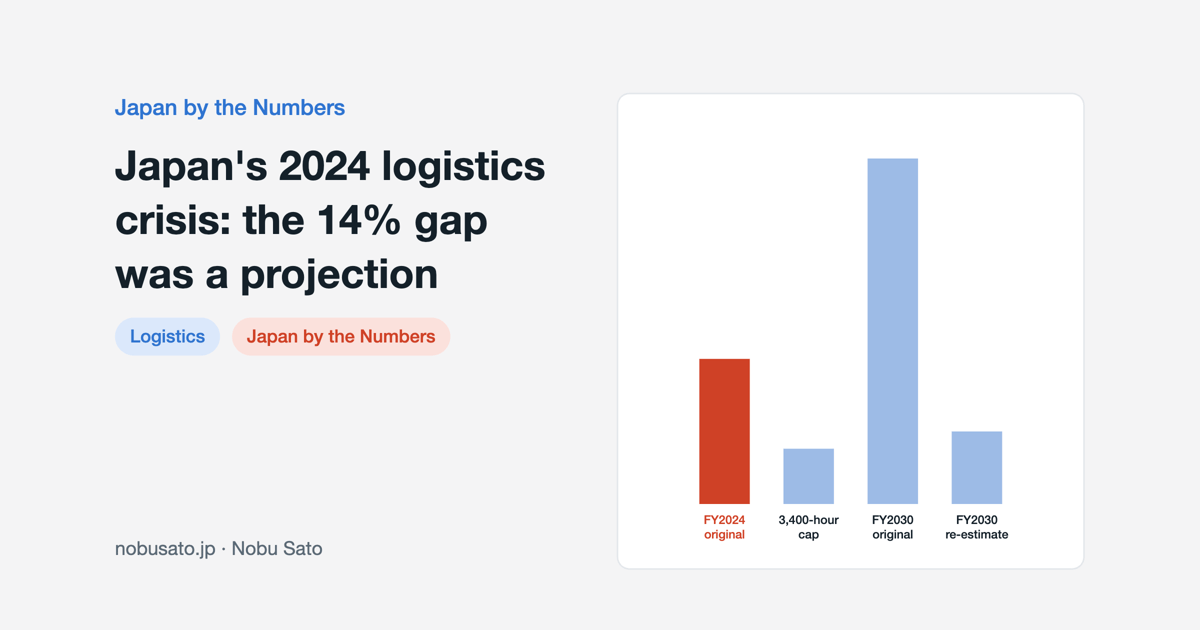
Fig.1The FY2024 shortfall is 14.2% with a 3,300-hour annual cap and 5.6% with 3,400 hours. The original FY2030 projection of 34.1% was re-estimated in March 2026 at about 7% on average and about 25% in the worst case. Sources: NX Soken (2022), government study group on sustainable logistics (2023), MLIT study group on the FY2030 logistics policy outline (2026).
What happened after April 2024
Japan's transport ministry (MLIT) study group on the next national logistics policy said in recommendations finalized on March 3, 2026 that the roughly 14% shortfall expected for FY2024 had been “largely overcome.” A big reason is that there was less to carry.
That part gets skipped a lot.
Its summary deck states that about 14 points of the original 34% gap were largely overcome through public and private efforts, and that freight demand fell about 12%. Freight volume in FY2024 was 2.51 billion tonnes, against the 2.84 billion tonnes the model was built on.
Trucks also got fuller. A macro estimate by Hojo (北條英) of the Japan Institute of Logistics Systems (July 2025), built from government transport statistics, puts the load factor at 41.3% on average for April to October 2024, up from 37.8% in FY2019. That covers seven months, not a full year. By his arithmetic, roughly 300 million tonnes less freight on its own shrinks the 400-million-tonne hole to about 100 million tonnes. Fuller trucks then work on what is left.
The price of trucking, meanwhile, keeps climbing. The Bank of Japan's services producer price index for road freight stood at 113.3 in August 2026 (2020 average = 100), up 4.3% year on year. That was the latest reading as of October 2026. My reading is that price and volume absorbed the shortage, and you can still see it in the bill.
What the national number hides
National totals average out the places where it hurts. In NX Soken's original estimate, agricultural and fishery shipping cooperatives faced a 32.5% shortfall, and the Chugoku region 20.0%, using FY2019 data (as reported by LOGISTICS TODAY, a secondary source). A balanced national ledger does not mean long-haul produce from rural Japan moves easily.
And I wouldn't give policy much credit for the demand drop. The economy, lighter and smaller shipments, and higher prices all played a part. If volumes come back, so does the gap. The 2026 re-estimate puts the FY2030 shortfall at about 7% on average and up to 25%, the worst case assuming demand returns to 2019 levels, driver numbers fall another 2%, and working hours shrink twice as fast.
I also could not find a clean national series showing how much individual drivers' hours actually fell. Working-time numbers depend heavily on who counts them, a problem I wrote about in Japan's two overtime numbers.
The buyer of warehouse robots has moved
If you sell automation in Japan, your buyer used to be the trucking company. More and more it is the shipper and the warehouse.
The reason is legal. Under the revised Logistics Efficiency Act, from April 2026 shippers that handle 90,000 tonnes or more a year must appoint a Chief Logistics Officer from among their executives, file a medium-to-long-term plan, and report waiting and loading times (METI). Waiting time at the dock is now a number a board member answers for.
That changes the sales argument. Warehouse automation, truck booking systems, standard pallets and consolidated delivery sell when you can say how many driver hours they remove. The same robot needs a different pitch for a 3PL site manager and for a shipper's CLO. I once studied companies selling the same product to the same target customers and found their customer-acquisition logic was completely different. Logistics tech is a market where that happens often.
Most of Japan's SMEs ship far less than 90,000 tonnes. As I argued in who you actually sell to when SMEs are 99% of firms, they will mostly pay for automation indirectly, through their 3PL or a shared delivery network. The direct buyers are the designated large shippers and the warehouse operators holding their goods.
On the people side, expect a fight over the few who understand operations, process improvement and data at the same time. Hiring drivers themselves stays hard; the job openings ratio by occupation shows how hard.
Some people now say the 2024 problem was overblown. I read it differently. The 14% was a what-if-nothing-changes number, and things changed: freight rates, load factors, and shippers' attention. The 7 to 25% range for 2030 depends mostly on whether freight volumes recover. If you put a shortage figure in a deck, add one line saying which assumptions it rests on.
Sources
- NX Soken, The impact of the 2024 logistics problem, Oct 6, 2022 (26.7% of drivers over 3,300 hours; 5.6% with a 3,400-hour cap), in Japanese
- Study group on sustainable logistics, interim summary, February 2023 (14.2% / 400m t; 34.1% / 940m t in FY2030), in Japanese
- Same study group, final summary (draft), June 2023 (attributes the 14.2% to NX Soken), in Japanese
- Ministry of Health, Labour and Welfare, revised working-time standard for truck drivers (960 hours; 3,300 to 3,400 on-duty hours), in Japanese
- Japan Institute of Logistics Systems (JILS), What happened to truck freight in FY2024, July 2025 (load factor 37.8% to 41.3%), in Japanese
- MLIT study group on the FY2030 logistics policy outline, recommendations, March 3, 2026 (FY2024 shortfall largely overcome; FY2030 about 7% to 25%), in Japanese
- Same, summary deck (demand down about 12%; 2.84bn t at 2019 level, 2.51bn t in FY2024), in Japanese
- MLIT press release on the recommendations, March 3, 2026, in Japanese
- Bank of Japan, Services Producer Price Index, August 2026 preliminary (road freight 113.3, +4.3% YoY)
- METI, Logistics Efficiency Act leaflet (90,000-tonne threshold, Chief Logistics Officer), in Japanese
- LOGISTICS TODAY (secondary source), NX Soken estimate of a 34.1% FY2030 shortfall, Nov 22, 2022 (by shipper type and region; 540m t from fewer drivers), in Japanese
Shorter notes that don't make it into a full article go on LinkedIn. Follow me there.