A third of ex-managers in Japan stepped down unexpectedly
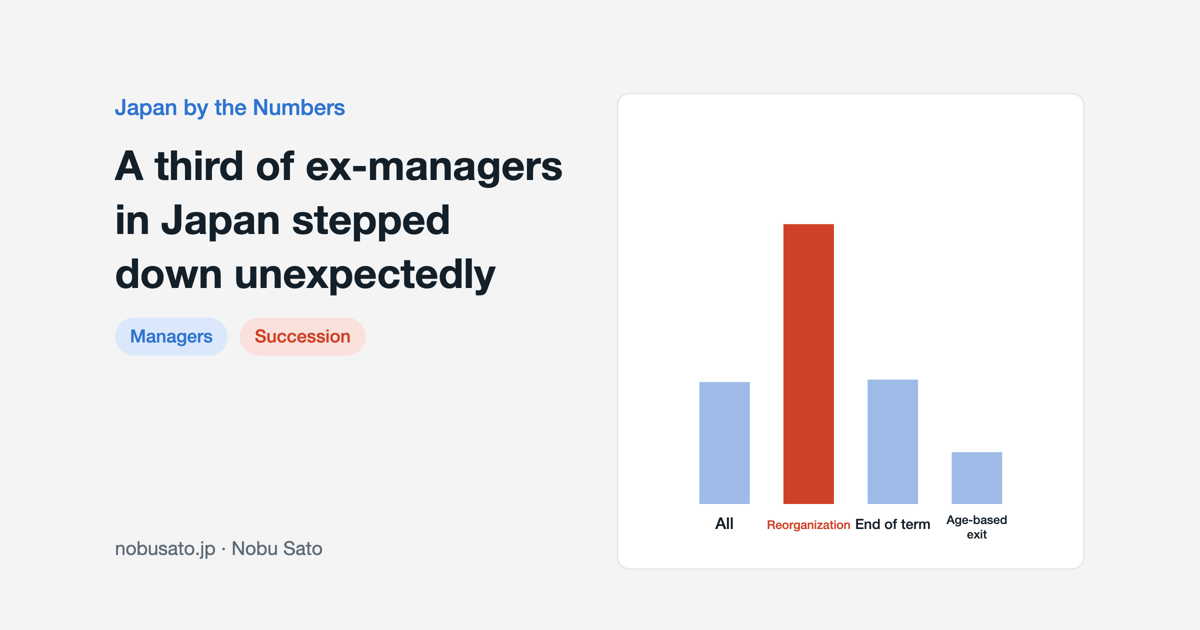
When you appoint a manager in your Japan entity, write down how they will leave the seat. A September 2026 survey of former managers in Japan found that 35.3% stepped down for a reason they hadn't expected, and 25.1% left earlier than they'd planned.
That is roughly one in three. The same survey also reports 39.1%, which is easy to mistake for the headline. It measures something else: the share who got no explanation, or one month's notice or less. I'll stick with 35.3%.
Who was asked?
The study is the Former Managers' In-House Career Survey by Persol Research and Consulting, a Tokyo HR think tank, published on September 25, 2026. It covers people aged 50 to 64 at companies with 300 or more employees who held a line manager post (section chief or above), stepped down, and still work for the same company. It was an online survey run in June 2026, with 690 former managers among the respondents. The survey outline is only published as an image, so I took the timing and sample size from a news report.
That sampling choice matters. Anyone who lost the title and then quit is not in the data. If people who felt blindsided were more likely to leave, the real share of unplanned exits could be higher than 35.3%. That's my inference; the survey can't show it. "Expected" is also a self-report, given looking back.
Which exits came as a surprise?
Reorganizations, overwhelmingly. Only 15.2% of all step-downs came from a reorganization, yet 81.0% of those people called it unexpected. About 36% of those whose fixed term ended said the same. For age-based role exits (Japan's yakushoku teinen, where a manager must give up the title at a set age) and for retirement and rehire, the figure was only about 15%.
Fig.1Former managers in Japan who called their step-down unexpected, by reason: 81.0% after a reorganization against about 15% for age-based role exits and retirement. 35.3% overall. Source: Persol Research and Consulting, Former Managers' In-House Career Survey (2026). Values marked c. are approximate in the published release
Rules people can read, they see coming. What they don't see is the seat disappearing. Among those removed by a reorganization, 56.2% got no explanation or a month's notice at most.
According to a news summary of the report, 73.5% of former managers expected to leave through a company rule such as retirement age or an age-based role exit. Only 57.8% actually did.
How early is early?
Often earlier than planned. 47.8% stepped down when they expected to and 25.1% earlier. 35.9% left the role at 54 or younger, more than in any later age band.
For section chiefs the average path ran like this: promoted at 42.0, stepped down at 53.9, 11.1 years in the role. If they work to 65, they spend another 11.1 years after the title is gone. From promotion to 65, half the time is spent as a former manager.
For context, Japan's Ministry of Health, Labour and Welfare puts the average age of section-chief-level employees at 49.5 and department heads at 53.1 (Basic Survey on Wage Structure, 2025). Different populations, so treat it as rough, but working section chiefs and former section chiefs are only about four years apart.
The formal age rule is less common than its reputation. The National Personnel Authority's 2017 survey of private companies found that 16.4% had an age-based role exit system, and 30.7% of those with 500 or more employees. It's old data, but it's the public figure broken out by company size. So at most companies, no age rule ends a manager's run. Something else does.
After the title, what predicts doing well?
Most go back to doing the work: 47.2% became individual contributors, and 26.7% moved into a job type they had never done. 37.2% did nothing in particular to prepare.
Seeing the next job in advance made the difference. Among those who understood their post-manager work well, 50.8% adapted well, against 21.4% among those who didn't. When the expected role was clearly communicated, 63.7% adapted well; when it wasn't, 17.2%. These are correlations, but wide ones.
Designing the exit when you create the seat
This part is my view. Foreign companies setting up in Japan usually debate who should fill a manager role and stop there. I think the role description should also say how it ends. How many years until the seat is reviewed. Who could take over, and by when. And what the person goes back to if they step down, with how they'll be evaluated there.
The cost of skipping this lands on the company, too. When a Japan entity head has to be replaced, my experience is that the search takes six to twelve months, and the search fee runs well above the usual 30% or so of annual salary. An unplanned exit at the top is a half-year gap at best.
Roles can be designed before people. When I opened regional offices, the local pool for an office head was empty, so I hired the front-line team first and searched for the head later. If the seat can come before the person, the exit can too. One version of this is to keep a credible successor close from day one, which I looked at in when two heads at the top actually work.
If you are the manager
Find out whether your company has a term limit or age rule for your title. Going by the 16.4% figure, an age rule is unlikely, which means your exit is more likely to arrive as a reorganization. Keep one skill you could deliver as an individual contributor tomorrow. Nearly half end up using it. And if you're working toward 60 and beyond, the pay and contract changes are in what happens when you're rehired after retirement age.
A caution on reach. The survey covers companies with 300 or more employees, and only people who stayed. I'd expect HQ-driven reorganizations to hit foreign-owned Japan entities more often, which would push the unexpected share up, but I haven't seen numbers that test it.
Next time you write a job description for a manager in Japan, add a last section called "How this role ends." Term, successor, return path. A rough draft is fine. It gives the person and the team something to plan around before a reorganization decides for them.
Sources
- Persol Research and Consulting, Former Managers' In-House Career Survey (released September 25, 2026, Japanese): 35.3% stepped down for unexpected reasons; 25.1% earlier than expected; 81.0% of reorganization exits unexpected
- Persol Research and Consulting, survey page and full report (Japanese)
- LIMO (October 4, 2026, Japanese): fieldwork June 2026, 690 former managers, companies with 300+ employees; 73.5% expected a rule-based exit, 57.8% had one (secondary source)
- Ministry of Health, Labour and Welfare, Basic Survey on Wage Structure 2025, by position: department head 53.1, section chief 49.5 (Japanese)
- National Personnel Authority, 2017 Survey of Working Conditions in Private Companies: age-based role exit system at 16.4% of companies, 30.7% at 500+ employees (Japanese)
Shorter notes that don't make it into a full article go on LinkedIn. Follow me there.