Resignation proxies in Japan: is it 2% or nearly half?
In Japan you can pay a company to quit your job for you. It is called taishoku daiko, a resignation proxy service. How many people use one? Depending on which survey you read, 2% or close to half.
Both numbers are real. That is the interesting part.
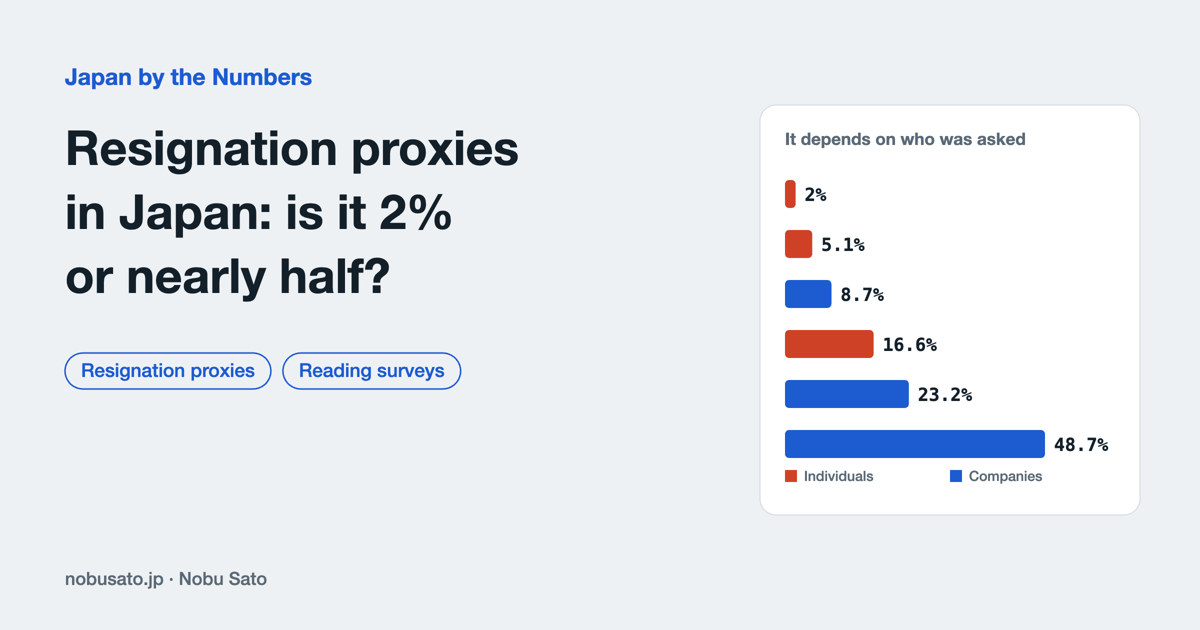
Fig.1Reported use of resignation proxies in Japan ranges from 2% to 48.7% depending on who was asked. Red: individuals. Blue: companies or workplaces.
Why do the surveys disagree so much?
The surveys disagree because they ask different people about different time windows.
Mynavi asked only full-time employees who had changed jobs in the past year: 16.6% had used a proxy. Everyone in that group has just quit, so the number runs high. Persol Research asked everyone who had left a job, and got 5.1%. en Japan asked users of its job site whether they had ever used one, which includes plenty of people who have never quit. That gives 2%.
Company surveys measure something else. They ask whether at least one employee left this way, so a bigger company is more likely to say yes. Tokyo Shoko Research found 21.3% of large firms and 7.8% of smaller ones. The Osaka Labour Bureau's 48.7% counts any case, ever.
None of them is wrong. Each answers its own question. The trouble starts when a headline turns one of them into a claim about how many young Japanese use quitting services.
The spread inside one survey says more than the average. In Mynavi's data, salespeople used proxies most, at 25.9%. People in their fifties barely did, at 4.4%.
Next to every number I use, I write down the source, the date and who was asked. Data published by the proxy companies themselves I read as a claim. It only counts their own customers.
Why do people pay someone else to resign?
Mostly because of the workplace. The top reasons are being held back, feeling unable to raise it, and fear of the boss.
In Mynavi's survey the top reason was being talked out of leaving, or expecting to be (40.7%), followed by feeling there was no room to bring it up (32.4%). In Persol Research's survey, 42.3% wanted to leave immediately and 28.8% were afraid of their boss. In en Japan's, 60% of users said they would not have used one if their boss had been easy to talk to.
Executives at overseas HQs often read this as a story about fragile young workers. I read it differently.
When I assess someone, I keep who they are separate from the situation they are in. The same person behaves very differently under a different manager. At least going by the answers, nearly every reason on these lists is about the situation: how departures get handled, and whether it feels safe to say you are leaving. I wrote more about looking at people in layers in a piece on exit surveys.
I once tried to keep a team member who had resigned. I asked for one more conversation. They declined to talk at all, and I never found out why they left.
When I saw that being held back was the top reason, I thought of that. What I meant as a conversation may have felt like pressure. And without the reason, the company had nothing to fix.
So if someone at your Japan entity quits through a proxy, read it as a diagnostic. One case tells you little. Several under the same manager tell you a lot about that manager.
Should you avoid hiring people who used one?
In a Tokyo Shoko Research survey from April 2026, 26.0% of Japanese companies said they would not hire someone who had used a resignation proxy at a previous job, and another 49.3% said they would be cautious. That is three firms in four.
Some caution is fair. Companies worry about handovers that never happen. In the same survey, about 30% of firms contacted by a proxy had received notices touching on matters only lawyers may handle, such as overtime claims. In February 2026 the head of a major proxy operator was arrested on suspicion of violating Japan's Attorney Act, and was later indicted.
Being wary of the operators is one thing. Judging the candidate is another. Used a resignation proxy is a label, and a label is not evidence about a person. Under that label you will find people escaping harassment and people dodging an awkward talk.
Tokyo Shoko Research notes that interviews and reference checks sometimes surface this history. When a label like that comes up, I stop and ask what actually happened. There is time to decide after that. I have written separately about what reference checks in Japan can and can't tell you.
What I still don't know
On the company side, Mynavi's number rose from 16.3% in 2021 to 23.2% in just the first half of 2024.
I can't tell from that alone what changed. Maybe more workplaces make it hard to speak up. Maybe people who always found it hard now have a way out.
Or maybe the people themselves have changed. In en Japan's survey, the top reason for not using a proxy was that you should tell the company yourself (44%). If that sense of should fades, behavior changes even when the workplace does not. More people seem to prefer text or a third party over a face-to-face talk, at work and outside it.
Probably it is all three.
Whichever it is, the question for anyone running a team in Japan is the same. If one of your people wanted to leave, would they tell you to your face?
The same reading applied to overtime hours: Overtime in Japan: 13 hours a month, or 21?
Shorter notes that don't make it into a full article go on LinkedIn. Follow me there.