10.23 Million Want to Change Jobs in Japan. 3.3 Million Did.
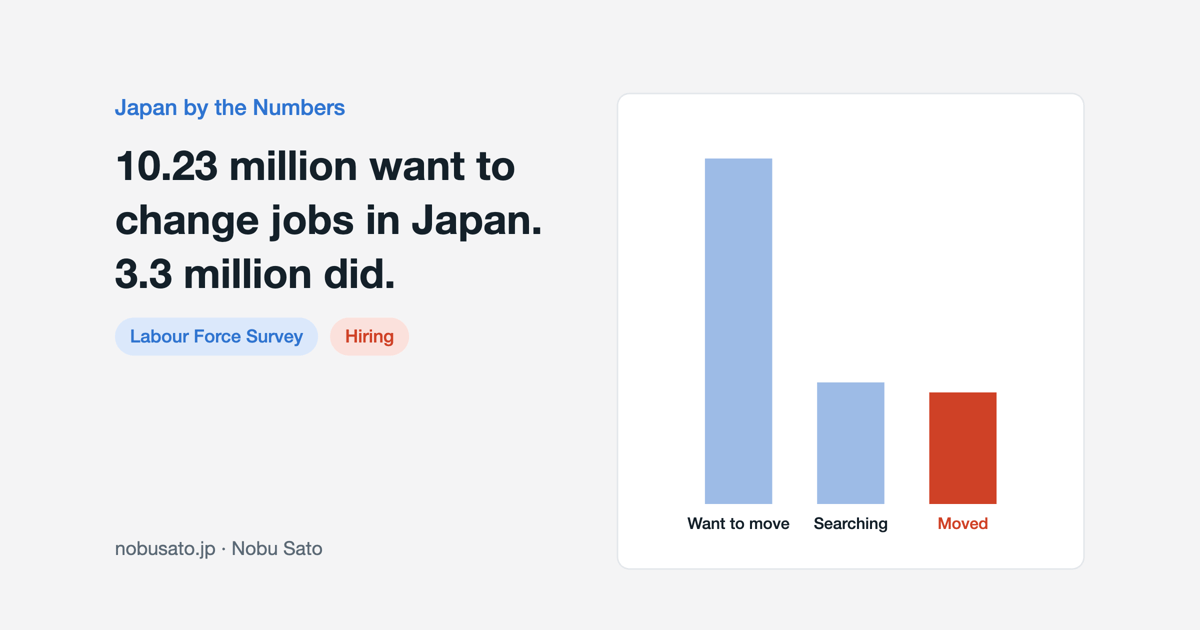
More people in Japan say they want to change jobs than at any point since comparable data began in 2013: 10.23 million in 2025, according to the Statistics Bureau's Labour Force Survey. The number who actually changed jobs that year was 3.3 million, and it has barely moved since 2023.
If you are hiring in Japan, the first number is the one recruiters will show you. The second is the one your pipeline will feel.
What do the two numbers actually count?
They count different people, so read the definitions first. In the Labour Force Survey (detailed tabulation), a job changer is an employed person who has a previous job and left a job within the past year. There were 3.30 million in the 2025 annual average, 4.8% of everyone employed.
The bigger group is called tenshoku-tō kibōsha, roughly “people wishing to change jobs, etc.” The “etc.” matters. It covers people who want to quit and move, and also people who want to keep their current job and add another one. Someone hoping for a side gig is in the 10.23 million. Headlines usually drop that part.
Both figures are headcounts at a point in time. Neither is a turnover rate or a success rate. The 3.3 million who moved are not necessarily drawn from last year's 10.23 million who wanted to; some moved on impulse, some were pushed out by restructuring. So dividing one by the other and announcing that “a third of people who want to move actually do” is wrong. What the pair supports is narrower: the volume of wanting and the volume of moving have been heading in different directions.
Ten years of wanting versus moving
The Statistics Bureau publishes the series back to 2015. People wishing to change jobs rose from 8.12 million to 10.23 million, up 2.11 million or about 26%. Actual job changers went from 2.99 million to 3.30 million, up about 10%.
Job changers peaked at 3.53 million in 2019, fell to 2.90 million in 2021, and have sat at 3.28, 3.31 and 3.30 million for 2023 through 2025. The wishing number dipped once, in 2024, and otherwise kept climbing.
Fig.1Japanese workers who want to change (or add) jobs rose from 8.12 million in 2015 to 10.23 million in 2025, while actual job changers rose only from 2.99 million to 3.30 million and have been flat since 2023. Of the 10.23 million, 3.60 million were actively searching in 2025. Source: Statistics Bureau of Japan, Labour Force Survey (detailed tabulation), 2025 annual average.
Only 3.6 million of the 10.23 million are looking
The survey splits the wishing group into those who are actually searching or preparing to search, and those who are not. In 2025, 3.60 million were searching and 6.63 million were not. About 65% of the people who say they want to move have done nothing about it yet.
The searching group itself grew, from 2.71 million in 2015 to 3.60 million. More people are looking. Moves still did not rise. My reading is that more people are searching and then staying put, either because nothing landed or because they decided the move was not worth it. That is an inference. The survey does not ask why.
Why don't more of them move?
Outside the statistics, the stopping points I see in hiring are fairly consistent. The base salary goes up, but the candidate cannot tell whether the full package, with retirement allowance and benefits, comes out ahead. A spouse is not on board. They do not want to leave their team in a bad spot. And they are unsure they will be good enough at the new place.
Saying “I'd consider it” is free. Resigning means clearing each of those, one by one. In Japan the cost of moving is real but hard to see from outside, which is why foreign managers tend to underestimate it.
The rise in wishing is still a real shift. Changing jobs has gone from unthinkable to thinkable for millions of people. Lifetime employment is loosening. It has not collapsed.
What this means for your Japan hiring plan
Treat “open to a conversation” as the top of a funnel with a steep drop. On a talent map, most people marked as willing are in the 6.63 million who are not searching. They will take your recruiter's call. That is different from accepting your offer.
I argued in a talent map is not a list that the map should show structure, not names. Readiness belongs in that structure. Even three rough stages help: willing to talk, actively looking, and has the family conversation behind them. Forecasts built on the first stage alone will run long. The numbers on offer declines in Japan show what happens at the last step.
Age widens the gap. I covered who moves by age in Japan's job change rate; the short version for 2025 is a 9.9% job-changer ratio for ages 15 to 24 and 3.5% for 45 to 54. The senior hires foreign companies most often need come from the slowest-moving band.
It also fits what I have seen when a Japan entity head needs replacing: the hire takes 6 to 12 months, with search fees well above the usual 30% of salary. A large pool of people who would talk does not shorten that. Budget the time as if the pool were small.
A caveat on the headline number
Because the 10.23 million includes people who want a second job, the growth in people who want to quit and move is probably smaller than the headline suggests. I have not checked the age breakdown of the wishing group, which sits in the detailed e-Stat tables. The 2025 annual average is the latest full-year data as of October 2026.
Even with those limits, 0.9 million more people searching over ten years and almost no change in moves is a gap I would put into any hiring plan for Japan before the first recruiter call.
Sources
- Statistics Bureau of Japan, Labour Force Survey (detailed tabulation) 2025 annual average, overview (Japanese): 3.30M job changers, 4.8% ratio; 10.23M wishing to change jobs (3.60M searching, 6.63M not); 2015-2025 series
- Statistics Bureau of Japan, Labour Force Survey (detailed tabulation) 2025 annual average, summary (Japanese): job changers down 10k, wishing up 230k
- Statistics Bureau of Japan, Statistics for Tomorrow 2026 (Japanese): wishing to change jobs at highest since comparable 2013 data
- Statistics Bureau of Japan, Labour Force Survey glossary (Japanese): definitions of job changer, wishing to change jobs, searching
Shorter notes that don't make it into a full article go on LinkedIn. Follow me there.