Chinese Mobile Games in Japan: 16% of Overseas Revenue
Chinese mobile games earned roughly $3 billion from Japan in 2025, by my estimate from China's own industry report. BYD, China's biggest carmaker, sold 2,223 cars in Japan in 2024. Same country of origin, same consumers. The difference is who owns the shop floor.
I bring this up because foreign hardware companies sometimes point to Genshin Impact as proof that Japanese consumers will buy Chinese products. They will. But a game gets into Japan by a route that is closed to almost everyone else. Copying the game playbook for a physical product is an expensive way to learn that.
How much do Chinese games earn in Japan?
China's game industry association does not publish a Japan dollar figure; it publishes a share. The source is the 2025 China Game Industry Report, released on December 19, 2025 (the latest edition as of October 2026) by the game publishing committee of the China Audio-Video and Digital Publishing Association, with data from Gamma Data (CNG).
According to that report, games developed by Chinese companies earned $20.46 billion outside China in 2025, up 10.23% year on year. Mobile games were $18.48 billion of that. By market, the US accounted for 32.31% of overseas mobile revenue, Japan 16.35% and South Korea 9.15%. Germany, the UK and France together came to 8.84%.
Multiply $18.48 billion by 16.35% and you get about $3.0 billion. That is my arithmetic on a rounded share, so treat it as an estimate.
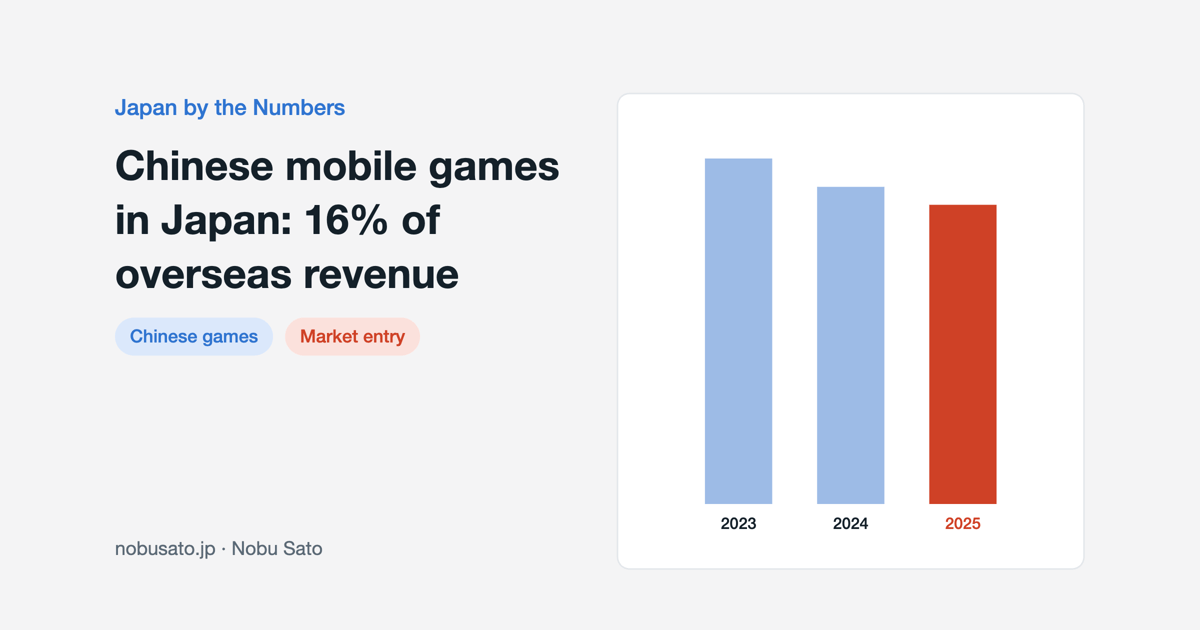
Fig.1Japan's share of Chinese self-developed mobile games' overseas revenue fell three years running: 18.87% in 2023, 17.32% in 2024, 16.35% in 2025. The US held at 31 to 33%; South Korea edged up from 8.18% to 9.15%. Source: China Game Industry Reports 2023 to 2025 by the Game Publishing Committee of CADPA (data: Gamma Data), via press reports.
What Japan's falling share means
Probably not a decline, at least in dollars. Working backwards from the 2025 mobile total and its growth rate, overseas mobile revenue in 2024 was about $16.3 billion. At Japan's 17.32% share, that is roughly $2.8 billion. So Japan most likely grew. Other markets just grew faster. Both dollar figures are my estimates.
Watch the denominator here. 16.35% is the share of Chinese games' overseas revenue that comes from Japan. It is a different number from the share of Japan's game market held by Chinese games.
For the second number, the closest public figure is from Sensor Tower. Japan's mobile game in-app purchase revenue on the App Store and Google Play was about $11 billion from August 2024 to July 2025, and Japanese publishers took more than 52% of it. Everyone else, from the US, Korea, China and elsewhere, splits the remaining 48% or so. Dividing my $3 billion by $11 billion gives a bit under 30%, but the two figures come from different firms using different methods. I would use that ratio only for a rough sense of scale, nothing finer.
Which titles are doing the work?
Title-level numbers come mostly from Sensor Tower analyses, here as reprinted by the Chinese trade outlet Baijing. In the second half of 2024, miHoYo, the studio behind Genshin Impact and Honkai: Star Rail, ranked third among publishers in Japan by revenue. Japan supplied 38% of Honkai: Star Rail's global revenue in that period. FirstFun's strategy game Last War made about $200 million in Japan in the same six months, and NetEase also made the top ten publishers.
The anime-style RPGs get the headlines. The money overseas leans on strategy games. In China's 2025 report, strategy titles (including SLG) made up 49.96% of revenue among the top 100 Chinese mobile games abroad.
Why a game can do this and a car can't
Mostly it's distribution, in my view. A game listed on the App Store and Google Play appears on every phone in Japan on launch day. There is no distributor to recruit, no dealer network, no repair centre, and the platform collects the money. It takes a fee for that. Even so, it is far faster than building retail in Japan from nothing.
A car has to build all of that first. BYD started selling passenger cars in Japan in 2023. Its 2024 sales of 2,223 units, reported by the Japan Automobile Importers Association, were up 54% and beat Toyota's battery-EV count in Japan. Against 4.42 million new vehicles sold in Japan in 2024, they are 0.05%. The whole Japanese EV passenger car market was only 59,736 units that year, which does not help. Japanese car buyers want to know where they can test drive, who fixes the car, and what the trade-in is worth. Each of those takes people and years.
Content is the second reason. The Chinese hits in Japan tend to ship with Japanese voice acting recorded with Japanese voice actors and an art style close to anime. Plenty of players don't think of them as foreign at all. A hardware product, however good, gets compared with Japanese brands at the counter, on the explanation it gets and on how repairs are handled.
If you sell hardware through a partner, I wrote about why your distributor in Japan isn't selling. Games are one of the few industries that can skip that layer entirely.
What this means for who you hire
Game companies in Japan tend to staff live operations, marketing, localisation and community before they build anything that looks like a sales team. Apple and Google own the storefront. The local team's job is deciding what Japanese players get, and when.
A hardware company that copies that org chart arrives with no one to own the channel or after-sales service. A software company has a different version of the trap, which I covered in why your first hire in Japan should not be sales. In both cases, I find it useful to start the org design from one question: who in Japan owns the point of sale and the repair or support promise?
Japan's stock of inward FDI is small, and I have argued it is a good market that is hard to enter. The game numbers suggest to me that much of that difficulty sits in owning the shop and the service in Japan. That is my reading. No dataset here proves the cause.
I also can't tell from the report whether Japan's falling share reflects saturation or Chinese studios shifting effort to the US and Europe. What stays with me is simpler. A business making around $3 billion a year from Japanese players does it without a single shop in the country. If you make physical products, that is the part of the story you can't borrow, and your Japan plan should budget for it from the first hire.
Sources
- Xinhua, release of the 2025 China Game Industry Report (Dec 19, 2025): overseas revenue of Chinese self-developed games $20.455bn
- Gelonghui, full text of the 2025 report: overseas mobile $18.478bn; US 32.31%, Japan 16.35%, Korea 9.15%; strategy 49.96%
- The Paper, 2024 China Game Industry Report (Dec 13, 2024): overseas $18.557bn; Japan 17.32%
- 36Kr, 2023 China Game Industry Report: overseas $16.366bn; Japan 18.87%
- Baijing, reprint of Sensor Tower 2025 Japan Game Market Insights: Japan mobile IAP about $11bn, Japanese publishers over 52%
- Baijing, reprint of Sensor Tower analysis (Feb 2025): 2H 2024 miHoYo third, Honkai: Star Rail 38% from Japan, Last War about $200m
- Sensor Tower, State of Japan Gaming 2025: (published September 2025): Japan mobile IAP revenue about $11bn, local publishers over half
- 36Kr Japan, based on JAIA and JADA releases: BYD 2,223 units in 2024; EV passenger cars 59,736
- nippon.com, based on JADA and Zenkeijikyo data: 4,421,494 new vehicles sold in Japan in 2024
- I could not reach the association's original report; figures above come via news coverage and reprints. Japan dollar amounts ($2.8bn, $3.0bn) are my estimates.
Shorter notes that don't make it into a full article go on LinkedIn. Follow me there.