Why you can't find most Japanese companies' financials
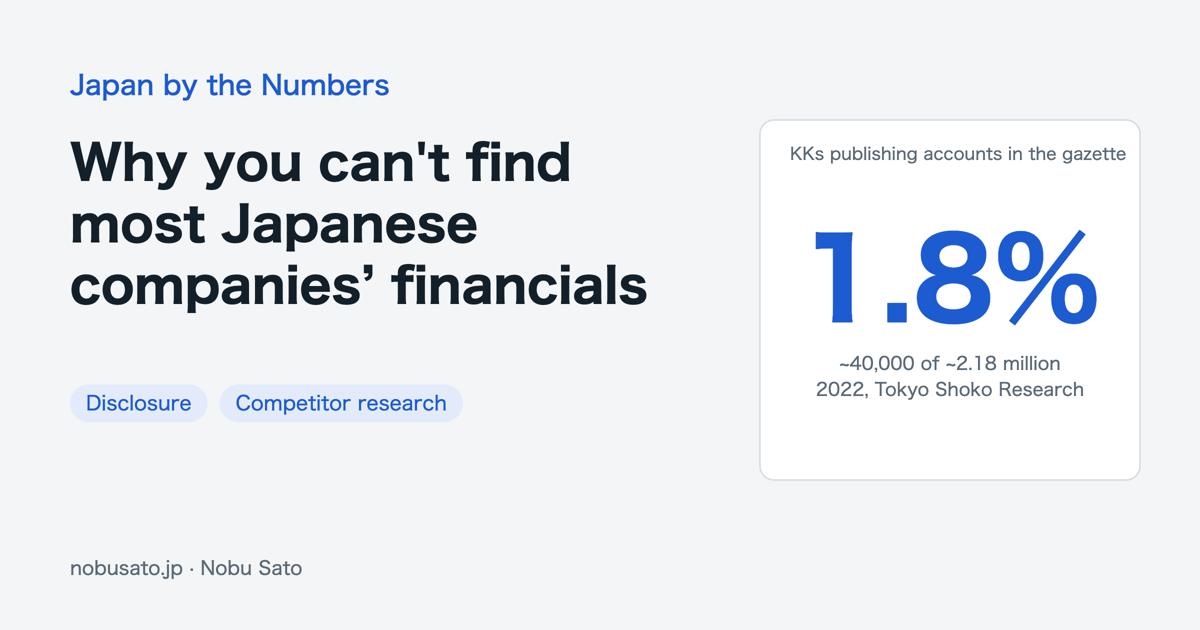
If you can't find a private Japanese company's revenue, it isn't your research skills. Japanese law requires every kabushiki kaisha to publish annual accounts. In 2022, only 1.8% did so in the official gazette.
That shapes how you should run competitor analysis and talent mapping in Japan.
Required by law, done by under 2%
Japan's Companies Act requires a KK to publish its balance sheet every year, and large companies their income statement too. Failure can bring a fine of up to ¥1 million.
Tokyo Shoko Research counted in 2022. About 2.18 million KKs were required to publish. About 40,200 published in the official gazette, kanpo, that year: 1.8%. The year before was also 1.8%. Listed companies file securities reports instead and aren't in the count.
TSR's explanation for the low rate is simple: the fine is almost never enforced.
Fig.1In 2022, 1.8% of KKs required to publish accounts did so in the official gazette. The count covers only the gazette, not newspapers or companies' own websites, so the true rate is somewhat higher, but not by enough to change the conclusion.
Check the definition: gazette only
Companies can publish accounts in three ways: the gazette, a daily newspaper, or an electronic notice on their own website. TSR counted only the gazette.
Strictly, 1.8% is the share you can find in the gazette, not the full publication rate. But most small firms that skip the gazette probably don't post accounts online either. For the private company you want to look at, assume the financials aren't there.
If you can't find it, write "not disclosed"
The most common mistake in competitor tables is filling the gaps anyway. No revenue figure, so someone multiplies headcount by an industry average and drops it in a cell. Three meetings later it's being treated as fact.
I write "not disclosed" in that cell and note next to it which proxy is available and where it came from. Estimates are fine if they're labeled as estimates with the method shown. People making decisions need to know what's fact and what's guesswork more than they need a full table.
Which companies belong on the list in the first place is the subject of Picking the wrong competitors. What the list is for is in A talent map is not a list.
Three legal proxies for company size
These three sources are public and legal to use.
The Japan Pension Service's registry of insured workplaces. Search by company name or corporate number and you can see how many people are enrolled in employees' pension at that workplace, updated monthly. It's closer to the real number of regular employees than "about XX staff" on a website. Two cautions: if head office enrolls everyone centrally, branch staff show up under head office; and the results may not be republished, so look but don't paste them into external documents.
The official gazette. The few companies that publish accounts there have balance sheets you can read. Mergers, capital reductions and dissolutions are also announced there, which tells you what has changed recently.
Credit research reports. Tokyo Shoko Research and Teikoku Databank sell revenue, profit, headcount and customer data on private companies. Some of it is self-reported, some estimated by their researchers, so cite it as such.
Cross-checking the three usually tells you whether a company has 30 people or 300, and revenue in the hundreds of millions of yen or the billions. For talent mapping, that's usually precise enough.
The TSR count is from 2022, and I haven't found an update on the same basis. There's no reliable figure for electronic notices, so I can't tell you whether the real publication rate is 3% or 10%.
The pension registry counts people in employees' pension only, not part-timers or agency staff, and doesn't break down by department. To size a specific team you still need LinkedIn and industry knowledge.
When you can't find a number on a Japanese competitor, what do you do with the cell?
Even listed companies that do disclose often give more than one number. For one company with four scopes, see One company, four female manager ratios.
Shorter notes that don't make it into a full article go on LinkedIn. Follow me there.