Four layers: one ruler for people and organizations
I've seen too many people with great skills leave after six months. I've also seen people with ordinary skills get better and better once they were in the right seat. The difference wasn't in the skills.
Yet traditional interviews spend most of their time on skills. What can you do, what have you done, which tools have you used. You do need to check those. They just tell you the least about whether a hire will work.
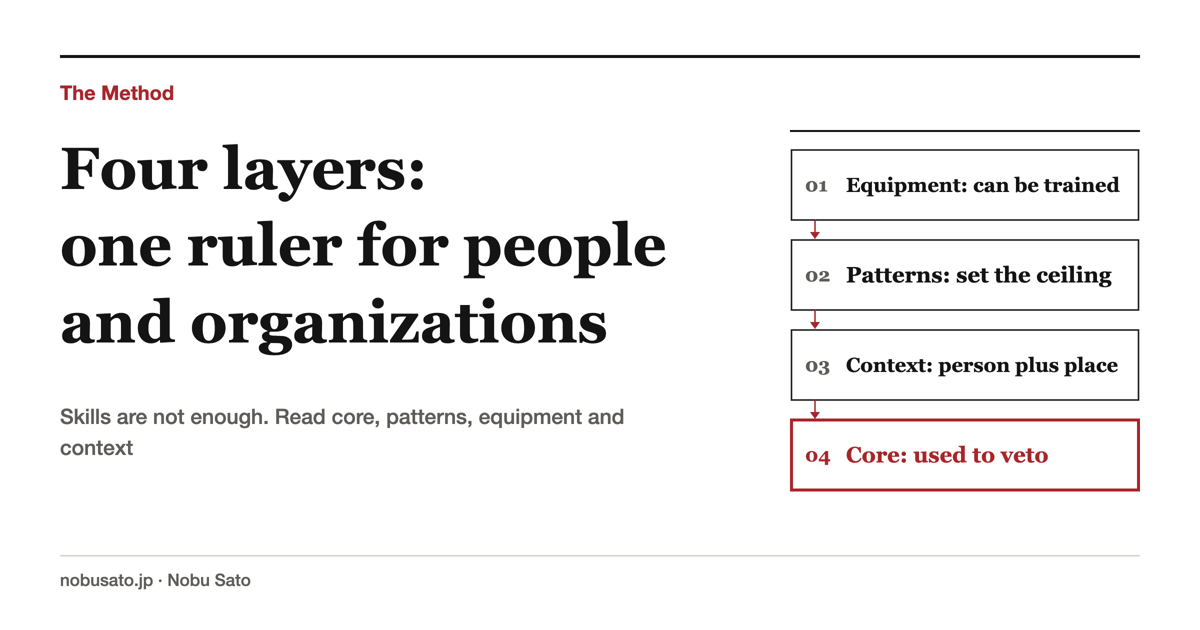
So I read a person in four layers.
Core: used to veto
Core is drive, deep traits and the values a person won't cross. This layer barely changes, so I use it to veto.
For drive I look at six things: autonomy, mastery, influence, belonging, security, reward. None is better than another. What matters is the order. If a role can't give someone the two things they want most, I won't recommend the hire, however capable they are. Sooner or later they'll leave.
I don't learn this by asking "what matters most to you?" Everyone can answer that. I look at why they actually left and joined their last few jobs. What people say and how they vote with their feet often differ.
Values work the same way. Don't listen to what they say. Look for a time they actually paid a price to hold the line.
Patterns: set the ceiling
Patterns are how someone behaves under pressure, how they learn on unfamiliar ground, and how they habitually think. They decide how high a person can go, and they're hard to change.
Under pressure, I mainly watch for derailers: excessive caution, arrogance, suspicion, drama, avoidance, perfectionism, people-pleasing. When things go well these barely show. Everyone looks fine. You have to take one real failure and ask what they did at the time. The lesson they drew afterward interests me much less. That part is usually rehearsed.
For how fast someone learns, I look in five directions: thinking through problems, dealing with people, facing change, driving results, and seeing themselves clearly.
Equipment: can be trained, can be replaced
Ability, experience and skills. For experience I mark the depth. Did they watch from nearby, take part, or lead it themselves? "I've done that" is where the most padding hides.
This layer can be trained, and the person can be replaced. I think traditional interviews weight it too heavily, and knowledge and skills are exactly what gets overestimated most.
Context: the person plus the environment
This layer belongs to the combination, not to the person alone. The same person can perform very differently under another boss, in another team, at another stage. So what I look at here is how they work with someone of the opposite style. Do they still deliver, do they need someone in between to translate, or does it turn into friction?
Without this layer, you can't separate "this person isn't good" from "this person isn't good in this seat."
A company gets the same four layers
When I look at a company, I use the same ruler.
An organization's core is its real priorities, its real power structure, its real rewards and punishments. Ignore the values poster. Look at the last few times resources were fought over, and where the money and people actually went. Look at who was recently promoted, who was disciplined, and why. Whatever behavior that rewards is what the company really rewards. If this layer is broken, say decision rights were never settled, I don't produce a redesign plan. I put it on the table as an owner-level problem first.
An organization's patterns have derailers too: approvals piling up, turf wars, only good news traveling upward, a firefighting culture, process perfectionism, pleasing HQ or a major client, nobody owning responsibility. The most telling question is this one. The last time someone openly challenged the status quo, how did it end?
An organization's equipment is its people, functions, mechanisms and experience. I look at this layer last. The most common misdiagnosis is to inventory only this layer. "We're missing an HR business partner." "A new system will fix it."
An organization's context is its stage: pioneering, scaling, tightening efficiency, or shrinking. And whether that matches the stage it's good at.
The interview order matters too. The top person first. Then middle managers and frontline staff about the same events. Then back to the top person to compare. Do it the other way and the middle managers will have aligned their story first.
Where the two sides connect
What an organization diagnosis finds in the patterns layer, how the company really makes decisions and what its managers are like, is exactly the context input you need when you read a person. You don't have to rely on the company's description of its own environment.
It works in reverse as well. Where the organization's derailers and the derailers of the person in a key seat sit on the same decision chain, that's where things break first.
The anchors aren't calibrated yet
I've used the four layers to read people for a long time, but I don't yet have enough look-backs after people joined to calibrate the anchors. The structure for organization diagnosis is set, but it hasn't been through a full real cycle. I'd rather not sound more certain than I am.
For one article that uses the four layers, see Before you change jobs, do a four-layer self-portrait.
Putting the four layers against a role is the next page: does this person fit this role? The method overview is one click back.
Shorter thoughts go on LinkedIn.