China's FDI into Japan halved in 2025: check the dates
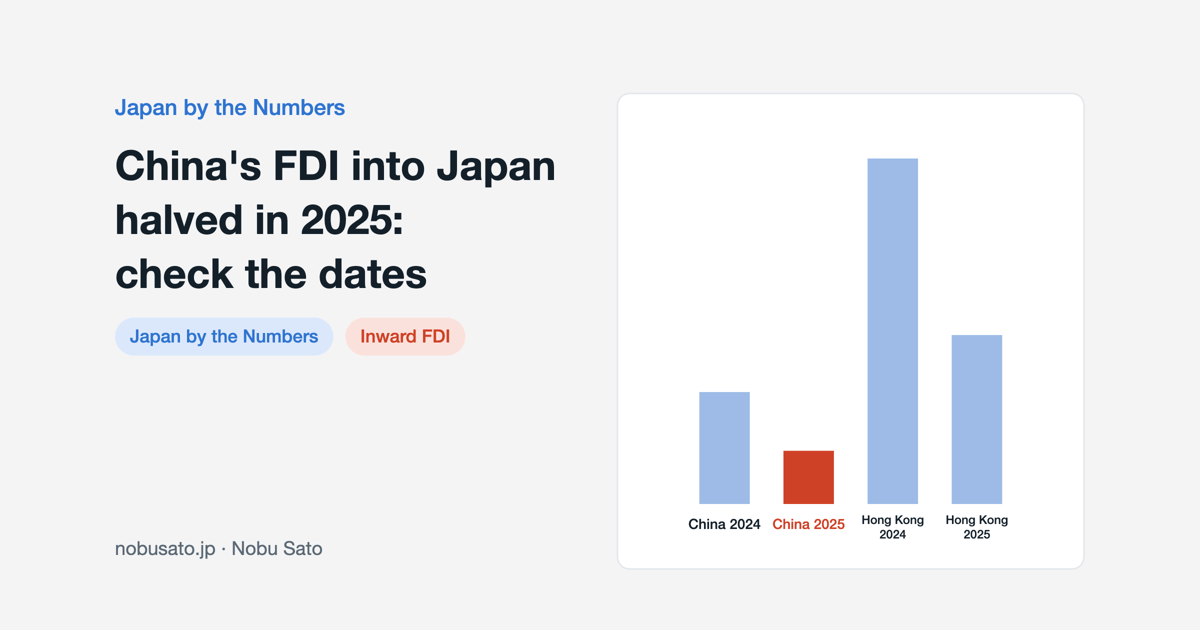
Direct investment into Japan from mainland China halved in 2025, and so did investment from Hong Kong. It's tempting to link that to the deterioration in Japan-China relations. The dates don't line up. Reports of the deterioration began in November 2025, when most of the year was already over.
As of October 2026, almost none of the official numbers that would answer the question cover the period after November. Some numbers did move, though. It helps to know which ones, and why.
What the 2025 drop can and can't tell you
Nobody can say yet whether the tensions did this. According to JETRO's World Trade and Investment Report 2026, which uses Ministry of Finance and Bank of Japan balance of payments figures, net direct investment into Japan from mainland China was $652 million in 2025, down 52.5% from $1,373 million in 2024. Hong Kong fell 51.1%, from $4,232 million to $2,068 million. Over the same year, total inward investment into Japan rose to $45.8 billion, about 2.4 times the 2024 level.
A few caveats before anyone builds a story on that drop.
Timing. An annual figure sums January to December. At most two months of it fall after November 2025.
Composition. Net flows include loans between parents and subsidiaries, so a single large repayment can swing a country's number. Hong Kong had jumped 88.2% in 2024, so some of the 2025 fall may simply be that spike unwinding.
Attribution. Balance of payments data is classified by the country of the immediate investor. Money routed through Hong Kong isn't necessarily Chinese, and a Chinese company investing through a Singapore holding company shows up as Singapore.
Scale matters too. JETRO's 2025 Invest Japan Report puts mainland China's direct investment stock in Japan at ¥1.33 trillion at the end of 2024, 2.5% of the total and 11th by country. Hong Kong held ¥3.26 trillion, or 6.1%. In Japan's inward investment as a whole, China is a small piece.
Fig.1The 2025 FDI flows (China and Hong Kong both roughly halved) and JETRO's foreign-affiliate survey (fieldwork September to October 2025) measure the period before the November 2025 reports. The numbers that do cover later months, Business Manager visa entries in H1 2026 (−80.9%) and Japanese firms in China as of June 2026 (Teikoku Databank), each carry other causes. Sources: JETRO, Immigration Services Agency via Kyodo, Teikoku Databank.
Counting Chinese companies in Japan
There's no current official count. METI's Survey of Trends in Business Activities of Foreign Affiliates ended with its 2020 edition (fiscal 2019 data), and METI now points users to JETRO. In that last edition, 317 of 2,808 tabulated foreign affiliates, or 11.3%, had a Chinese lead shareholder, as of March 2020. That is a six-year-old number based on respondents, not a census.
JETRO's own FY2025 survey of foreign-affiliated companies in Japan (fieldwork September to October 2025, published February 2026) measures sentiment instead of headcount. Among Chinese-owned firms (n=168), the share saying Japan's geopolitical importance had declined rose from 8.8% to 17.9%, the largest rise of any parent region. Still, 50.0% saw no change and 19.6% said it had increased. And the fieldwork, again, ended before November.
The number that moved most in 2026 has another cause
New entries to Japan on the Business Manager residence status fell 80.9% year on year in the first half of 2026, to 635 people, according to Immigration Services Agency figures reported by Kyodo. Jiji Press reported the same 80.9% fall. The figure covers all nationalities.
The obvious driver is regulatory. From October 16, 2025, the minimum capital for this status rose from ¥5 million to ¥30 million, at least one full-time employee became mandatory, and the applicant or an employee must show business-level Japanese. The cheap route for small founders largely closed. In this number, there's no way to separate any effect of the change in relations from the rule change.
The reverse flow: Japanese companies in China
Teikoku Databank counted 10,118 Japanese companies operating in mainland China (excluding Hong Kong and Macau) as of June 2026, down 22.4% from 13,034 in 2024 and the lowest since its survey began in 2010. Over two years, 4,137 exited or could no longer be traced while 1,221 entered. TDB lists several factors, including the deterioration in relations, China's slower growth, and supply chains moving to Southeast Asia and Japan. Most of that two-year window predates November 2025, and the decline has run since the 2012 peak of 14,394.
So here's where things stand as of October 2026. Both directions were already shrinking, and the reported deterioration in relations came on top of that trend. How much it added won't be measurable until full-year 2026 balance of payments data, with revised figures due in spring 2027.
What to do while the statistics catch up
Watch your own numbers before the headlines. Deal velocity, the questions customers' credit and compliance teams ask, applications per job post, offer declines. These move months before any national statistic. A foreign company entering Japan once came to me with questions that were all about procedures. Where it actually got stuck was hiring its first employee: who, at what pay, how to interview and attract them. That part rarely shows up in public data, so your own funnel is the only early signal you have.
Plan for longer timelines. Under the new Business Manager rules you need ¥30 million in capital and a full-time employee, which means finding someone to hire before the founder's status is approved. Hiring in Japan often takes several months on its own, so a six-month launch plan now looks optimistic to me. I wrote about who that first person should be in why your first hire in Japan should not be in sales.
Decide the company name deliberately. Some firms keep the parent brand, others choose a trade name that tells Japanese buyers what the business does. Either can work. Customers' credit checks will surface the ownership anyway, so put the parent company in your corporate profile from day one and keep a name you can explain in one sentence. With candidates, a concrete job post that says what the Japan team does and how it is staffed usually counts for more than the name.
None of this is specific to Chinese companies. Most of it is the same set of problems I described in what foreign companies struggle with in Japan, in a market whose inward investment is low to begin with, as covered in Japan's inward FDI is low. For now I treat the change in relations as an added cost on an already hard entry, sized by your own pipeline data.
Sources
- JETRO, World Trade and Investment Report 2026 (Japanese), inward FDI: 2025 China $652m (−52.5%), Hong Kong $2,068m (−51.1%), world $45.8bn
- JETRO, 2025 Invest Japan Report (Japanese), FDI by country: end-2024 stock China ¥1.33tn (2.5%), Hong Kong ¥3.26tn
- Ministry of Finance, inward and outward direct investment (balance of payments; source data for JETRO figures)
- JETRO, FY2025 Survey on Business Conditions of Foreign-Affiliated Companies (fieldwork Sep to Oct 2025): Chinese firms seeing lower importance 8.8% to 17.9%
- METI, 54th Survey of Trends in Business Activities of Foreign Affiliates: Chinese-led 317 firms (11.3%, March 2020)
- METI, Survey of Trends in Business Activities of Foreign Affiliates (discontinued after 2020 edition)
- Immigration Services Agency, revision of Business Manager landing criteria (effective October 16, 2025)
- Kumamoto Nichinichi Shimbun (Kyodo, October 16, 2026): Business Manager new entries H1 2026: 635, −80.9% (ISA figures; original release not checked)
- nippon.com (Jiji Press, October 16, 2026, Japanese): Business Manager down 80.9% (ISA figures)
- Teikoku Databank, Japanese companies entering China survey 2026: 10,118 firms (June 2026), −22.4% vs 2024
Shorter notes that don't make it into a full article go on LinkedIn. Follow me there.