Japan's 570,000 Care Worker Gap by 2040 Is a Projection
The 570,000 figure for Japan's care worker gap in 2040 is a government estimate of need. Nobody measured a shortage. What has been measured is worse news: the number of care workers actually fell in 2023, for the first time since Japan's long-term care insurance began.
If you sell care robots, run a staffing business, or plan to hire foreign caregivers, the difference matters. One number tells you how big the problem might get under today's way of working. The other tells you the supply side has stalled.
570,000 is the need if nothing about the work changes
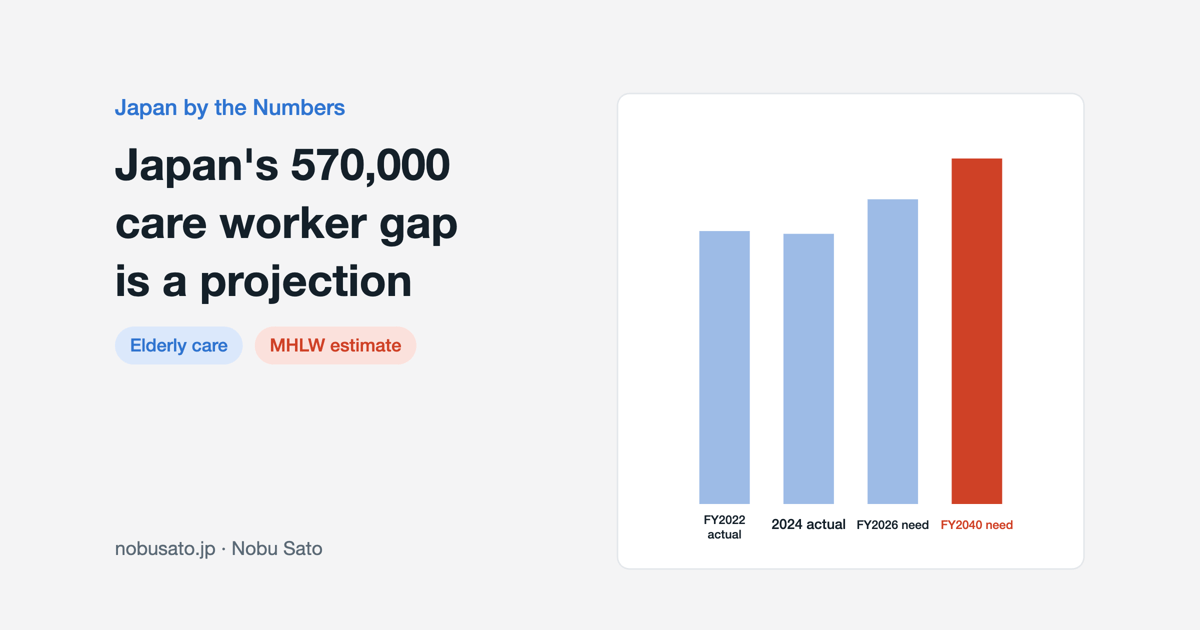
The source is a July 2024 release from Japan's Ministry of Health, Labour and Welfare (MHLW), titled "Required number of care workers based on the 9th long-term care insurance plans." It puts the care workforce at about 2.15 million in fiscal 2022. It estimates that Japan will need about 2.40 million in fiscal 2026 and about 2.72 million in fiscal 2040. The gaps are roughly 250,000 and 570,000.
It helps to know how it was built. Each prefecture estimated the volume of care services it expects to provide under its 9th plan (FY2024 to FY2026) and converted that into a headcount. MHLW added the prefectures up. The figures are headcounts, not full-time equivalents.
There are two things the number doesn't say. It doesn't forecast supply. There's no projection of hiring, quitting or foreign intake in it. And because it converts service volume into people, it roughly assumes each worker keeps supporting the same amount of care as today. That second point is my own reading of the method. The release doesn't spell it out. If productivity rises, the need falls. If demand for care grows faster than the plans assume, it rises.
So the honest label is "people needed if nothing about the work changes."
What the actual count shows
MHLW also publishes a measured series. In its December 2024 update, as of October 1, 2023, Japan had about 2.126 million care workers, down about 29,000 from the year before. That was the first year-on-year decline since the system started in 2000. The October 2024 count, published in December 2025, was 2,126,227, up just 487. As of October 2026 that is the latest figure.
Fig.1Japan's measured care workforce fell in 2023 for the first time and stayed flat at about 2.126 million in 2024. Against MHLW's estimated need of about 2.40 million (FY2026) and 2.72 million (FY2040), the gap from the 2024 count to FY2040 is about 590,000. Sources: MHLW, required number of care workers (July 2024); MHLW care worker series (December 2024 and December 2025).
Measured from the 2024 count, Japan needs about 590,000 more care workers by FY2040. That's 37,000 a year, every year, for 16 years. The last two years delivered minus 29,000 and plus 487. The FY2026 target would need 270,000 more people in two years. I'd treat it as already missed.
The job market agrees. In a September 2025 paper to the long-term care benefits subcommittee, MHLW reported a jobs-to-applicants ratio of 3.87 for care occupations in June 2025, against 1.05 for all occupations. That ratio only counts Hello Work, the public job service, so private job boards and agencies are outside it. I went through what these occupation ratios can and cannot tell you in the piece on job openings ratios by occupation. Care sits near the top either way.
How much are foreign workers filling?
There are four main routes for foreign caregivers: EPA candidates under economic partnership agreements, the "Care" residence status (for people who hold Japan's certified care worker license), technical intern training in care, and Specified Skilled Worker (SSW) in care.
SSW is the big one. MHLW counted 65,505 SSW care workers at the end of November 2025, a preliminary figure and a record. The Immigration Services Agency reported 12,227 people on the Care status at the end of 2024. EPA candidates and graduates numbered 3,004 as of February 2026. I could not find a published count of technical interns in care that is clearly labeled by occupation, so I have left them out. The three confirmed routes add up to about 80,000 people on mismatched dates, a little under 4% of the care workforce. Interns would not take that anywhere near 10%. For the wider picture, see foreign workers in Japan by the numbers.
That growth is fast. Next to the gap, it's still small. The government's planned intake ceiling for SSW care is 135,000 over the five years from FY2024. Fill it completely and you cover less than a quarter of 570,000. SSW (i) also caps total stay at five years. Unless a worker passes the national care worker exam and switches to the Care status, they eventually leave. So the real lever is retention. The size of the intake matters less.
Since April 2025, SSW and technical intern caregivers can also work in home-visit care, provided they have completed the entry-level care training and usually have at least a year of hands-on experience. Home care is where the shortage bites hardest. It is also solo work in a client's house, with records and family conversations in Japanese, so whether this works comes down to the employer's training.
Will robots and ICT shrink the need?
Adoption has moved quickly. An MHLW research survey run from September to November 2025 found that 47.2% of residential and overnight care facilities used monitoring devices (bed sensors and the like), and 56.4% used care-work support systems such as digital records. In the FY2022 survey the figures were 30.0% and 10.2%.
The state is paying for it. Prefectures subsidize care robots and ICT through a regional fund, and the 2024 care fee revision added a productivity bonus for providers. Uptake of that bonus is still thin: among eligible providers, 2.7% claimed the higher tier and 22.1% the lower tier in August 2025 claims.
Read the adoption rates with care. The survey's response rate was 35.1%, and facilities that have invested in technology are more likely to answer, so 47.2% probably runs high. An adoption rate also says nothing about hours saved. A sensor can cut night rounds. Bathing and toileting still need hands. I could not find any official estimate of how many workers technology could take out of the 2040 need.
What this means if you sell, staff, or work in care
For a robot or ICT vendor entering Japan, care looks like a market where labor scarcity sells machines. That's partly true. Subsidies and the bonus do push buyers. But the buyers are mostly small operators. The facility director and a floor leader decide, and there is no IT department. Who configures the system and trains night staff after the sale decides whether it gets used. If that job is left vague and handed to a distributor, deployments stall.
For staffing and support firms, the SSW pipeline keeps growing, but it is bounded by the ceiling and the five-year cap. The value is in keeping people and getting them to the national license.
If you work in care, a 3.87 ratio is bargaining power. Ask about night shifts, digital records and monitoring devices when you compare employers. Facilities that have invested tend to put less load on each person.
The 570,000 is the cost of keeping the work as it is. The more useful number would be how much care one worker can support in 2040. MHLW doesn't publish that yet. I will be watching whether the 10th plan estimates change that assumption.
Sources
- MHLW, Required number of care workers based on the 9th long-term care insurance plans (July 12, 2024): ~2.15M (FY2022), ~2.40M (FY2026), ~2.72M (FY2040)
- MHLW, Update to the care worker series, 2024 (December 19, 2025): 2,126,227 as of Oct 1, 2024, up 487
- MHLW, Update to the care worker series, 2023 (December 25, 2024): ~2.126M as of Oct 1, 2023, down ~29,000
- MHLW, paper to the long-term care benefits subcommittee (September 5, 2025): jobs-to-applicants ratio 3.87 for care occupations vs 1.05 overall, June 2025
- MHLW, Current state of foreign care workers (March 2026): SSW care 65,505 (end Nov 2025, preliminary), EPA 3,004 (Feb 1, 2026)
- MHLW, Foreign care workers in home-visit services (report, March 17, 2025): effective April 2025
- Immigration Services Agency, policy panel paper (August 20, 2025): Care residence status 12,227 at end 2024
- Immigration Services Agency, SSW nursing care field: planned intake ceiling 135,000 over five years
- MHLW, paper to the long-term care benefits subcommittee (March 30, 2026): monitoring devices 47.2%, care-work support 56.4%, response rate 35.1%
Shorter notes that don't make it into a full article go on LinkedIn. Follow me there.