Japan's Convenience Store Count Has Barely Moved Since 2019
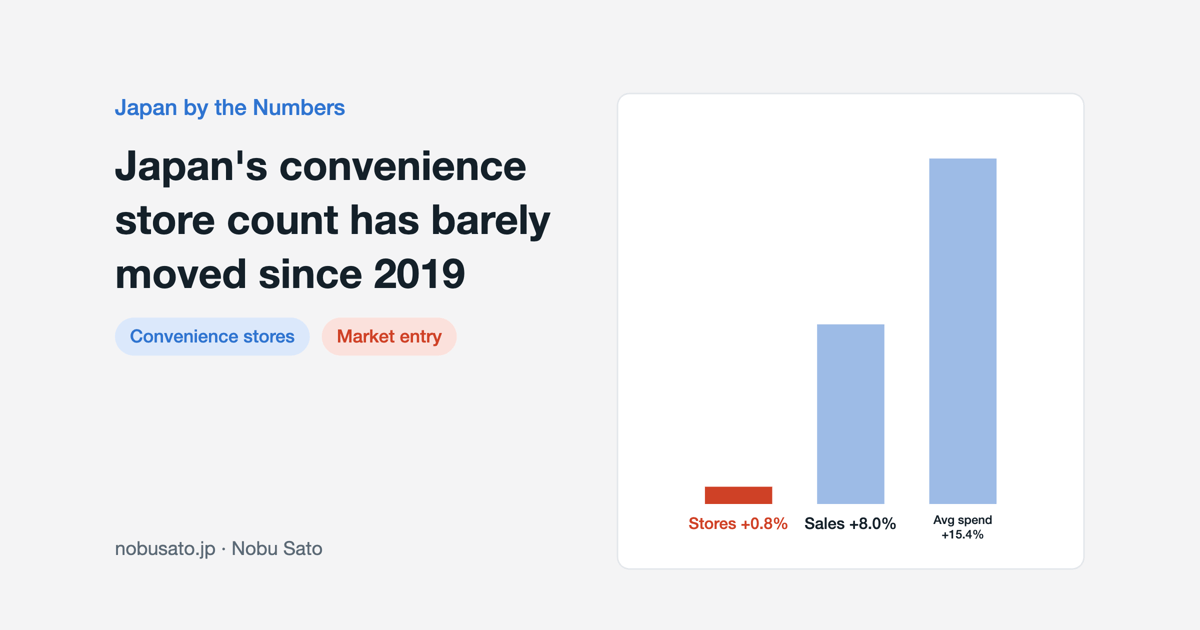
Japan's convenience store count has barely moved in seven years: 55,620 stores at the end of 2019, 56,054 at the end of 2025. Sales, meanwhile, have set a new record every year since 2022. If you plan to sell into this market, that gap tells you where the money is going, and it is not into new stores.
The numbers come from the Japan Franchise Chain Association (JFA), which has published monthly convenience store statistics since 2005. Read together, they describe a mature market that is short of people. That changes who you should be talking to.
Flat, give or take a few hundred
The end-2025 figure is technically a record, about 100 stores above the previous high in 2021. The JFA's year-end counts run 55,620 (2019), 55,924 (2020), 55,950 (2021), 55,838 (2022), 55,713 (2023), 55,736 (2024) and 56,054 (2025). Seven years inside a band of about 500 stores. The latest monthly figure I could confirm, for April 2026, is 56,125, up 0.5% year on year (as of October 2026).
In 2019 the count dipped for the first time since the series began, and the headlines called it the end of convenience store growth. Then it went up again. Both stories were reading a few hundred stores of noise on a base of 55,000.
Check the denominator before you quote any of this. The JFA figure covers its seven regular member chains: Seven-Eleven, FamilyMart, Lawson, Ministop, Daily Yamazaki, Seicomart and Poplar. The Ministry of Economy, Trade and Industry (METI) runs its own Current Survey of Commerce, which counted 56,703 convenience stores in April 2026, about 600 more. Different scope, different counting. Don't mix the two series in one chart.
The growth is in spend per visit
Compare 2019 with 2025 in the JFA data. Total sales rose 8.0%, from ¥11.16 trillion to ¥12.06 trillion. Customer visits fell 6.4%, from about 17.46 billion to 16.34 billion. Average spend per visit, excluding tax, rose 15.4%, from ¥639.3 to ¥737.9. Sales are visits times spend, so nearly all of the growth came from spend.
Nearly all of the six-year sales growth came from spend per visit
Change from 2019 to 2025. Japan Franchise Chain Association, Convenience Store Statistics (7 member chains, all stores). Bars show the size of the change; the sign shows its direction
- Stores55,620 → 56,054+0.8%
- Customer visits~17.46bn → 16.34bn−6.4%
- Average spend (ex. tax)¥639.3 → ¥737.9+15.4%
- Total sales¥11.16tn → ¥12.06tn+8.0%
Stores aren’t growing and visitors haven’t come back. Sales rose because spend per visit rose 15.4%.
Visits collapsed in 2020, crept back, and never reached the 2019 level. In 2025 they slipped again, down 0.2%, the first fall in four years.
The numbers can't tell you whether anyone is buying more. Price increases are widely reported as the main driver of spend. Jiji Press credited inbound tourists with lifting 2024 sales. You cannot separate resident demand from tourist demand in this series, so be careful with any pitch deck that calls it a growth market.
Why aren't the chains opening more stores?
There are several reasons: drugstores selling food, good sites already taken. From where I sit, working on hiring, the one that binds hardest is staff.
METI's 2018 survey of franchise owners found that 61% said they were short of staff, up from 22% in its 2014 survey. The data is old, but it is still the public survey people cite, because it asked owners directly. Since then the chains have cut back on 24-hour opening in some stores, rolled out self-checkout, and leaned on foreign part-timers. I covered the broader picture in foreign workers in Japan by the numbers.
A store needs enough people to cover every shift. Where demand exists but staff don't, the chain either skips the site or builds a store that runs on fewer hands. My reading is that the flat line is partly a staffing ceiling.
Where a newcomer can get in
Launching a chain is out. Using the chains' own counts as compiled by J-CAST (around September 2023), I add Seven-Eleven's 21,431, FamilyMart's 15,592 and Lawson's 14,612 to get 51,635. Against the JFA's end-2023 total of 55,713, that is roughly nine in ten (about 93%). The dates and scopes don't match exactly, so treat it as my rough calculation. The rest is shared among mid-sized regional chains.
The openings are inside the existing chains. Supplying products or private-label manufacturing. Payments. Anything that saves staff hours per store: checkout, ordering, inventory, cleaning. Hiring and training support for foreign staff fits the same logic. In a market where visits are flat and labor is scarce, budgets go to whatever lets one store run with fewer people.
I once studied several companies selling the same product to the same customers. Their ways of winning customers had almost nothing in common. Convenience store vendors are similar. The product matters less than which door you knock on.
Headquarters or franchise owners?
Most stores are franchised and run by owners. But what equipment and systems go into a store, and what goes on the shelves, is largely set by headquarters through its standards and the franchise agreement. If you sell a register, a payment terminal or an ordering system, assume your buyer is headquarters.
That sale is slow. Expect trials in test stores before any national rollout, and budget for a Japan team that can wait that long. The prize is scale: tens of thousands of stores on one decision.
Owners buy what headquarters leaves to them: recruiting, shift cover, training, local fixes. Most owners are small businesses, so you are selling one store or one owner group at a time. That is the problem I described in SMEs are 99% of Japan, so who do you sell to. If you plan to reach them through resellers, read why your distributor isn't selling first.
One thing I am holding loosely. The count rose by 318 stores in 2025, a large step by recent standards. It could be the start of a new opening cycle at one or two chains, or just another wobble. I will redraw the series when the 2026 annual figures come out in January.
Sources
- Japan Franchise Chain Association, Convenience Store Statistics (index of annual and monthly reports)
- Jiji Press via nippon.com, 2025 annual: sales ¥12.0583tn (+2.2%), 56,054 stores, average spend ¥737.9
- Kyodo News via OANDA, 2025 annual: sales ¥12.0583tn, 56,054 stores, 16.34bn visits, average spend ¥737.90
- Jiji Press, 2024 record sales led by inbound spending; 55,736 stores at end-2024
- Jiji Press, 2023 record sales; 55,713 stores at end-2023
- Ryutsu News, December 2022: 55,838 stores
- Business+IT, 2021 annual: 55,950 stores; 2019 sales ¥11.1607tn
- J-CAST, end-2019: 55,620 stores, first decline since 2005
- Ryutsu News, April 2026: 56,125 stores, +0.5% YoY
- CREX (compiles JFA data): 2019 visits 17.46bn, average spend ¥639.3
- METI Current Survey of Commerce via WIC, April 2026: 56,703 convenience stores
- J-CAST, 2023 chain-level store counts from company disclosures
- METI study group on convenience stores: 61% of owners short of staff (FY2018; 22% in FY2014)
- Note: the JFA PDFs could not be opened directly from my working environment, so yearly figures were checked through the press and data-site reports above.
Shorter notes that don't make it into a full article go on LinkedIn. Follow me there.