Japan's Crime Fell 30% in a Decade. Why 80% Say It's Worse
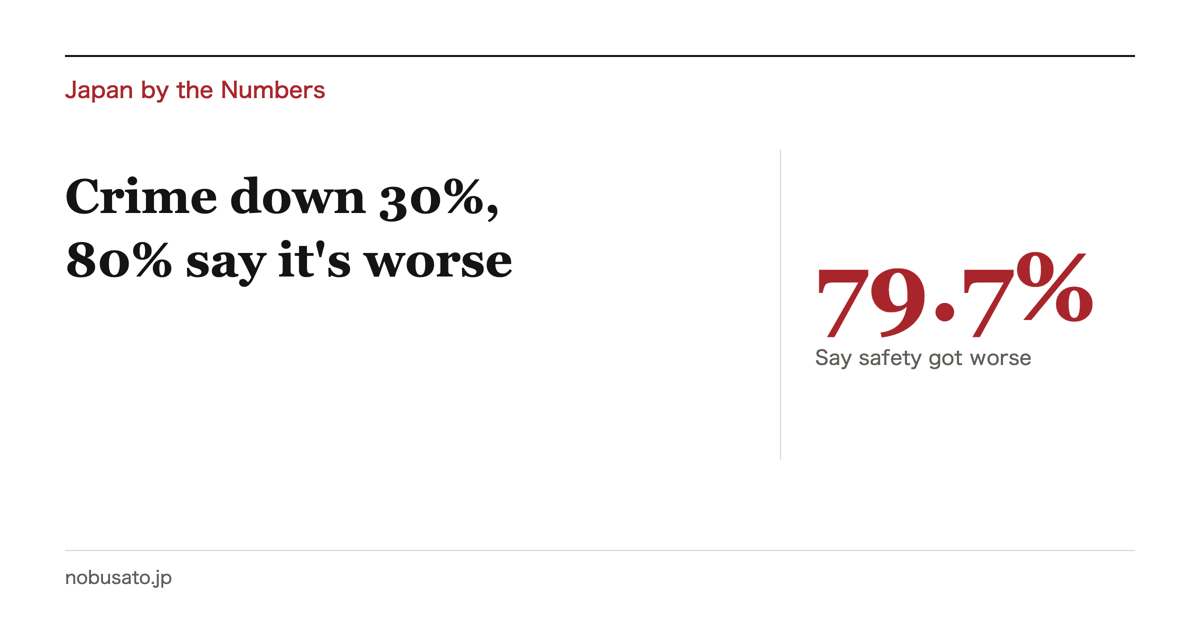
Recorded crime in Japan fell by about 30% between 2015 and 2025. In October 2025, 79.7% of people told the National Police Agency that public safety had got worse over the past ten years. Both numbers are official and both are accurate. They just measure different things.
How much has crime in Japan actually fallen?
A lot. Penal Code offenses known to the police fell from 1,098,969 in 2015 to 774,142 in 2025. The postwar peak was about 2.85 million in 2002, so today's level is roughly a quarter of that.
"Known to the police" is the key phrase. Japan's headline crime figure counts cases the police have recorded, usually after a report. It hit a postwar low of 568,104 in 2021. It has risen since, but it is still far below where it was twenty years ago.
If you only looked at this series, you'd say Japan became a much safer country over two decades.
And yet four in five say it got worse
Every October the National Police Agency runs an online survey of 5,000 people aged 15 and over. The share who think safety worsened over the past ten years was 71.9% in 2023, 76.6% in 2024 and 79.7% in 2025. Three years of increases. "Eight in ten" is a fair rounding.
The same survey found that 60.3% think Japan is safe, up from 56.4% in 2024 but below 64.7% in 2023. So most people hold two beliefs at once: Japan is safe, and it's getting less safe.
One caveat about the survey itself. It is an online survey, so I would treat any single year's level with some care. The direction over three years, asked the same way each October, is more telling than the exact figure. And the direction is clearly up.
Over the ten years respondents were asked about, recorded crime fell 30%. Those saying it got worse rose to 79.7%
Penal Code offenses known to police (scaled to the 2002 peak) and share saying safety worsened over the past ten years (%). National Police Agency crime reports, Ministry of Justice White Paper on Crime, National Police Agency public safety survey (each October, online, 5,000 people aged 15+)
The decade respondents were asked about (2015 to 2025)Other years
- 2002postwar peak~2.85m
- 20151.10m
- 2021postwar low0.57m
- 20250.77m
- 202371.9%
- 202476.6%
- 202579.7%
Both numbers are right. Check what each one counts before you argue.
Where does the feeling come from?
Mostly from the news. The survey asked people who said safety had worsened why they thought so. 76.4% said they were seeing more crime coverage on TV and in newspapers. 61.1% said the same about online news. Only 14.2% said they, or someone they knew, had been a victim or nearly one.
It also asked which crimes they had in mind. 72.0% thought of fraud: phone scams posing as relatives, investment scams, romance scams, phishing. Data leaks from hacking and random attacks on strangers also came up often.
Now look inside the official total. In 2025, theft accounted for 513,931 of the 774,142 cases, about two thirds. The headline number goes up and down mostly with theft. People are thinking about fraud and violent incidents. The statistic is mostly counting stolen property.
So the two numbers aren't really in conflict. They're answering different questions under the same word, "safety."
The feeling isn't simply wrong
It would be easy to conclude that the public doesn't understand the data. I don't think that's fair. Change the time window or the type of crime, and the public's view starts to look reasonable.
Since the 2021 low, recorded crime has risen four years in a row. The 2025 figure was about 36% above 2021 and 3.4% above pre-pandemic 2019. If your mental window is the last few years, things did get worse.
Fraud is the clearest case. Recorded fraud rose 26.5% in 2025 to 72,532 cases. Within that, so-called special fraud, mostly phone and impersonation scams, reached 27,832 cases, with losses of about ¥142.3 billion, up 98.0% in a single year. The crime people picture is exactly the one growing fastest.
Serious violent crime (murder, robbery, arson and non-consensual sexual intercourse) was 7,287 cases in 2025, 54.8% above 2019. Part of that is a change in the ruler. Japan's revised sexual offense law took effect on 13 July 2023 and broadened what counts as a crime, which may also have made reporting easier. So the 54.8% doesn't mean violent incidents rose by half.
"Down 30% in ten years" and "up 36% in four years" both come from the same official series. Which one you show decides what your audience concludes.
The same gap shows up inside companies
Every manager has seen a version of this. The CEO says more people seem to be quitting. HR pulls the annual attrition rate and says nothing has changed. Both can be right. The rate is a company average. The CEO may be looking at one key team, or at two people he hired himself. An engagement score can sit flat while one layer of the organization is already interviewing elsewhere. Exit surveys have their own version of the problem, which I wrote about in Why exit surveys never tell you why people left.
My suggestion is boring. Before the argument starts, agree on who is being counted, over what period, and against what denominator. That settles about half the disagreements on its own. It's the same rule behind Japan by the Numbers: Check Who Was Counted.
The official count has a blind spot. Recorded crime only includes what reaches the police. Online fraud and crimes between people who know each other often go unreported. So "down 30%" may be a little rosier than reality. How much of the 80% is media amplification, and how much is the statistic missing things? The current data can't separate the two, and I'd be wary of anyone who says it can.
Sources (as of October 2026)
- National Police Agency, Crime Situation in 2025 (final figures, including the public safety survey)
- Ministry of Justice, White Paper on Crime 2025, Part 2 Chapter 1: Penal Code offenses
- nippon.com, recorded Penal Code offenses (2002 and 2021 figures from the Ministry of Justice White Paper on Crime 2022)
- National Police Agency, White Paper on Crime Victims 2020, recorded offenses by type, 2015 to 2019
- Ministry of Justice, Q&A on the 2023 sexual offense law amendments