Japan's Labor-Shortage Bankruptcies Hit 427: Who Fell
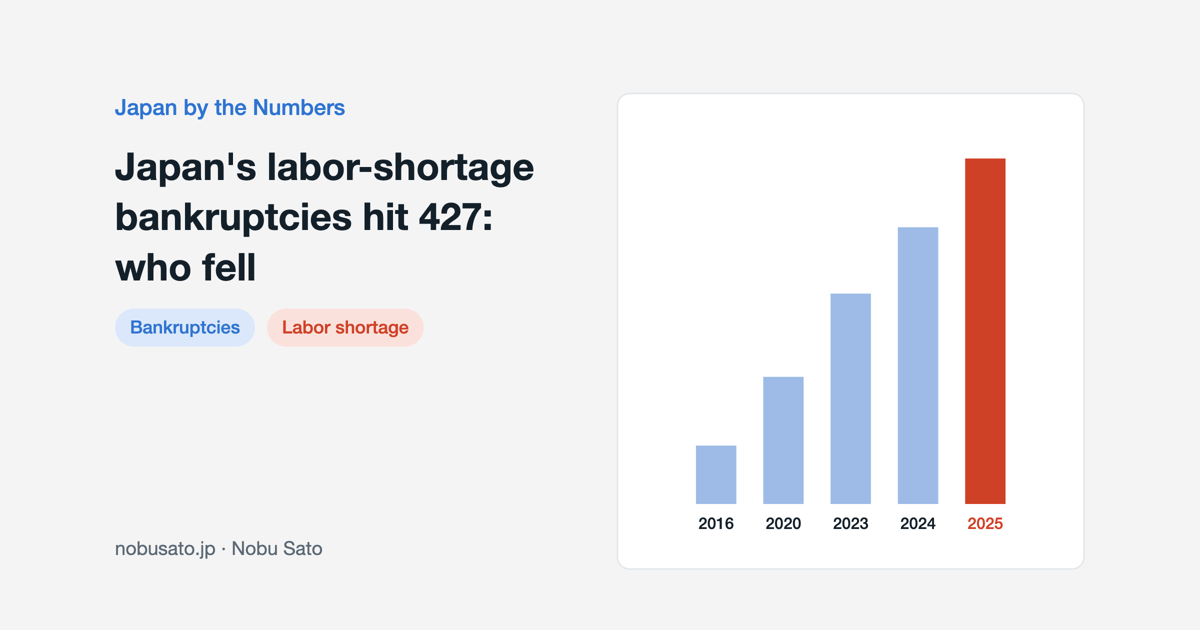
Teikoku Databank counted 427 labor-shortage bankruptcies in Japan in 2025, a record for the third year running. If you run a Japan entity or plan to buy into one, look under the headline. Of those companies, 77% had fewer than ten employees. And the fastest-growing cause was staff walking out.
The number gets quoted a lot, usually as proof that Japan is running out of workers. That's roughly true. But it's also one research firm's classification, with its own boundaries. A second research firm counts the same year differently.
What TDB actually counts
In Teikoku Databank's (TDB) data, a labor-shortage bankruptcy is a legal bankruptcy filing with liabilities of at least ¥10 million where TDB judged the main cause to be staff resignations, failure to recruit, or rising labor costs. That judgment is a private data company's call. There's no legal category behind it, and no government statistic.
Now put it next to the denominator. TDB counted 10,261 bankruptcies in total in 2025, so the 427 are about 4% of them. Companies that simply closed their doors without a legal filing are not in the count at all. A ten-person subcontractor that couldn't find anyone and quietly shut down doesn't show up here.
Fig.1In Teikoku Databank's count, labor-shortage bankruptcies dipped in 2020 and 2021, then set a record three years running from 2023, reaching 427 in 2025. H1 2026 had 227 (202 a year earlier). Source: Teikoku Databank, labor-shortage bankruptcy survey 2025 (Jan 2026) and H1 2026 bankruptcy statistics (Jul 2026).
Who is going under
Small companies, in industries where revenue depends on bodies on site. Construction led with 113 cases in 2025, the first time above 100. Logistics followed with 52, also a record. Then eldercare (21), staffing agencies (13), beauty salons (11) and security services (10), all from TDB's 2025 report.
Size matters more than sector. Of the 427, 329 companies (77.0%) had fewer than ten employees. In a firm that size, two drivers leaving can cut capacity by a fifth overnight, and there is no budget to replace them quickly. TDB reads it the same way. It expects resignation-driven failures to stay high among small firms that can't pay enough to keep people.
The trend hasn't turned. In the first half of 2026 TDB counted 227 cases, up 12.4% from 202 a year earlier and the highest first half on record. Construction had 65, services 59, transport and communications 38. As of October 2026, that is the latest published figure.
Why Tokyo Shoko Research says 397
Tokyo Shoko Research (TSR), Japan's other big credit research firm, reported 397 labor-shortage-related bankruptcies for 2025, up 35.9% and also a record. The gap with TDB's 427 comes from scope and judgment. Neither firm is wrong.
Start with scope. TDB counts only court proceedings such as bankruptcy and civil rehabilitation. TSR also counts out-of-court failures, such as companies suspended from bank transactions or wound up informally. So TSR casts the wider net and still ends up with fewer labor-shortage cases. My reading is that most of the gap comes from how each firm decides a failure was caused by labor shortage.
TSR takes bankruptcies with liabilities of ¥10 million or more and picks out those it attributes to recruiting difficulty, staff resignations or labor costs, explicitly leaving out companies that failed for lack of a successor. Its breakdown: 152 from rising labor costs, 110 from resignations. Subtract both from 397 and 135 remain, which should be recruiting difficulty. That's my own arithmetic. It assumes each case sits in exactly one category, and TSR did not publish a recruiting figure. TDB puts its own resignation-driven category at 124 for 2025.
The two firms even disagree on direction for one sector. TDB shows logistics at a record. TSR shows transport at 60 cases, down 14.2%. Different industry buckets, different coding. If someone tells you labor-shortage failures in trucking rose or fell last year, the honest answer depends on which firm they read.
Keep this in mind the next time a single labor statistic gets passed around a head office. I wrote about the same trap with official overtime data in a post on Japan's two overtime figures.
What the count doesn't tell you
It doesn't prove labor shortage alone killed these firms. Most failures combine weak sales, debt and costs that couldn't be passed on to customers. A company with thin margins can't raise pay, so people leave, so it loses contracts, so it runs out of cash. Where you put the label "cause" in that chain is a judgment.
It also leaves out voluntary closures, which is where I suspect much of the real damage sits. My view, not TDB's, is that the total effect of labor shortage on small business is bigger than 427.
If you employ people in Japan
Both firms agree that the fastest-growing type is resignation. TDB's resignation-driven bankruptcies rose 37.8%, from 90 to 124. TSR's rose 54.9%. Losing the people you have is now doing more damage than failing to hire new ones.
For a foreign company's Japan entity, this changes what retention means. On a small team it's a solvency question. And it's won or lost long before anyone hands in notice. By the time someone tells you they're leaving, you have very few moves left. Both research firms also point to the widening pay gap between large companies and small ones. If you can't outbid a big Japanese employer on salary, you need reasons to stay that aren't salary. If you want the price of getting this wrong, I broke down the true cost of hiring in Japan elsewhere.
If you are entering Japan
Buying or partnering with a small Japanese company is a common shortcut into the market. This data adds one item to the due diligence list. In a firm with fewer than ten employees, a handful of craftspeople or salespeople often carry most of the revenue. If they leave after the deal, you bought a shell. Map who the business can't run without before you look at the balance sheet.
If you sell labor-saving tools, the data draws your customer for you. Construction, logistics, eldercare and security. Under ten people, no IT staff, and the owner signs the order. That owner is probably around sixty. TDB puts the average Japanese company president's age at about 60, as I looked at in who runs Japan's companies. My bet is that this buyer picks the tool that takes one task off a person's plate next week, with almost no setup, over the one with the longest feature list.
TDB expected in January 2026 that these bankruptcies would stay high for a while, and the first-half numbers bear that out. For a manager, though, a smaller number matters more. How many people left your own team last year, and how many of them told you why?
Sources
- Teikoku Databank, labor-shortage bankruptcies 2025 (Jan 2026, Japanese): 427 cases, construction 113, logistics 52, under 10 employees 77.0%
- Teikoku Databank, resignation-driven bankruptcies 2025 (Japanese): 124 cases, up from 90
- Teikoku Databank, bankruptcy statistics 2025 (Japanese): 10,261 bankruptcies, up 3.6%
- Teikoku Databank, bankruptcy statistics H1 2026 (Japanese): 227 labor-shortage cases, up from 202
- Tokyo Shoko Research, labor-shortage-related bankruptcies 2025 (Japanese): 397 cases, labor costs 152, resignations 110, successor issues excluded
- Tokyo Shoko Research glossary, definition of bankruptcy (Japanese): bank transaction suspensions and informal liquidations are counted
Shorter notes that don't make it into a full article go on LinkedIn. Follow me there.