Building a Japan entity from zero
Your first hire in Japan decides more than your company registration ever will.
A foreign company once came to me with nothing but paperwork questions. How to register, how visas work, how long a bank account takes.
All of that can be handed to someone. What actually stopped them was the first employee. What kind of person, at what salary, how to interview them, why that person would join, and how to talk to them once they did. None of those has a procedural answer.
This page strings the other method pages together and walks them through a Japan entity that has nothing yet. It is the kind of work I have done most.
The order doesn't change
Two maps, product, sales, organization, then the systems. Starting from zero doesn't change the order. It just strips each step bare, because there is no existing team to absorb the mistakes.
Two steps get skipped most often: the talent map and the organization.
The talent map gets skipped because posting a job ad feels like enough. Six months later you learn that the person in the ad barely exists in Japan, and you lower the bar to fill the seat. The organization step gets skipped because it looks like an HR matter. Yet whether the earlier steps work in practice depends on it.
Before anything else I ask clients to do one thing. List every requirement in the job description and count how many people in Japan meet all of them at once. If you can't count them, go back to the two maps.
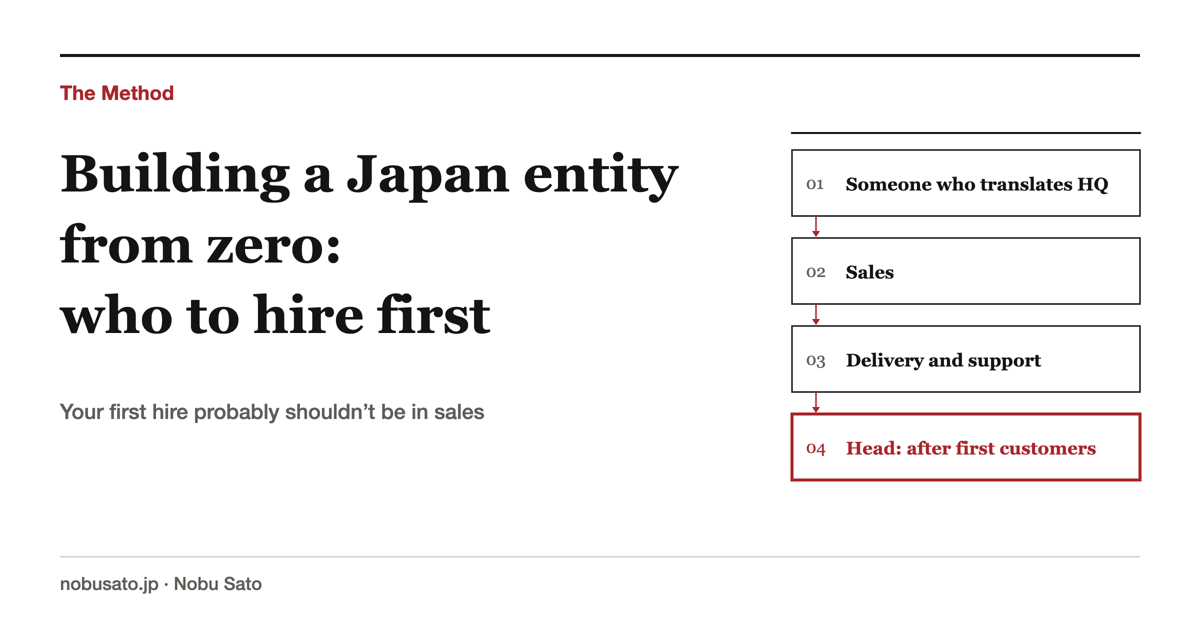
Your first hire probably shouldn't be in sales
Most companies make their first hire a salesperson. The reason is obvious: they want revenue.
I usually start with someone who can translate headquarters for Japanese customers. I don't mean language. Product, compliance, pricing and delivery commitments are described one way at headquarters, and Japanese customers evaluate them in another. Someone has to rebuild the first into the second. Once that person is in place, the salespeople have something to sell.
The order is the translator, then sales, then delivery and support. Where to find this person and what budget to set is covered in Your first hire in Japan shouldn't be in sales.
There are exceptions. If the product already sells in Japan through resellers or cross-border e-commerce, or your customers are Chinese companies already operating in Japan, start with sales. And all of this applies only to B2B with a meaningful deal size.
Don't look for a superhero. Split the role
At zero, founders want one person who can do everything. Knows the industry, can sell, can handle technical support, can run the back office, and ideally speaks Chinese too. Such people exist in Japan, but they are very rare and very expensive.
What I usually do is split the role. Sales, technical support (field application engineers) and back office are hired separately, and the back office is outsourced at first. When you relax requirements, relax the ones that are easiest to make up for later: language, degree, years of experience. Hold on to the hardest one to find, which is willingness to build from nothing inside a small company.
I once spent six months looking for a bilingual English-Japanese IT project manager because I insisted on native Japanese. When I dropped that requirement, I hired within a month.
One more thing people overlook. What you pay your first hire becomes the ceiling for everyone after them. The moment you publish a salary range, you are telling the market which pool you mean to fish in.
The three questions Japanese candidates don't ask out loud
When a foreign or Chinese company's Japan entity interviews, Japanese candidates may not say it, but most are thinking about three things. Will this company pull out in a couple of years? Can the Japan side make its own decisions? Will pay and evaluation be imposed uniformly from headquarters?
The more concretely you answer, the more people you can hire. The second question matters most, so write authority down in numbers: up to what amount Japan can approve on its own, and which terms Japan can negotiate. In Japan, "everything waits for headquarters" is one of the more common reasons people quit.
Front line first, or the head first?
Instinct says find the head first and let them build the team. I often do the opposite.
When I opened a regional office, nobody local could lead it. I hired the front-line team first and only looked for a head once the team had real size. It went more smoothly that way. There is another reason heads are hard to find early: candidates are checking you too. Do you have a team? Any customers? With two or three public customers, hiring the head gets much easier.
I have also seen a Japan entity run by two heads. The one sent from headquarters spoke no Japanese, and the one hired locally spoke no English. They couldn't talk directly, so everything went through an interpreter. Eventually the local head left and the Japan business never took off. Two heads side by side can work, but only if someone referees, and that person stays close. I wrote about it in When two heads work.
The year-one math
Judge year one by milestones, not by activity: channel partners signed, the first public customer reference, service commitments met several months running.
Work out the cost of a bad hire before you make one. By my own estimate, hiring the wrong salesperson at a 10 million yen salary and replacing them costs about 14 million yen in total, plus a full year. Hire the wrong head of the Japan entity, and finding the next one takes six to twelve months, with the business mostly on hold. Two extra months spent drawing the maps properly is far cheaper.
One more move costs almost nothing. Before the first deal, write down what "done", "quality" and "urgent" mean, and have senior people on both sides sign off. Japanese customers and headquarters often read those words very differently.
Where this path stands
I have used every piece of this page while building real teams. What I haven't done yet is run them as one fixed path, start to finish. The product and sales steps are still taking shape too, as the previous page says.
So expect this page to change more often than the others.
How each step works is on Product, sales, organization, Four layers and Three-track pay. The whole order is on the overview.