After you hire foreign staff in Japan, the hard part begins
The Japan entity hires its first foreign engineer. Vietnamese, Japanese at N2 level, strong technical interview. Three months later his manager says he "doesn't understand instructions". He says the manager "never says clearly what he wants". Six months later he leaves for a foreign firm. Four months of recruiting and an agency fee over a million yen were in the budget. The hole he leaves behind was not.
I see versions of this story all the time in Japan. There are numbers for it too.
What the survey says
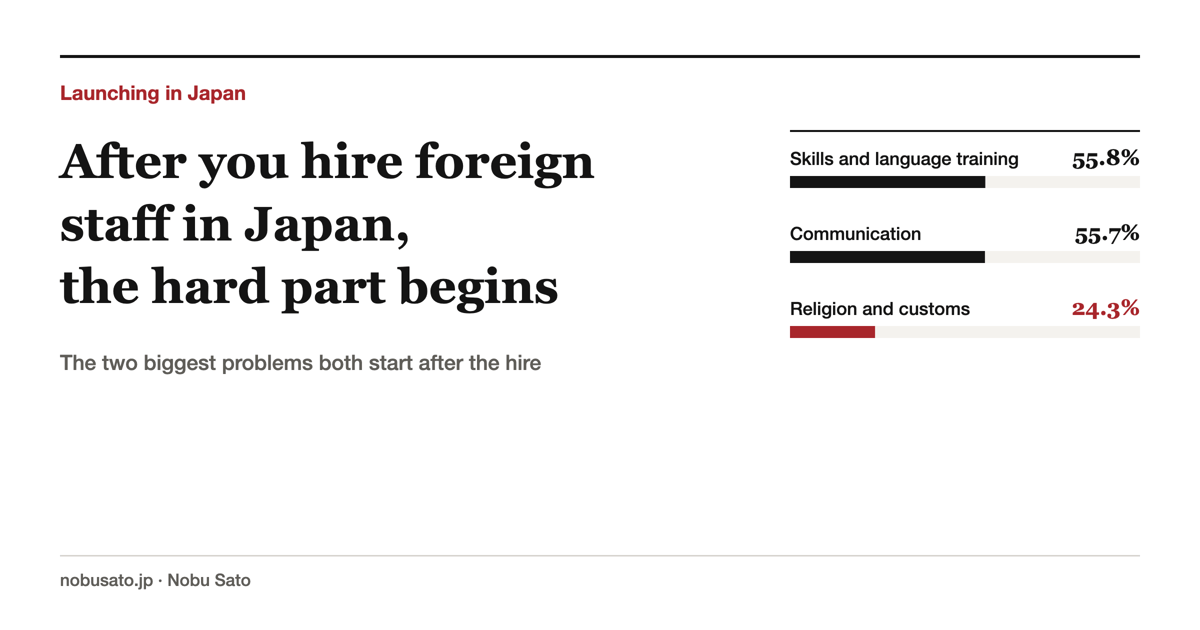
In August 2025 Teikoku Databank asked more than 26,000 companies nationwide and 10,700 answered. 24.7% employ foreign workers, up one point in eighteen months. Asked about the challenges of employing them, the top answer was skills and language training at 55.8%, with communication almost level at 55.7%, and consideration for religious and lifestyle differences third at 24.3%. The survey also describes retention problems, such as unexplained absences and early resignations, without giving a percentage.
Both top figures are about what happens after hiring. Labour shortage is why companies hire foreign workers, and it isn't on this list of problems, because it gets solved on the day of hire. The money goes into everything that comes after.
The two biggest problems with foreign hires both start after the hire
Challenges reported by companies employing foreign workers (multiple answers). Teikoku Databank, August 2025, 10,701 valid responses
- Skills and language trainingafter hiring55.8%
- Communicationafter hiring55.7%
- Religious and lifestyle differences24.3%
After the hireOther
The labour shortage is why you hire, and it is solved on the day you hire. Before hiring, give each of the four things an owner and a budget.
Where it goes wrong after the hire
Communication first. Many companies read "communication" in the survey as Japanese proficiency, so the fix becomes demanding N1. Most of the communication problems I have seen have little to do with language level. They come from what goes unsaid. Instructions in a Japanese office are incomplete by default. "Have a look at this," and context fills in the rest. Japanese staff can fill it in, because they have spent twenty years in the same context. Foreign staff can't, and they get judged as not understanding. The fix sits with the speaker. Say what, by when, and what done looks like. It helps Japanese staff too. They've just never been asked to work this way. Bilingual staff are not translators looks at the other side of the same problem.
Then training. Japanese OJT assumes the newcomer shares roughly the same base as the senior and can learn by watching. Foreign staff have a different base and can't learn by watching. The senior concludes they "don't learn", and the newcomer concludes "nobody teaches". Training that works makes the implicit explicit: procedures, criteria, why things are done this way. It is extra work, and it lands on the busiest person. Budget for it.
Retention. The most common reason foreign staff leave is that they can't see their next step in the company. Promotion paths in Japanese companies are vague for Japanese staff too, but Japanese staff know vagueness is normal. Foreign staff read vagueness as absence. On top of that, the visa is tied to the employer, a change in duties may require a change of residence status, and usually nobody is thinking about any of this for them. The fix is to say it at onboarding. Where you might be in one year and in three, and how the company supports visa and permanent residency. Foreign workers in Japan by the numbers showed that the group that moves on is the best group.
Evaluation. Japanese evaluation criteria are often unwritten and rely on everyone just knowing. Foreign staff don't know, so they work to the criteria they infer and find out at review time that the criteria were different. Twice in a row and they leave. The fix is simple. Write the criteria at the start of the period and evaluate against what was written. Every employee should get this. Foreign staff arriving just makes it impossible to put off.
The foreign-subsidiary version
A foreign-owned Japan entity usually finds hiring foreigners easier than a Japanese company does. The working language may be English, and HQ is foreign anyway. But the four problems show up in mirror image, with Japanese staff as the minority. Japanese staff "don't understand instructions" in an English environment, "nobody teaches them" where there is no OJT, and feel "disrespected" under HQ's direct style of evaluation. The problems are the same four. Only the people on the receiving end change.
So my advice is the same for both kinds of entity. Before hiring, give each of the four an owner and a budget. Who turns the implicit into the explicit. Who trains, and how many hours a week. Who keeps the visa calendar. When the evaluation criteria get written. Together these come to roughly 20 to 30% of the person's first-year salary. That sounds like a lot. It is cheaper than four months of recruiting, a million-yen agency fee and the hole six months later.
Hiring is the start. 55% of the companies in the survey found that out after the hire.