Before HQ monitors the Japan team through software
HQ and Tokyo sit in different time zones, with a language barrier on top, so HQ cannot actually see what the Japan team does day to day. In year two HQ decides to install a system: time logging, screen activity, every action in the CRM, the length of customer calls. The reason given is "we need visibility". The Japan head does not object. Neither do the staff. Six months later there is a great deal of data, performance is unchanged, and the best salesperson has left.
I think I know why nothing changed. HQ was missing something, and it wasn't data.
Monitoring and performance: no correlation
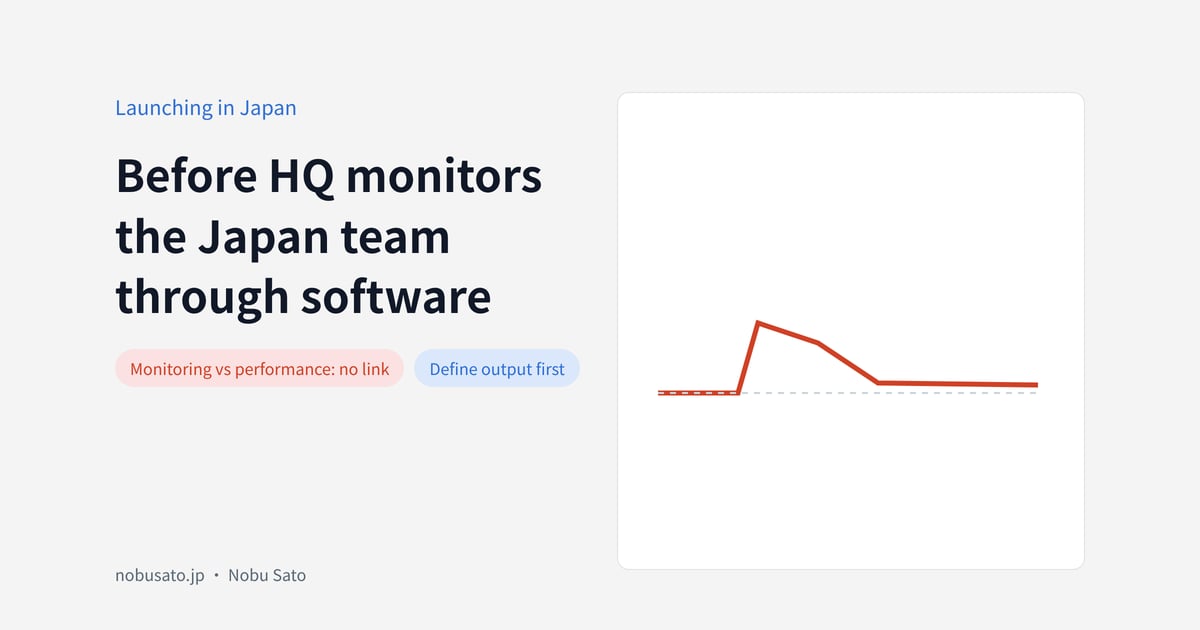
In 2022 Ravid and colleagues published a meta-analysis of research on electronic performance monitoring, covering more than 23,000 participants. The conclusion is blunt. There's no correlation between monitoring intensity and performance. Some studies saw a short-term lift, but the organisational psychologist Cornelius König's reading is that people behave a little better in the first weeks of being watched, then habituate and return to baseline. Some things don't return to baseline. Stress goes up, perceived autonomy and privacy go down, and workarounds appear, such as tapping two keys every few minutes to keep the activity metric green.
An August 2026 review in Knowable Magazine surveys this research and cites a 2020 study in which electronically monitored truck drivers complied better with hours-of-service rules and had more accidents. Watch one metric and people optimise that metric. The cost shows up somewhere else. The review's other finding is that many companies buy the tools, accumulate terabytes of data, and have no idea what to do with it.
Fig.1Performance rises slightly in the first weeks of being watched, then returns to baseline. Stress and workarounds rise and stay there.
Researchers allow three conditions under which monitoring helps: a clear purpose, a human interpreting the data, and mutual trust underneath. An HQ monitoring its Japan team from a distance usually meets none of the three.
What HQ actually lacks
When HQ says it needs visibility, its real problems are two others, and monitoring solves neither.
It does not know what each role should deliver. If the Japan entity's sales roles had clear output definitions, so many qualified visits, proposals and stage advances per quarter, HQ would have no need to look at screen activity. Output would suffice. The urge to install software mostly comes from output never having been defined, leaving only process to look at. Score the role before the person is, here, the substitute for monitoring.
It does not trust. Distrust usually has one of two sources. Either the wrong people were chosen, or the relationship was never built. If the people are wrong, monitoring finds out sooner, at the price of watching the right people too, which is why the best salesperson left. If the relationship was never built, monitoring makes it harder to build, because it says "we don't trust you" and says it clearly. Allen's research found that people fifty metres apart barely communicate. HQ and Tokyo are nine thousand kilometres apart. That distance has to be bridged by something else, and software is not it.
The Japan specifics
Japanese law allows employers to monitor work equipment within reasonable bounds. The case-law standard is social reasonableness, meaning a legitimate purpose, proportionate means and prior notice. The personal information law requires the purpose of use to be stated. In practice, the Personal Information Protection Commission's guidance recommends writing the purpose, the responsible person and the rules into the work rules or an internal policy and informing staff. Do that and monitoring itself is lawful.
Lawful doesn't mean effective. The default mode of a Japanese workplace is high trust and low supervision. The boss does not watch the process and relies on hō-ren-sō, the employee reporting, informing and consulting. A monitoring system installed by HQ sends a louder signal there than elsewhere. It says HQ thinks the Japan team needs watching. Japanese staff will not protest. They will do what the system asks, and only what the system asks. That is where "lots of data, no change in performance" comes from.
What to do when HQ wants visibility
Define output first, per role, on paper, signed by HQ and the Japan head. That is the real source of visibility and it costs almost nothing.
Then look at output, not process. Once a quarter, compare against the defined outputs. Where the gap is large, look at process for that role, together with that person. Monitoring is aimed at everyone. Diagnosis is aimed at one person. The second is far cheaper and harms nobody else.
If a system must be installed, answer three questions first. What decision will this data inform? Who looks at it every week? Do employees know it exists and what it is for? If any answer is missing, don't install it. You'll end up with terabytes nobody reads and a team short its best seller.
HQ's anxiety is real. Not seeing is uncomfortable. But the remedy for not seeing is regular trips to Tokyo, regular trips by the Japan head to HQ, and output written down. These cost a little more than software and work far better. Motivation is a design decision, and the motivation monitoring designs is "don't get caught". That motivation does not sell anything.
Shorter notes that don't make it into a full article go on LinkedIn. Follow me there.