Closing a Japan entity: the paperwork is the easy part
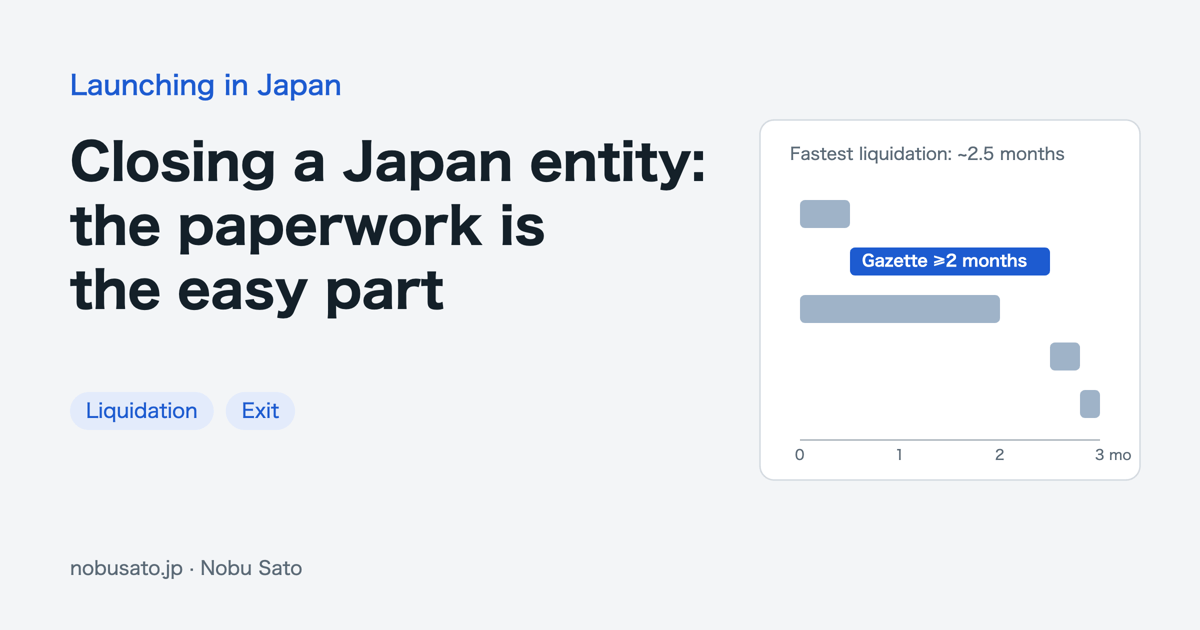
Closing a Japanese kabushiki kaisha takes about two and a half months at minimum, and the statutory filing and notice fees come to under ¥100,000. The time and money go elsewhere: people, contracts and getting cash back to headquarters.
Plenty gets written about entering Japan. Very little about leaving. I once watched a foreign company's Japan entity run by two de facto heads. One came from HQ and spoke no Japanese. The local hire spoke no English. They couldn't talk to each other directly. The local head left, and the Japan business never took off. Situations like that end with HQ deciding whether to keep funding or close.
Liquidate, go dormant, or sell
There are three usual ways out.
Liquidation closes the company for good. Most of this post is about that.
Going dormant keeps the company but stops the business. It looks easier, but the company still exists: annual tax filings continue and registry changes still have to be filed. If a KK goes 12 years with no registration, the Legal Affairs Bureau treats it as dissolved. Unless you really plan to restart within a few years, dormancy just postpones the cost of closing.
Selling the entity, or merging it into another group company, is worth a look if it has customers, licenses or a team.
If the company is insolvent, ordinary liquidation is off the table. That means special liquidation or bankruptcy, and a lawyer first.
How liquidation works in Japan
For an ordinary KK liquidation the order is roughly this.
Shareholders pass a special resolution to dissolve and appoint a liquidator. Both are registered within two weeks. The company then publishes a notice in the official gazette giving creditors at least two months to come forward, and notifies known creditors individually. Those two months can't be shortened, and they set the minimum length of the whole process.
A tax return for the period up to dissolution is due within two months of the dissolution date. After the notice period, the liquidator collects receivables, pays debts and distributes what is left to shareholders, files a final liquidation return, gets shareholders to approve the final report, and registers completion within two weeks. The tax office, prefecture and city are notified last.
Fig.1The fastest an ordinary KK liquidation can go is about two and a half months, set by the two-month gazette notice. Companies with many counterparties or fixed assets often take two to three years.
The statutory fees are small: ¥30,000 to register the dissolution, ¥9,000 for the liquidator, ¥2,000 for completion, and roughly ¥35,000 to ¥45,000 for the gazette notice. Lawyers, tax accountants and judicial scriveners cost far more.
Social and labor insurance have their own deadlines: 5 days to close health and pension insurance, 10 days for employment insurance, 50 days for the final labor insurance return.
The hard part: employees
Deciding to dissolve is the company's call. Letting employees go because of it is still a dismissal in law, with at least 30 days' notice or 30 days' pay.
Japanese courts look at whether the dissolution is genuine and whether the process was handled with care. In the Ryusei Jidosha case, a taxi company whose revenue collapsed in COVID dissolved and let everyone go, and the Tokyo High Court (2022) upheld the dismissals because the procedure was considerate enough. In the Gurin Seika case, a company that still had room to continue dissolved and dismissed all staff, and the Osaka District Court (1998) called it an abuse of the right to dismiss. Moving the business to a new entity and leaving only the people behind is riskier still.
In practice, tell people early and plainly: why you're closing, when, what they will get, and how you'll help them find work. Whether to improve exit terms, and by how much, is a question for an employment lawyer before you start. About seven in ten Japanese labor tribunal cases end in settlement, as I wrote in the labor tribunal numbers. Closing an entity runs on the same logic.
Don't forget expatriates. Once the entity is gone, the basis of their residence status changes. Check timing and visas with an immigration specialist early.
Then contracts
Read the office lease for the notice period and restoration clause. Notice periods of several months are common for offices in Japan, and that rent is hard to avoid. Decide who takes over maintenance, support and data obligations in customer contracts: HQ, another group company or a partner. List suppliers, SaaS subscriptions, domains and phone numbers, and close them one by one.
None of this has a legal deadline, which is why it drags. More contracts means a longer liquidation.
Then getting the money home
What's left at the end goes back to shareholders as a distribution of residual assets, after wages, exit packages, taxes and all debts are paid. The bank account usually closes last, because refunds and final payments still need to move.
There are two tax returns, one at dissolution and one at the end. Whether the distribution triggers deemed-dividend tax, and how your home country treats it, needs tax advisers on both sides looking at it together.
Do it in reverse order
Settle the employee plan and the timing of internal and external communication first. Then decide how each contract ends. Put the shareholder resolution last. Once the dissolution is registered it's public, and if staff or customers hear it from the registry or from someone else first, every conversation after that gets harder.
Half the cost of closing is set when you open
How hard it is to close depends a lot on how you opened: lease terms, employment contracts and work rules written to Japanese standards, and who you hired first. I've written about that first hire in Your first hire in Japan should not be a salesperson, about the real cost of a hire in What one hire in Japan really costs, and about getting a hire wrong in the probation post.
Where I'm not sure
This covers ordinary liquidation of a KK. A GK is broadly similar. Closing a foreign company's Japan branch is a different procedure, and insolvency means special liquidation or bankruptcy. Tax and immigration details vary by company. This isn't legal or tax advice. Work with a lawyer, a tax accountant and a judicial scrivener.
If you're thinking about closing a Japan entity, where are you stuck first?
References
- Money Forward: the dissolution and liquidation process (Japanese)
- SME Support Japan, J-Net21: from dissolution to completion (Japanese)
- Closing social and labor insurance: forms and deadlines (Japanese)
- RSM Shiodome Partners: deemed dissolution of dormant companies (Japanese)
- VSG Law: closing a business and employees (Japanese)
- Rodo Shimbun case law: Ryusei Jidosha, Tokyo High Court, May 26, 2022 (Japanese)
- Rodo Shimbun case law: Gurin Seika, Osaka District Court, July 7, 1998 (Japanese)
As of October 2026. Not legal or tax advice.
Shorter notes that don't make it into a full article go on LinkedIn. Follow me there.