Japan's 790,000 IT Worker Shortage: Where It Comes From
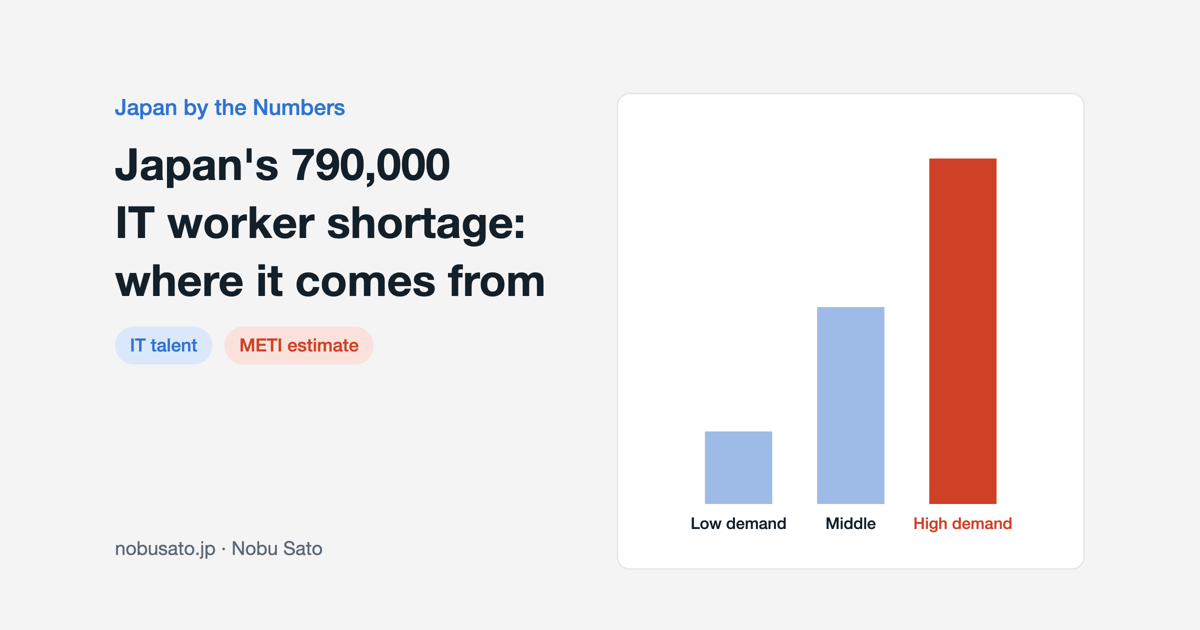
Japan will be 790,000 IT workers short by 2030. You have probably seen that line in a market-entry deck or a recruiting pitch. It comes from a 2019 government estimate, and it is the most pessimistic of six scenarios in that estimate.
That matters if you are deciding how to build an engineering team here. A stress test is being read as a forecast, and hiring plans get built on it.
787,000 is the worst of six scenarios
The figure is 787,000, rounded up. It is the 2030 shortfall in the scenario where IT demand grows fastest and productivity grows slowest. The study is the IT talent supply and demand survey (IT人材需給に関する調査) that Mizuho Information & Research Institute ran for the Ministry of Economy, Trade and Industry (METI), published in March 2019.
A few definitions first. "IT talent" here means people in IT companies plus people in the IT departments of user companies such as manufacturers and banks, counted from occupation codes in the 2015 census. Supply was 1.032 million in 2018, projected to reach 1.133 million in 2030.
Demand was modeled three ways:
- Low: 1% a year, on the idea that IT demand tracks real GDP.
- High: 3 to 9% a year, taken from a company survey by IPA, the government IT promotion agency.
- Middle: halfway between, roughly 2 to 5%.
Each was crossed with two labor productivity assumptions: 0.7% a year (the information and communications industry's average since 2010) and 2.4% (its average since 1995). Six cells.
Fig.1Japan's 2030 IT talent gap in METI's six scenarios (Mizuho Information & Research Institute for METI, March 2019). At 0.7% productivity growth the shortfall runs from 164,000 to 787,000; at 2.4% it runs from a 72,000 surplus to a 438,000 shortage. The widely quoted 790,000 is one cell: high demand with low productivity growth.
The report also calculates what productivity growth would close the gap completely by 2030: 1.84% in the low case, 3.54% in the middle, 5.23% in the high. Nowhere does it say which cell is the forecast. Read as a whole, the table says the answer swings from a 72,000 surplus to a 787,000 shortage depending on what you assume.
One more thing about the high case. It rests on companies estimating their own future IT demand. My suspicion is that companies asked about their own plans lean optimistic. So the famous number stacks the most optimistic demand on top of the least optimistic productivity.
How the assumptions look seven years later
Some have clearly moved. One is wide open.
Start with people. The Labour Force Survey from the Ministry of Internal Affairs and Communications counts employment in the information and communications industry. It was 2.78 million in 2023, up 480,000 from 2019 (as tabulated by JILPT, the government labor research institute). The 2025 average was 3.02 million.
You can't subtract this from the METI supply number. The Labour Force Survey counts by industry, so it includes telecom salespeople and publishing staff, and it misses engineers sitting in a carmaker's IT department. But the direction is hard to miss. METI assumed supply would grow by about 100,000 over twelve years. The industry has been adding people far faster than that.
Productivity is the open question, and generative AI is the reason. The evidence is split:
- In a randomized experiment by Peng, Kalliamvakou, Cihon and Demirer (2023, arXiv) with 95 recruited programmers, developers with GitHub Copilot finished a set task, writing an HTTP server in JavaScript, 55.8% faster than those without it.
- In a randomized controlled trial by METR (Becker et al., 2025, arXiv), 16 experienced open-source developers worked on 246 real tasks in projects they knew well. With AI tools they took 19% longer. They still felt faster.
These measure different things: a fresh, well-defined task versus maintenance work in a mature codebase. Neither was run inside a Japanese company, and I would not stretch either one onto a Japanese development team. My own read is narrower. The case for treating 0.7% productivity growth as fixed until 2030 is weaker in 2026 than it was in 2019.
And yet companies still feel short. In IPA's DX Trends 2025 survey (fieldwork February to March 2025, companies doing some form of digital transformation), 85.1% of Japanese firms said they lacked enough people to drive it, counting "severely" and "somewhat" short together. In the same survey, 73.6% of US firms and 52.5% of German firms said they had enough or more than enough.
More people, still a shortage. I read that as a mismatch between the profile companies ask for and the profile the market has. The METI report hints at this too. It splits conventional IT work (contract development, maintenance) from advanced work (AI, IoT). In the summary's middle-demand case at 0.7% productivity, with only 1% of people reskilling into advanced work each year, 2030 shows a 550,000 shortage of advanced IT talent alongside a 100,000 surplus of conventional IT talent.
What should you do differently when hiring engineers in Japan?
If you take 790,000 at face value, your plan collapses into one move: pay more and fight for the same candidates. I would look at your own requirements first.
I once spent six months searching for a bilingual IT project manager on a limited budget. When we dropped the requirement for native Japanese, we hired within a month. The market wasn't short of PMs. It was short of PMs who were native in Japanese, fluent in English and inside our budget. Remove one condition and the candidate pool changes size.
How far you can relax Japanese depends on how you cut the team. Separate the roles that talk to Japanese customers and stakeholders from the roles that design and build, and the second group can be hired abroad or remotely. I wrote about drawing the team before hiring into it in the post on Conway's law. If you want to know how much English you can actually expect from Japanese colleagues, the numbers on Japan's English proficiency are a sober starting point.
Will Japan be short of IT workers in 2030? Probably, by some amount. Faster productivity can be eaten by faster demand. But the honest range from the source is 164,000 to 787,000 at low productivity growth, and lower still if productivity improves. Build your plan on the range. Then go through your job descriptions and count how many requirements you could drop.
Sources
- METI (conducted by Mizuho Information & Research Institute), IT人材需給に関する調査 report, March 2019: 2030 gap 164k to 787k (0.7% productivity), 72k surplus to 438k (2.4%); supply 1.032m to 1.133m
- METI, IT人材需給に関する調査 summary, April 2019: middle demand, 0.7% productivity, 1% reskilling gives a 2030 shortage of 550k advanced IT talent and a 100k conventional surplus
- JILPT, Business Labor Trend, March 2024 (MIC Labour Force Survey): information and communications employment 2.78m in 2023, +480k vs 2019
- JILPT chart, employment by industry, 2025 average (MIC Labour Force Survey): information and communications 3.02m
- IPA, DX動向2025 (DX Trends 2025), June 2025: 85.1% of Japanese firms short of DX talent
- Peng, Kalliamvakou, Cihon, Demirer (2023), The Impact of AI on Developer Productivity: Evidence from GitHub Copilot, arXiv: 55.8% faster
- Becker et al. (METR, 2025), Measuring the Impact of Early-2025 AI on Experienced Open-Source Developer Productivity, arXiv: 19% slower
Shorter notes that don't make it into a full article go on LinkedIn. Follow me there.