Reading Japan's 65% Offer Decline Rate
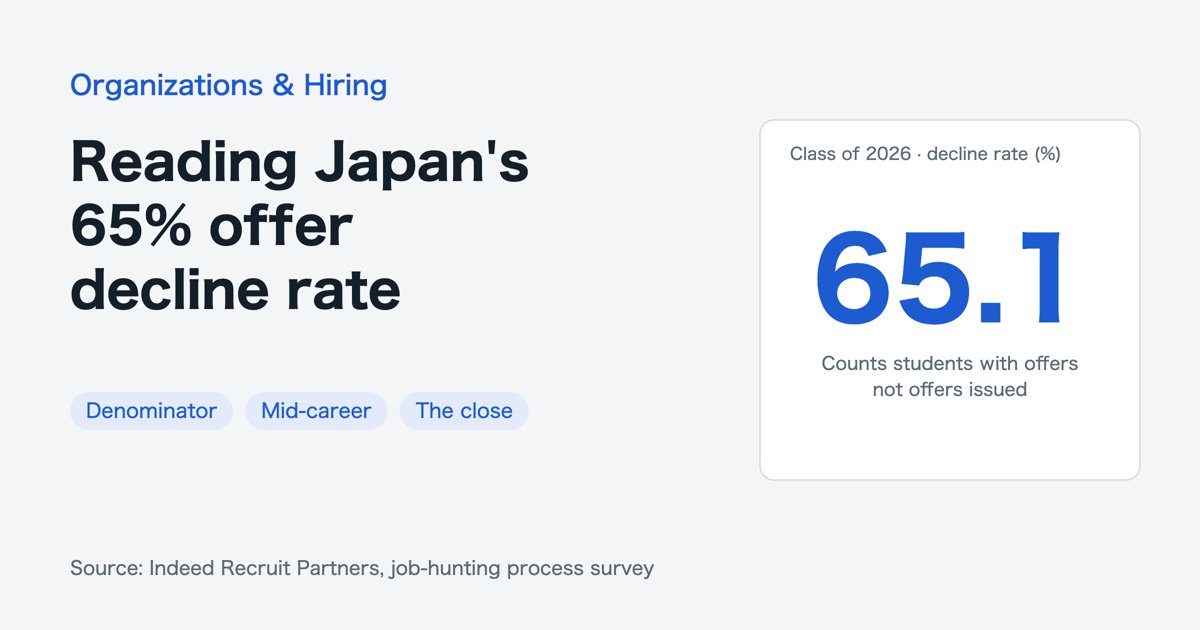
Japan's new-graduate offer decline rate is 65.1%. The figure is for university students graduating in March 2026, as of December 1, 2025, from the job-hunting process survey run by the Indeed Recruit Partners research center. Many people read it as two out of every three offers being turned down.
That is not what it says.
The denominator is students, not offers
Fig. 1Both rates count students, not offers issued by companies. 94.8% hold an offer, and 65.1% of those have declined at least one.
The 65.1% is the share of students with offers who have declined at least one offer so far. Both numerator and denominator are people. A student who received three offers and accepted one counts as having declined.
So the figure says that roughly two-thirds of students held more than one offer, not that 65% of the offers companies made were refused. For a single company, the share of its own offers declined needs a different denominator: offers declined divided by offers made. Each company calculates that for itself, and there is no public statistic.
The rate is also stable. For the class of 2018 it was 65.7% at the same point; for the classes of 2025 and 2026, 65.1%. The same survey puts the 2026 offer rate at 94.8%. Nearly everyone has an offer and most have more than one. That is the normal state of the new-graduate market, the system described in the post on the 98% graduate employment rate.
Mid-career: no common number
For mid-career hiring I could not find a public statistic with a consistent definition that can sit next to the new-graduate figure. Numbers from recruitment firms and surveys use different denominators. Some count candidates, others offers. Some count only declines between offer and response; others include candidates who accept and then drop out before starting.
When you see a mid-career decline rate, ask three things first. Is the denominator people or offers? From which point to which point? Which companies and roles are in the sample? Without answers, the number cannot be compared with your own.
After you pick the right person, there is still the close
Matching answers whether this is the right person. Whether that person joins is a separate question. In Japanese mid-career hiring, one to three months often pass between accepting an offer and starting: notice has to be given, leave used up, and the current employer may try to keep them. This is the stretch where things most often go wrong and the one most often ignored.
I would design the close as its own stage:
- Offer structure: state pay, grade, scope, how performance is assessed and what the next promotion requires, so the candidate can compare it line by line with other offers. For the candidate's side of that comparison, see Run a five-level check on your job offer.
- From offer to answer: give a reasonable deadline and have the hiring manager talk with the candidate again in that window. Bring out concerns the candidate has not raised yet, such as family, commute or probation.
- From acceptance to start: stay in touch, send onboarding material early and arrange a meeting with the team. Talk through how they would think about a counteroffer at the point of acceptance.
What to look for in interviews is in After the resume screen: what I look for in an interview. This post is about what comes after.
What I am not sure about
First, the 65.1% comes from a monitor panel with 774 valid university student responses, which does not exactly match the structure of all graduates.
Second, it is a December 1 figure. More declines happen before graduation, so the final rate may be higher.
Third, I give no mid-career number, because I found no consistent definition I could cite with confidence.
Has your company ever counted how many of the offers it made did not turn into a start date?
Sources
- Indeed Recruit Partners research center, job-hunting process survey (class of 2026), as of December 1, 2025: offer decline rate 65.1%, offer rate 94.8% (Japanese)
- Same, release page: survey outline, 774 university and 285 graduate students, December 1 to 8, 2025 (Japanese)
- Shushoku Mirai Kenkyusho, job-hunting process survey (class of 2018), December 1, 2017: decline rate 65.7%, defined as the share of offer holders who declined an offer (Japanese)
Shorter notes that don't make it into a full article go on LinkedIn. Follow me there.