No guessing: how I read markets, people and organizations
Most companies entering Japan start by hiring someone. I think that's usually the wrong first move.
It usually sounds like this: "Let's hire a country manager first." Or two sales people to test the market, or an HR person who knows Japan to set things up.
I understand the instinct. The trouble is what nobody knows yet at that point. Who you'll fight for customers in Japan. Who you'll fight for people. What you'll actually sell in year one. The person arrives before the direction does. A year later the person and the job don't fit, and you replace them.
That replacement is expensive. Finding a new head for a Japan entity usually takes six to twelve months, and the search fee is well above an ordinary hire's. For that whole stretch the Japan business is standing still.
I remember one foreign company whose first worry was procedures, registration and visas. Once things got moving, the real blocker turned out to be the first employee. What kind of person, what to pay, how to interview, how to get them interested, how to talk to them once they joined. None of that is a procedure question. All of it was waiting on an earlier answer: in this market, who are you being compared with?
Most of my work comes down to keeping that step from being a guess.
What comes first, and why?
The order I work in
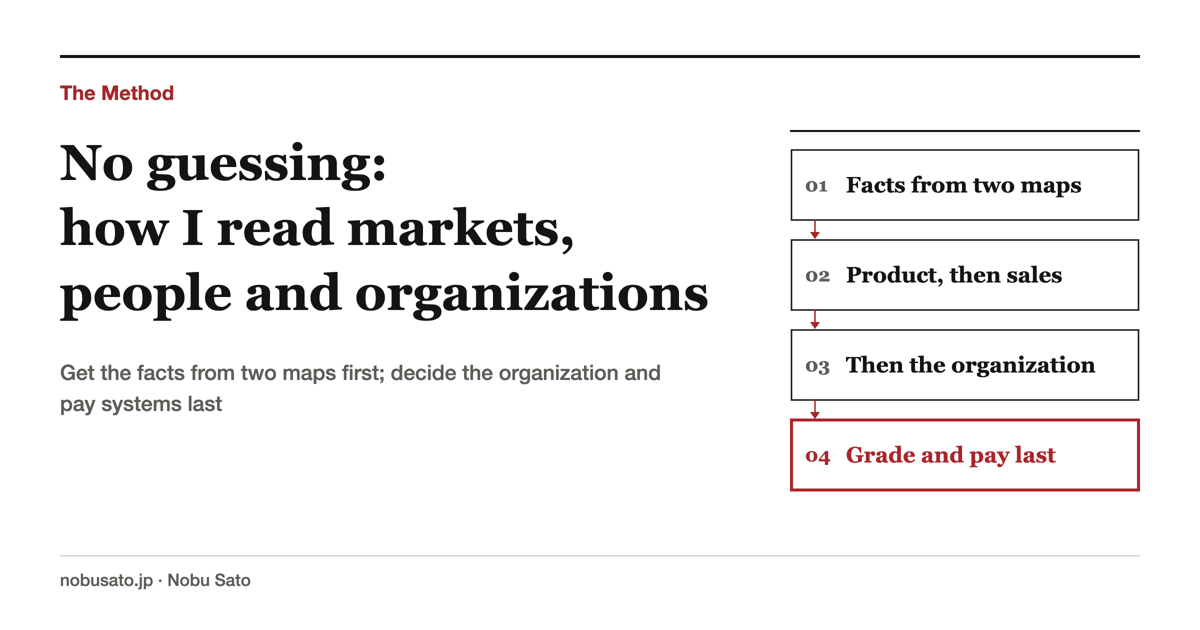
- 01Mapsmarket and talent
- 02Productwhat to sell
- 03Saleshow to sell
- 04Organizationwho sells
- 05Systemsgrade, allowance, bonus
Market map, talent map, then product, sales and organization. Grades and pay come last. The organization exists to serve sales, and sales exists to serve the product. Run it in the other direction and the pieces don't connect.
Plenty of companies do run it the other way. Build the team, then work out what it sells. I see why. Hiring is visible, it looks like momentum, and HQ likes a headcount update. But if the earlier steps are undecided, a well-built team on top is still a guess. The bill usually arrives in year two.
The five parts, one page each
Each part has its own page, written so you can pick it up and use it.
- The ground rules: where facts come from, how judgments get written, how systems get designed. And who decides on a hire. Not AI.
- The two maps: the market map shows who competes with you for customers and people. The talent map shows where the people you need are and what the market pays them.
- Four layers for people and organizations: core, patterns, equipment, context. What an organization diagnosis finds plugs straight into the context layer when you read a person.
- Does this person fit this role?: veto items first, then the weakest layer, then one of five verdicts. A look back at day 90.
- Three-track pay: grade sets base pay, responsibility modules set the role allowance, results set the bonus.
The terms are defined in the glossary.
Different questions, different entry points
I don't run the whole thing from scratch every time.
"What's wrong with our organization?" starts with a diagnosis. If the problem is at the very top, say nobody has settled who decides, I stop there and put that on the table first. A redesign plan before that point is wasted.
"Who should sit in this seat?" starts with the two maps. Once you're talking to real people, read them in four layers, give a verdict, and only then talk grade and money.
"Where do we go next?" gets the full order.
"We're starting from zero in Japan" is the same order with nothing in place yet. I'm still working this part out, and it will get its own piece later.
How finished is each part?
Some of it is proven on real work. Some of it isn't yet, and I'd rather say so.
- Market map and talent map: run end to end on real work, with results delivered.
- Reading people in four layers: in use, but there aren't enough look-backs after people joined to calibrate it.
- Organization diagnosis, the five-level fit check, three-track pay: the structure is set, but none has been through a full real cycle.
- Product and sales strategy: still taking shape, so no separate pages for now.
Each time I run it, what I fix is the method. These pages change with it.
If a step doesn't hold up for you, or your experience says otherwise, tell me.
Shorter thoughts go on LinkedIn.