Who decides in the Japan entity when the boss is away
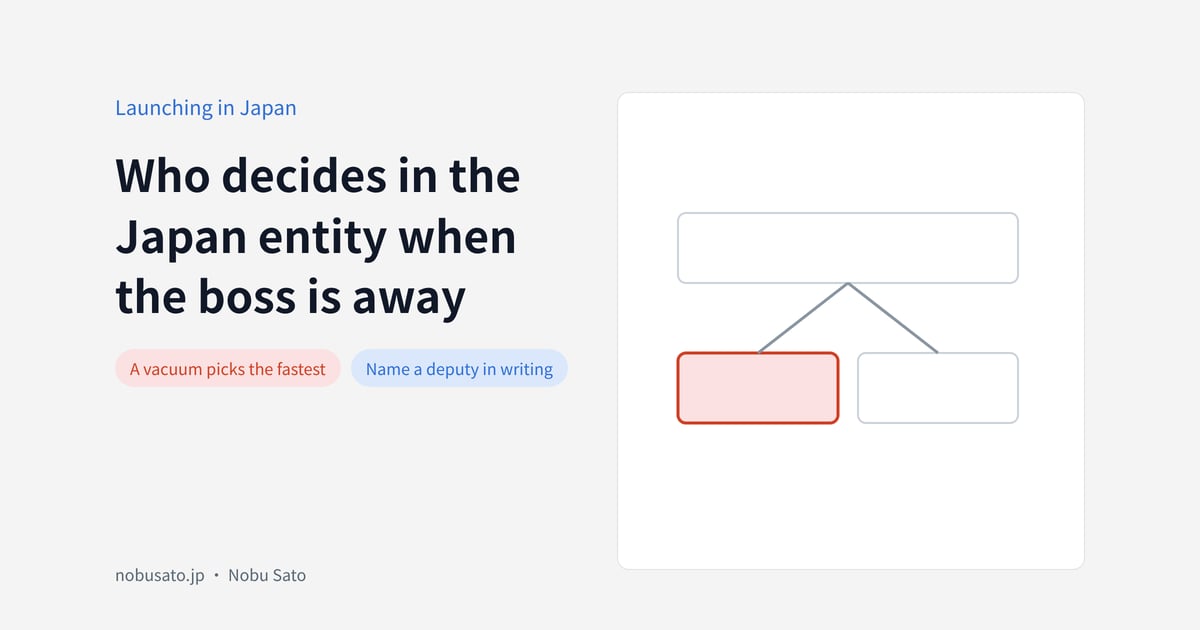
The country manager spends two weeks at HQ. In those two weeks three things happen in the Tokyo office. A customer demands an urgent contract change. An employee resigns. A letter of inquiry arrives from the labour inspection office. Who handles them? The org chart doesn't say. So the most impatient salesperson agrees to the customer's change himself. Nobody picks up the resignation, and the employee simply leaves. The inspector's letter sits on a desk for two weeks.
That's a small power vacuum. I want to describe a large one, because at that size you can actually see how it works.
1629, an island with no water
In 1629 the Dutch East India Company ship Batavia struck a reef off the west coast of Australia. About two hundred people survived on islands with no fresh water and little food. The captain and the senior merchant took a small boat to Java to seek help, and left no clear arrangement for command.
The vacuum was filled by Jeronimus Cornelisz, a junior merchant on his first voyage with no formal authority on board. He placed his associates in key positions, made everyone swear loyalty, sent likely opponents to other islets to "look for water", and then began killing. More than a hundred died. Among the same survivors, a soldier named Wiebbe Hayes, sent away on one of those water-finding errands, actually found water and organised some twenty people on another island. They divided the work, made weapons, built a low wall, and repelled at least three of Cornelisz's attacks until the rescue ship arrived.
In 2026 a historical case study in the Asian Journal of Business Ethics mapped Cornelisz onto the modern checklist for corporate psychopathy, found he fit nearly every item, and called the episode a natural experiment in leadership. Same crisis, two men, opposite outcomes. I'd hold back on the diagnosis itself. Reaching a psychological conclusion about one man across four centuries rests on thin evidence, and a single case can't carry general laws. But one thing the story shows clearly needs no psychology at all.
Fig.1One crisis, two kinds of leadership. A vacuum selects by who steps forward first, which barely overlaps with who fits.
A vacuum selects for who steps forward, not who fits
Cornelisz rose less because of who he was than because nobody had been named. Power vacuums fill by self-selection. Whoever wants it, moves fast, and dares to say "follow me now" gets it. That filter barely overlaps with "who is suited". Hayes was plainly better suited. He was also the one sent away, and his leadership only grew on another island, where nobody competed with him for it.
Back to the Japan entity. While the manager is away for two weeks, the vacuum fills just the same, only more quietly. The most impatient salesperson may decide on his own. The person closest to HQ may become the default messenger and, over time, the default approver. Or nobody decides and everything waits two weeks. None of the three was your choice.
One feature of Japanese offices makes this harder to see. Almost nobody will say out loud "I'm in charge now". The vacuum is not seized by one person. It is filled by a pile of small, separate decisions, and when the manager returns the rules have shifted slightly and nobody can say who shifted them.
What to settle before the boss leaves
Name a deputy, in writing, and tell everyone. "Call me if anything comes up" isn't enough. Say "while I'm away, these three categories are decided by A, these two wait for me, this one goes straight to HQ". Japanese companies call this shokumu daikō, acting authority, and it is often already in the work rules and approval-authority regulations of established firms. New entities usually haven't written it.
The deputy need not be the number two. In the spirit of scoring the role, the deputy role asks for three things: willingness to decide in your absence, telling you what was decided, and not hiding mistakes. None of this correlates with sales rank. It correlates a little with the person's place in the network you can't see on the org chart.
Write "wait" down as a decision too. Some matters really should wait for the manager. Say so explicitly, and say who tells the other party "we will respond on the Xth". An inspector's letter unanswered for two weeks and a prompt reply that the manager returns on the Xth and will answer that day are two entirely different events.
The last point is for HQ. If the Japan entity has one manager and no deputy, don't let that manager be away for more than a week. It isn't that you can't trust the team. You just don't control how the vacuum fills. The Batavia's officers also expected to be back soon.
Shorter notes that don't make it into a full article go on LinkedIn. Follow me there.