What it costs to let someone go in Japan
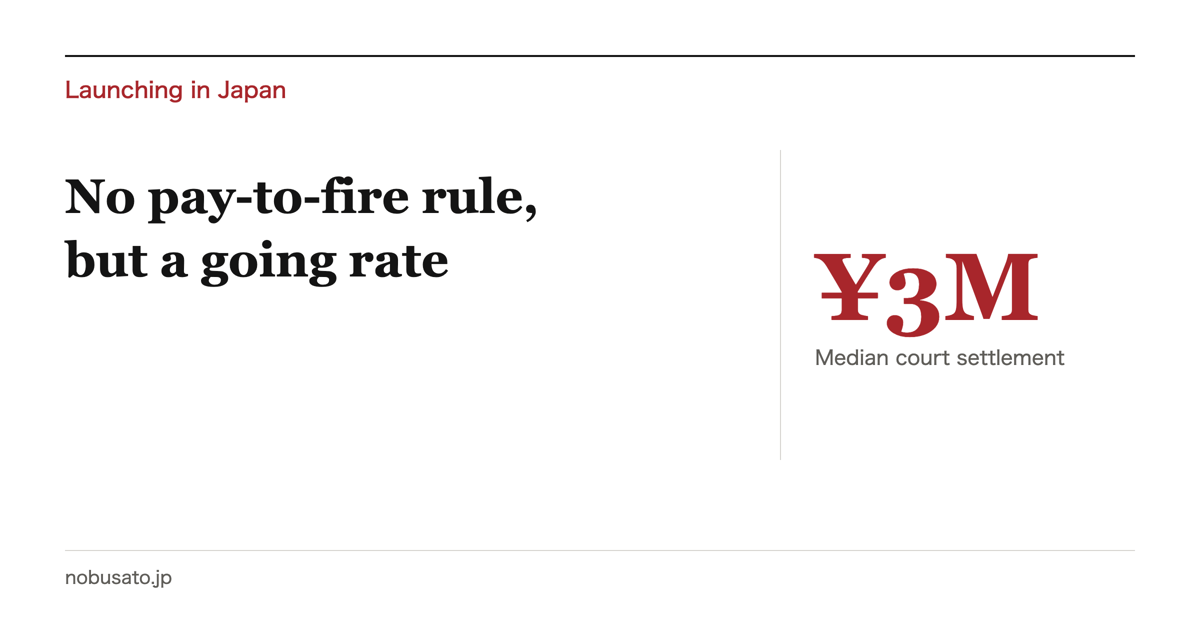
In Japan you can't buy your way out of an employment contract. There is no severance formula that makes a dismissal valid. There is still a price, though. When a dismissal dispute ends in a court settlement, the median payout is 3 million yen, about seven months of salary, and it takes about a year to get there.
Can you pay to dismiss someone in Japan?
No. Article 16 of Japan's Labor Contract Act says a dismissal that lacks objectively reasonable grounds and isn't socially acceptable is an abuse of rights, and void. Paying notice money doesn't change that. The Labor Standards Act requires 30 days' notice or at least 30 days of average wages instead, but that is a procedural rule. Whether the dismissal itself stands is a separate question.
Japan has debated a system that would let courts settle invalid dismissals with money. The labor ministry ran a study group on the legal details from 2018 and passed the question of whether to adopt it to the Labor Policy Council without a decision. In November 2025 the council's working conditions subcommittee reportedly agreed to set up a new expert panel, economists included, in 2026. As of October 2026 there is no such law.
So there's no list price. But almost every dispute ends with money anyway. What sets the amount is where it ends.
What does each route cost?
The Japan Institute for Labour Policy and Training (JILPT), a government research body, has counted settlements in dismissal cases across three routes. The labor ministry put the comparison in front of the subcommittee in November 2025. All figures are medians.
Mediation at a prefectural labor bureau (fiscal 2023, 485 cases at four bureaus): 235,000 yen, 1.03 months of salary, 2.05 months from application to agreement.
Labor tribunal (cases from 2020 and 2021): 1.5 million yen, 4.74 months of salary, 3.12 months.
Court settlement (same years): 3 million yen, 7.27 months of salary, 12.63 months.
You'll see "the median dismissal settlement is 3 million yen" in Japanese headlines. That's true only for the last route, cases that went all the way to court. A tribunal costs half that. Mediation costs less than a tenth.
Take a dismissal to court and the median settlement is 3 million yen, after a year
Medians for dismissal-type employment termination cases. Mediation: fiscal 2023. Tribunal and court settlement: cases from 2020 and 2021. JILPT data, labor ministry working conditions subcommittee paper (November 2025)
- Labor bureau mediation1.03 months¥235,000
- Labor tribunal4.74 months¥1.5M
- Court settlement7.27 months¥3.0M
- Labor bureau mediation2.05 mo
- Labor tribunal3.12 mo
- Court settlement12.63 mo
The route sets the price more than the reason does. A month of thinking at hiring is cheaper than a year at the exit.
Two caveats. The people on each route differ. Median tenure was 0.61 years in mediation, 1.30 in tribunals and 2.08 in court, and median monthly pay rose from 230,000 to 320,000 to 370,000 yen. Longer-serving, better-paid people pick the heavier route, so part of "court is expensive" is just "court plaintiffs earn more." The gap survives conversion into months of salary, which is the part the route itself adds.
And medians hide the tail. In JILPT's 2023 report the mean court settlement was about 6.13 million yen, roughly double the median.
Mediation is cheap partly because companies don't show up
Mediation is voluntary. In fiscal 2023 the employer didn't take part in 42.7% of cases, and only 37.1% ended in agreement. An employee who gets nowhere can go on to a tribunal or sue. So the mediation price is what you pay if the other side stops there. You don't get to choose it.
Japan sees a few thousand labor tribunal cases a year. I looked at what that number means in Japan sees 3,400 labor tribunal cases a year.
The cost that isn't in the settlement
Time is the bigger one. A year of a manager's and HR's attention, drafting statements and sitting in meetings, while the rest of the team watches how it ends. Lawyer fees too, which I'll leave out because they vary too much to give a useful number.
And the outcome is nearly fixed. In JILPT's data, 96.5% of court settlements and 96.6% of tribunal outcomes ended with the employee leaving and receiving money. You fight for a year and still part ways for cash.
There is a softer path: asking someone to resign. If the employee agrees and resigns, it isn't a dismissal. But the labor ministry warns that pressure strong enough to override the person's free choice counts as forced resignation and can be unlawful. There's no legal standard for how many extra months to offer. In practice both sides measure the offer against the numbers above, meaning what a tribunal would likely give.
What BMW did differently
Germany is a useful contrast. BMW is cutting around 8,000 jobs worldwide by the end of 2027, a little over half in Germany. In October 2026 it said it would close its voluntary exit program for indirect staff in Germany early, because it had hit its target (dpa-AFX). Provisions are reported at just over 1 billion euros. Handelsblatt reported some individual offers above 650,000 euros; BMW declined to confirm that figure. The portal showing personal offers was overloaded for a few hours, and some German reports said new applications were paused.
BMW priced the exit up front, budgeted it, and let employees decide. A large Japanese company can do the same thing through a voluntary early retirement program.
A 20-person Japan subsidiary can't. You want one person to leave, you're negotiating with that one person, and the only reference price you have is a median from a government study.
Spend the money at the door
My view: most of what foreign companies pay to part with people in Japan was really spent at hiring. Good negotiation at the exit recovers little.
So move the money forward. Define the role before you hire, including what passing looks like, or you won't be able to say later what fell short. I wrote about scoring the role before the person. Design probation as an observation period with written criteria and recorded check-ins at month one and month three. It won't let you dismiss freely (probation in Japan doesn't mean you can let someone go), but it changes what you have to stand on. Keep performance notes through the year, not just at review time.
One hire in Japan already costs 1.2 to 1.5 times salary. A wrong hire adds roughly five to seven months of salary and three months to a year on top.
None of this gets mistakes to zero. Some things you only learn once a person is inside. Know the exit price. Just don't keep your budget there.
This article is general information, not legal advice. For a specific dismissal, resignation request or dispute in Japan, consult a Japanese lawyer or a licensed labor and social security attorney (sharoushi). The figures are medians from public studies and don't predict any individual case.
Sources (as of October 2026)
- Ministry of Health, Labour and Welfare, Labor Policy Council working conditions subcommittee (205th meeting), paper No.2-1, JILPT analysis of dismissal cases in labor bureau mediation (November 18, 2025)
- JILPT, Comparative analysis of employment termination cases in labor tribunals and court settlements, Research Report No.226 (2023)
- JILPT Research Eye No.78 (2023)
- Ministry of Health, Labour and Welfare, Rules on ending employment contracts
- e-Gov, Labor Contract Act, Article 16
- e-Gov, Labor Standards Act, Article 20
- Ministry of Health, Labour and Welfare, leaflet on resignation requests and forced resignation (2016)
- Bengoshi JP News, status of the monetary remedy debate (January 21, 2026)
- dpa-AFX, BMW closes severance program for employees (October 20, 2026)
- Motor1, BMW voluntary exit program, citing Handelsblatt (October 20, 2026)