Can foreign hires become site engineers in Japan?
Whether a foreign hire in Japan becomes core technical staff depends mostly on what the company builds around them. Daito Trust Construction, a major Japanese builder and manager of rental housing, is testing this with foreign site supervisors, and the most important person in its program may be the Japanese site manager next to them.
Same pay, same training, a license in four years
Since 2024, Daito Trust has hired graduates of national universities in Uzbekistan, and is preparing students in Indonesia, as full-time construction management engineers on the same pay and terms as Japanese staff. They work under Japan's "Engineer/Specialist in Humanities/International Services" residence status, the standard visa for professional work. The job is site supervision: running schedules, quality and safety on a building site.
The company announced the plan in June 2024. In September it interviewed in Tashkent and hired five graduates. They arrived in December, joined the company, took Japanese-language training, and in April 2025 joined that year's Japanese graduates in the same training curriculum. Pay matches Japanese employees, and so does company housing. The stated goal is Japan's first-class building construction management engineer license, at the earliest about four years after joining, according to the construction trade site Sekou no Kamisama in July 2024.
One of the first five, now 24, graduated in June 2024, joined that December and has worked as a site supervisor since June 2025. In an October 2026 Mynavi News TECH+ report, he said he learned the technical vocabulary from his site manager and senior colleagues.
The program has kept going. A second group of three, interviewed in September 2025, started as site supervisors in April 2026. In September 2026 three more students in Tashkent received offers. In Indonesia, a partner university runs a dedicated course: 23 students in the first cohort from 2025 and 32 in the second from 2026, with the first cohort due to interview in April 2027 and join in December 2027.
The head of the company's career design department put the goal plainly: "Our hiring goal isn't the day they join. It's for them to grow into construction managers we can trust with a site, the same as our Japanese employees." The long-term aim is for some to become site managers.
Why site supervisors?
Because site supervision is one of the hardest layers of Japanese construction to replace. Using the government's Labour Force Survey, the transport ministry counts 4.78 million people working in construction in 2025, down about 30% from the 1997 peak of 6.85 million. 36.6% are 55 or older. Only 11.9% are 29 or younger.
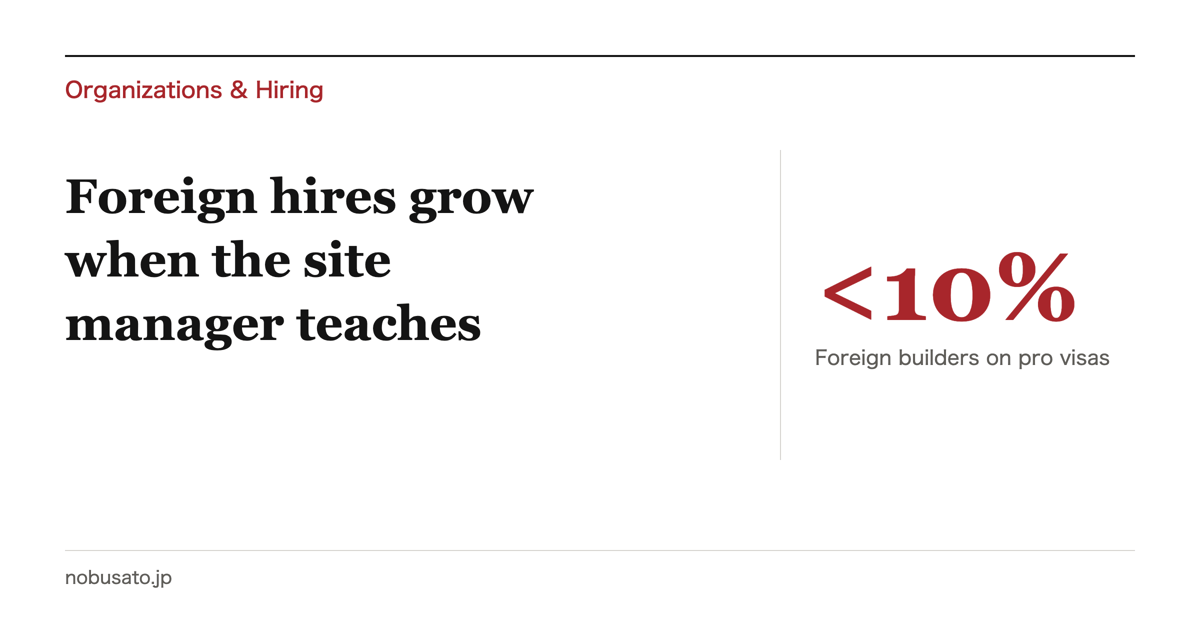
Foreign workers in construction are increasing fast, but mostly in other roles. Japan's labor ministry counted 206,468 foreign workers in construction at the end of October 2025, up 16.1% in a year. Of those, 119,868, nearly six in ten, are technical intern trainees. Only 19,849 hold the professional visa that covers engineering work like site supervision. That's under one in ten. For the wider picture of who Japan's foreign workers are and which visas they hold, see Foreign workers in Japan: who the 2.57 million are, and where.
So the hands increasingly come from abroad. The people who plan the work and answer for quality, safety and schedule are still almost all Japanese, and getting older. Daito Trust went after that second layer.
"Labor shortage" is one phrase covering very different problems by occupation (Japan's job-to-applicant ratio only makes sense by occupation). For hands, Japan already has visa channels and sending systems. For someone you can trust with a site, there is no channel. They have to read drawings in Japanese, direct tradespeople and explain things to the client, and a company has to build that over years. That's why this is a training story more than a hiring story.
Hiring and placement are done. Whether they become engineers will be decided over the next few years
Daito Trust's foreign construction management engineers: progress and plans, from reports by Sekou no Kamisama (July 2024) and Mynavi News TECH+ (October 2026)
Stages nobody has reached yet
- 2014Supports trainees at partner firmsAbout 1,335 Southeast Asian technical intern trainees in total. Not direct hires
- 2024Interviews in Tashkent, hires first 5 as full-time staffProfessional residence status, same terms as Japanese staff
- 2025Same training as Japanese graduates, on site from JuneTechnical vocabulary learned from the site manager and seniors
- 2026Second group of 3 on site, 3 more offersIndonesian course: 23 in cohort one, 32 in cohort two
- 2027First Indonesian cohort due to joinInterviews in April, joining in December
- c. 2028First-class construction management licenseEstimated from the company target of about four years after joining, at the earliest
- LaterSite manager roles, 100 to 200 foreign supervisorsTarget reported in 2024
The company itself says joining isn't the goal. The test is whether they reach the license and the site manager's seat.
Where does "labor" end and "engineer" begin?
It ends where the company writes down, on day one, how far the person can go. At Daito Trust that path is written in concrete terms: the same training and pay as Japanese hires, a license as the midpoint, a site manager role as the destination. If you're hiring hands, you don't need any of that. If you're hiring engineers, they won't stay without it.
A rule change helps here. From fiscal 2024, Japan's transport ministry opened the first stage of the first-class construction management exam to anyone 19 or older, with no work experience required. The second stage opens after a set period of on-site experience. A foreign graduate can now pass stage one early and work toward stage two on the job.
Being allowed to sit the exam and passing it are different things. The exam is in Japanese and dense with construction terms. In May 2026 Daito Trust and the training firm Hands Global launched a study program for foreign candidates: about 1,000 key terms picked from roughly 6,000 in the exam scope, each with images, furigana, translations and linked past questions. The idea is simple. Someone who knows the engineering shouldn't fail on the vocabulary.
The site manager is the real curriculum
In the end, I think the Japanese site manager decides whether a foreign supervisor grows. The young supervisor above didn't learn the vocabulary from a textbook. He learned it from his site manager and the people around him. Site language is learned on site.
That's hard to put in a policy. A site manager is busy with his own schedule and safety record. Time spent explaining terms to a foreign subordinate usually counts for nothing in his evaluation or pay. So whether he teaches depends on his personality, and only the people assigned to a good one grow. I wrote about this gap in After you hire foreign staff in Japan, the hard part begins.
For a foreign company hiring engineers of any nationality in Japan, what's worth copying from Daito Trust is the order of steps more than the recruiting channel. Decide the career path and the license or level targets first. Then decide what the receiving Japanese manager is supposed to do, and count that time as real work. Hire after that.
The 2024 target was 100 to 200 foreign supervisors. So far, reports show eight hired from Uzbekistan and three more with offers. The first five can reach the license around 2028 at the earliest. How many are still there then, and how many are close to running a site, is the number that will answer the headline question.
Sources (as of October 2026)
- Mynavi News TECH+, Daito Trust's foreign site supervisor program (from Zaikai Online, October 19, 2026, Japanese)
- Sekou no Kamisama, on Daito Trust hiring Uzbek site supervisors (July 31, 2024, Japanese)
- Hands Global and Daito Trust, release on a license study program for foreign talent (PR TIMES, May 8, 2026, Japanese)
- Ministry of Health, Labour and Welfare, Employment Status of Foreign Workers, end of October 2025 (published January 30, 2026)
- Ministry of Health, Labour and Welfare, tables by industry and residence status (Tables 4 and 6)
- Ministry of Land, Infrastructure, Transport and Tourism, briefing on the construction industry (April 2026, based on the Labour Force Survey)
- Ministry of Land, Infrastructure, Transport and Tourism, revised eligibility for construction management exams (announced May 12, 2023, effective fiscal 2024)