Tokyo vs the Regions: Japan's Job Openings Ratio
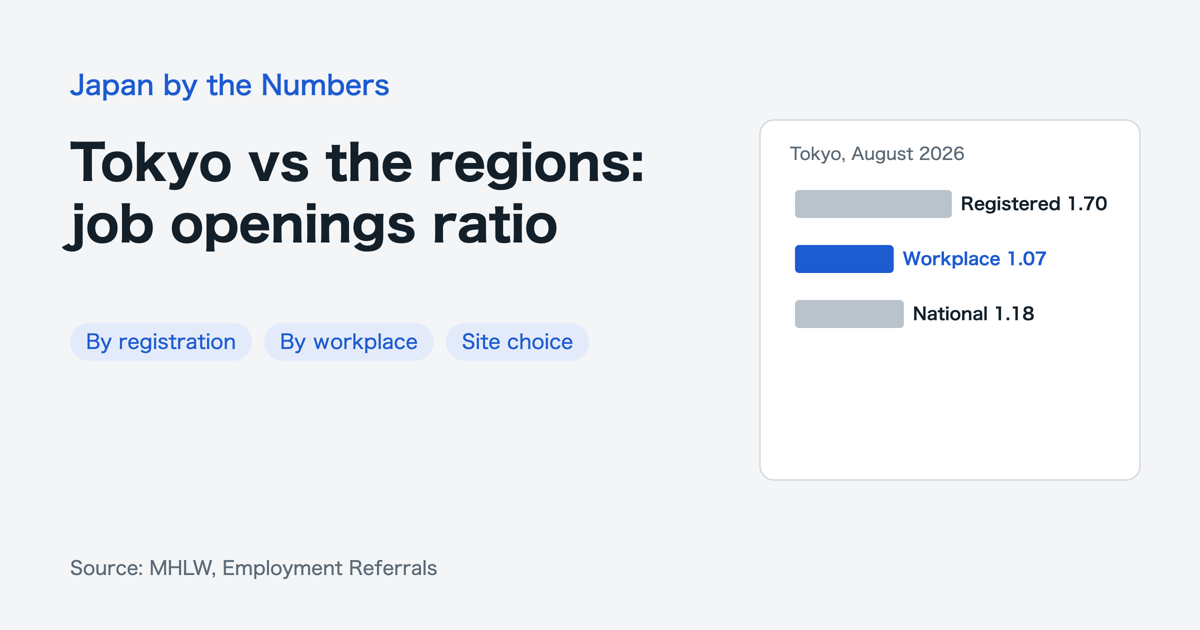
Tokyo has the highest job openings-to-applicants ratio in Japan: 1.70 in August 2026. Yet the same month's data, in the same release, gives Tokyo a second number: 1.07, below the national 1.18.
The difference is how the openings are counted. The first counts them by where the job was registered. The second counts them by where the work is.
Place of registration and place of work
The Ministry of Health, Labour and Welfare's ratio divides active job openings at Hello Work, the public employment service, by active jobseekers. By prefecture it is reported two ways: by the location of the Hello Work office that took the posting, and by the location where the job is actually done.
Companies headquartered in Tokyo often register openings for sites around the country at a Tokyo Hello Work office. Counted by registration, all of those jobs sit in Tokyo. Counted by workplace, they go back to Saitama, Chiba, Kanagawa and further afield. Over 2025 as a whole, Tokyo's gap between the two measures was 0.63 points, the largest in the country.
Fig. 1Same month, two measures. Tokyo falls from 1.70 to 1.07, while prefectures around Tokyo and those with many factories, such as Chiba, Shiga and Saitama, go the other way.
When choosing a site, the workplace measure is the one to use. On that basis, the highest ratios in August 2026 were Fukui at 1.72, Yamanashi at 1.71 and Toyama at 1.68; the lowest were Osaka at 0.95, Fukuoka at 0.97 and Hokkaido at 0.98. Tokyo, at 1.07, sits on the low side.
Are frontline staff easy to hire outside Tokyo? It depends where
The idea that frontline staff are easy to find outside Tokyo does not hold everywhere. Osaka, Fukuoka and Hokkaido are below 1, with more jobseekers than openings. Hokuriku prefectures and Yamanashi are above 1.6, where competition for frontline workers is far fiercer than in Tokyo.
These figures come through Hello Work and lean toward frontline and smaller-company jobs. As covered in the post on ratios by occupation, ratios in the same area can differ more than tenfold by occupation.
Regional gaps for managers do not show up in public data
I looked for a figure showing how short regions are of managers, and public statistics do not provide one. In August 2026, Hello Work nationwide had just 4,955 active openings for managerial occupations against 6,101 jobseekers, a ratio of 0.81. Manager hiring rarely goes through Hello Work; it runs through search firms, referrals and internal transfers. That 0.81 does not mean managers are easy to hire.
Here judgment has to come from experience. When I set up a regional site, I hired the frontline team first and looked for a local head once the team had reached a certain size. My reading is that frontline hiring can be planned from local ratios, while a head is often hard to find directly in the local market. Once a team exists, it is also easier to explain what the role covers and why it is worth taking.
What it means for a foreign company choosing a site
- Use the workplace measure, not the registration measure. Tokyo's 1.70 largely reflects headquarters registering jobs centrally.
- Frontline: set hiring timelines and budgets from the workplace ratio. Where it is above 1.5, plan for frontline roles to be hard to fill too.
- Site head: do not assume you will find one locally. Send someone from Tokyo, move someone internally, or, as above, build the team first and bring in the head later.
Who the first person at a new entity should be is covered in Your first hire in Japan should not be a salesperson.
What I am not sure about
First, these are Hello Work figures only. Private job boards and search firms are not included, and competition for white-collar roles may look different.
Second, these are single-month, seasonally adjusted figures and move from month to month. The 2025 annual averages point the same way: Tokyo highest by registration at 1.73, Fukui highest by workplace at 1.84.
Third, I found no reliable public data on regional gaps for managers. The judgment above comes from experience.
For the regional sites you have considered, which ratio were you looking at?
Sources
- MHLW, Employment Referrals, August 2026: national 1.18; by workplace highest Fukui 1.72, lowest Osaka 0.95; by registration highest Tokyo 1.70, lowest Kanagawa 0.83 (Japanese)
- Same, press materials, Table 6: ratios by prefecture, by workplace and by registration, seasonally adjusted (Japanese)
- Same, reference tables: ratios by occupation, managerial 0.81 with 4,955 openings (Japanese)
- JILPT, Business Labor Trend, April 2026: 2025 averages, Tokyo 1.73 by registration, Fukui 1.84 by workplace, Tokyo gap of 0.63 points (Japanese)
Shorter notes that don't make it into a full article go on LinkedIn. Follow me there.