Pick your next company with a market map
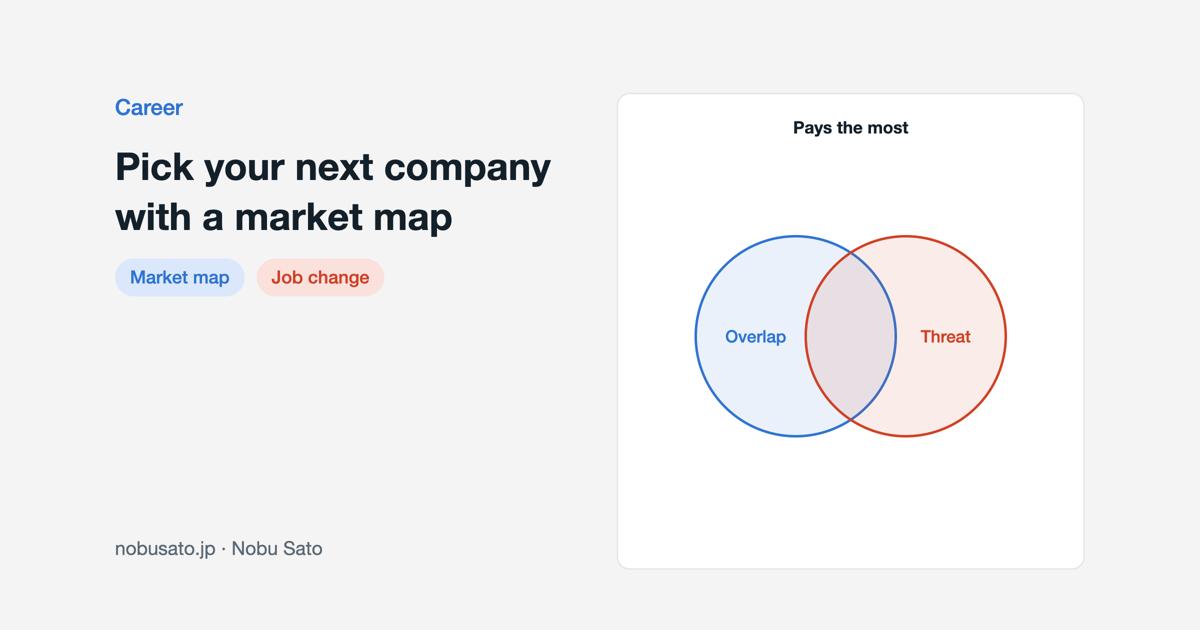
Your best-paid next move in Japan is usually to a company that hires people like you and is losing deals to your current employer. Most job searches start from a list of famous names instead, and that list says nothing about price.
In my work I draw market maps a lot, mostly for hiring and competitor studies. A company earns a place on the map for two reasons: talent overlap and business threat. This post hands that tool to you, the candidate.
Who pays the most for you?
Companies that sit in both groups at once. They need the work you do every day, and they see your current employer as a problem in the market.
I wrote earlier about which circle of the talent map you are in. That was about your position on a recruiter's map for one role. This is the other direction. You put yourself in the middle, draw a small map, and decide where to walk.
Fig.1When a company both employs your function cluster and competes with your employer's business line, your hire is weighed against lost revenue, so offers tend to be higher. This is the author's observation, not survey data.
What do you actually do all week?
Overlap is measured per role at each company. The smallest unit is a function cluster: the bundle of tasks you actually do. Job titles are too coarse for this. In a talent map is not a list, I argued that the value of a map is in where you draw the lines. The same applies here.
Take "B2B sales." Someone who visits small shops every day and gets turned down most of the time does very different work from someone who spends six months walking a purchase through a large company's approval chain. The first person overlaps with sales roles in other industries that sell to the same shops.
So skip the title. Write three or four lines on what you did in the last three months: for whom, what, and how often. For an engineer, something like "built payment reconciliation and kept it working through the banks' spec changes."
Then search job posts by those verbs and counterparts, not by title. You will find companies in industries you never considered.
Who fights your employer for customers?
Ask who fights your current company for customers. Compare at the level of business lines. I made this point in picking the wrong competitors. One division of a large group may be the main rival to your employer's core product, while the rest of the group is irrelevant.
You already know much of this. Which names come up in deals? Who wins when you lose? That market knowledge is yours to use. Customer lists, pricing and internal documents are not. Leave them where they are.
Where to check in Japan, using public sources
Japan publishes more about employers than many foreigners expect. Three sources I use:
- Annual securities reports (yuho), free on the FSA's EDINET. The employee section lists headcount by segment, plus average age, tenure and annual salary for the filing company. Line up a few years and you can see which business is adding people. Since an ordinance amendment of January 31, 2023, reports for fiscal years ending March 2023 onward also include the ratio of women in management, the male parental leave rate and the gender pay gap, where the company already publishes them under other laws. The business risk section sometimes names the competitive pressure.
- Mid-career hiring ratio. Under the Act on Comprehensive Promotion of Labor Policies, since April 1, 2021, employers with 301 or more regular employees must publish the share of mid-career hires among their regular hires for the latest three fiscal years, roughly once a year (MHLW leaflet, as of October 2026). It appears on the company website or on the ministry's Shokuba Lab site. "Mid-career" here means any hire other than new graduates (MHLW Q&A).
- Job posts. How many roles in your cluster are open, and for how long? A post that has stayed up for six months is probably not getting filled.
Read the hiring ratio as a habit signal. High for three years means the company is used to buying talent from outside. A sudden jump means a new business or a rush to respond to something. Check it against the threat axis and you can often guess whether that something is your employer. A low ratio is not a red flag, but expect to be a minority and to need longer to settle in.
Why does a threatened competitor pay more?
Because it compares you to a different number. For an overlap-only company, you are a line in the headcount budget, priced by the grade table. For a threatened company, you are weighed against the revenue it loses if it doesn't hire you. The business head shows up in interviews and pushes exceptions through. In what I have seen, these offers come faster and have more room to negotiate.
Ramp-up time is part of the price too. Someone who knows the customers and the rival can talk to clients in the first month.
One caveat: I haven't found public statistics on how big this premium is in Japan. Treat it as a practitioner's observation. Also, moving straight to a rival is still sensitive here, for people and for companies. Your work rules or a pledge you signed on joining may include a non-compete clause. Read them before you move. This is general information, not legal advice. If in doubt, a labour consultation corner or a lawyer can tell you what applies to you.
And the map has blank spots. Companies under 301 employees don't have to publish the hiring ratio, and only listed companies file securities reports. For startups, you will need to ask people.
After the map
When you place companies in the four boxes, the top-right one is usually small. Three companies is plenty. That gives you your order of applications. When offers come in, run them through a five-level check on your offer. A high price and a good fit are separate questions.
Start with the company that worries most about your current business line. It probably doesn't know your name yet.
Shorter notes that don't make it into a full article go on LinkedIn. Follow me there.