Career in Japan: Moving, Offers and Your First 90 Days
A recruiter messages you about a role that pays 20% more. You open your resume file, then close it again, because you are not sure the money is the real question.
This column is for professionals working in Japan, including the many who are not Japanese, who are thinking about their next move or living with one they already made. My main conclusion is simple. In Japan, your next employer, your boss and the terms of your contract shape your career more than the title or the headline salary. Know why you moved the last three times, read an offer by its floor, and check what you were promised in your first 90 days.
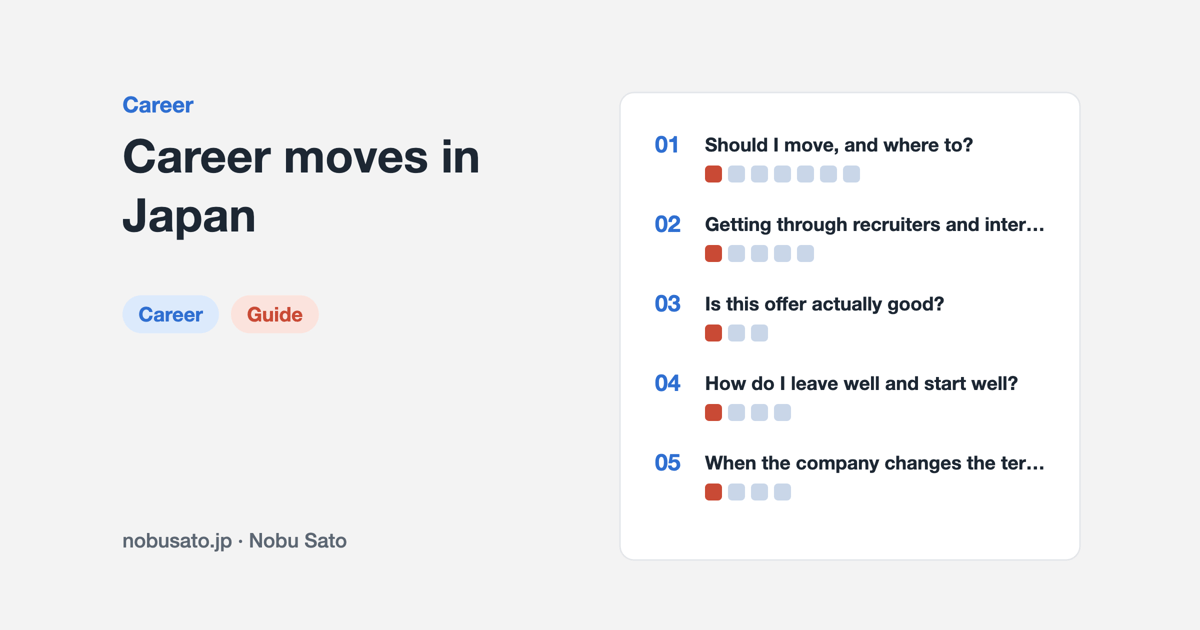
Should I move, and where to?
Start with yourself. Line up the real reasons behind your last three moves. Whatever recurs is what the next job has to give you. Then look at the market the way an employer does. The company most likely to pay you well hires your function and competes with your current employer.
- Before you change jobs, do a four-layer self-portrait: a way to see your own motives before a recruiter's number frames them for you.
- Pick your next company with a market map. How to build the list from public data.
- Which circle of the talent map are you in? Whether recruiters call depends on where you sit on the map, and the calls stop at the first circle.
- Choose your boss, not the company: nearly 30% of resignation-proxy users feared their boss, so spend the last five minutes of the interview on the person you will report to.
- When "experienced" stopped being a selling point explains why judgment got expensive while years of experience got cheaper.
- After AI, which layer of you loses value first? The writable part of your skills goes first. Stanford found a 13% drop for 22 to 25 year olds in AI-exposed jobs.
- Changing Jobs After 40 in Japan: You Sell Judgment: about half of Japan's job changers are now 40 or older (MHLW, 2025), and how to show the way you decide.
Getting through recruiters and interviews
Japanese recruiters are paid by employers, often 30 to 35% of first-year pay, and only on placement. That explains who they call first. After the resume screen, interviewers collect evidence about what you did under real conditions, so prepare stories with the conditions and the costs left in.
- Why recruiters in Japan don't reply to you: what gets you dropped, and a five-line message that gets read.
- Your resume is a request to be put in a box. The screen sorts you into an org box, and the article shows how people cross the lines.
- After the resume screen: what I look for in an interview: conditions, trade-offs, results, costs, and what that means if you sit between boxes.
- Telling failure as evidence. Interviewers want what you did at the time. The lesson you drew afterwards tells them much less.
- After a rejection, read which layer you got stuck on: a veto item means changing target roles, a weak layer can be fixed, and the interview usually tells you which.
Is this offer actually good?
Two ¥8 million offers can look the same. One can carry twice the risk of the other. Split each into base pay by grade, allowances by role and bonus by results, and compare the floors.
- Read your offer in three tracks: how to take the total apart and see what is guaranteed.
- Run a Five-Level Check on Your Job Offer. Score the offer the way the company scored you: veto items first, then the weakest layer. Read the scope-of-change clause before you sign.
- A 50% raise, and he still left is about the counter offer you may get when you resign, and why money rarely settles it.
How do I leave well and start well?
By law you need to give two weeks' notice. By custom, it's a month. Tell your boss first, in person. Then, before day one at the new place, write down what you were promised and check it at 30, 60 and 90 days.
- How to resign well in Japan: one sentence, delivered as a notice, with no request for permission attached.
- The Favors You Leave Behind: Quitting a Job in Japan. Reference checks here say little, but your handover, your timing and who you take with you are remembered for years.
- Your First 90 Days in Japan: Check What You Were Promised: scope, budget, headcount and pay review, and when to speak up.
- When your boss changes: the first 90 days are an interview. What a new manager judges, and how to make your work visible and agree priorities again.
When the company changes the terms
Some of the biggest career moments in Japan are decided by the employer: a transfer, a restructuring, the return from leave, the age-60 rehire. Your contract and Japanese labor law give you more ground in some of these than you might expect, and less in others.
- Can You Refuse a Transfer in Japan? Without a location limit in your contract, rarely. Negotiate after the informal notice.
- Layoffs at a Foreign Company in Japan: Your Rights: you can refuse a request to resign, and your separation reason changes your benefits.
- After Parental Leave in Japan: Keep Your Promotion Track. The law protects the job; your rating depends on the talk you have with your manager before you return.
- Rehired at 60 in Japan: Pay Cuts and Role Redesign: pay falls an estimated 20 to 30 percent, and the article covers what to settle before you sign.
Not sure where to begin? If an offer is on the table, read the two offer articles tonight. If nothing is on the table yet, the four-layer self-portrait is the slower and better start. I wrote most of these with mid-career people in mind. If you are early in your career, some of the advice about leverage will feel optimistic.
Terms like four-layer model and five-level fit check are defined in the glossary. For the data on how often people in Japan actually change jobs, see Japan by the Numbers.
Shorter thoughts go on LinkedIn.